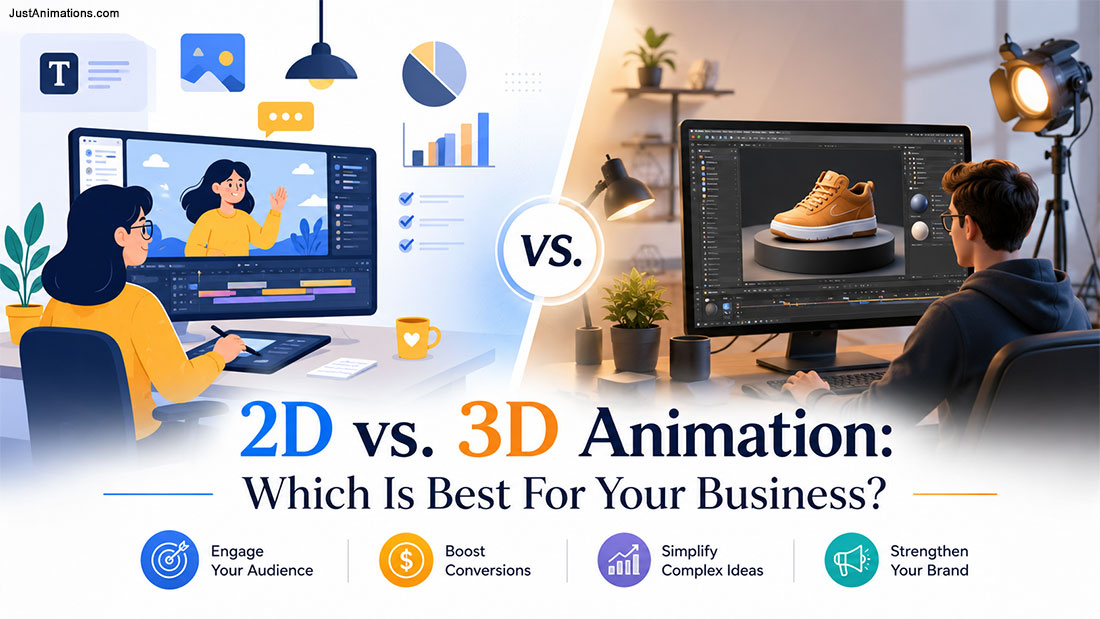
Chosing between 2D Video Animation vs 3D Video Animation is a critical process for businesses looking to create new video content.
Both styles can be powerful.
Both can look professional.
Both can explain ideas, promote products, support marketing, and help audiences understand a message faster.
But they are not the same.
2D animation is usually better for clear storytelling, service explanations, training content, social media ads, educational videos, and animated explainers.
3D animation is usually better for product demonstrations, technical visuals, medical animation, architecture, machinery, and videos that need realism, depth, or dimensional movement.
The right choice depends on the goal of the video.
Not just the style.
Not just the budget.
Not just what looks more impressive.
A good animation should make your message easier to understand, easier to remember, and more useful for your audience.
This guide compares 2D animation and 3D animation so your business can choose the best style for its message, budget, timeline, and audience.
Quick Answer: 2D vs. 3D Animation For Business
| Factor | 2D Animation | 3D Animation |
|---|---|---|
| Best for | Explainers, service videos, training, social media, education | Product demos, technical visuals, architecture, medical, machinery |
| Visual style | Flat, illustrated, cartoon, graphic, motion-based | Dimensional, realistic, detailed, immersive |
| Cost | Usually more affordable | Usually more expensive |
| Timeline | Usually faster | Usually longer |
| Realism | Lower realism, stronger simplicity | Higher realism, depth, and detail |
| Complexity | Moderate | Higher |
| Best business goal | Explain clearly | Demonstrate visually |
| Common use | Marketing, sales, training, social content | Product, technical, medical, industrial, premium presentations |
Simple Rule
Choose 2D animation when your business needs to explain something clearly, quickly, and affordably.
Choose 3D animation when your business needs to show depth, realism, product detail, physical movement, or technical function.
Choose a hybrid 2D and 3D animation style when your video needs both simple messaging and premium visual impact.
What Is 2D Animation?
2D animation is animation created in a two-dimensional space.
That means the visuals have height and width, but not realistic depth.
Characters, icons, text, objects, backgrounds, graphs, and illustrations are designed in a flat or stylized format, then animated to create movement.
2D animation can feel clean and modern.
It can feel cartoon-like.
It can feel professional.
It can feel playful.
It can feel educational.
It can also be highly branded with custom colours, typography, characters, and visual systems.
This flexibility makes 2D animation one of the most common choices for business videos.
Common Types Of 2D Animation
2D animation can be used in many formats.
Common types include:
- Explainer videos
- Motion graphics
- Character animation
- Whiteboard animation
- Animated infographics
- Logo animation
- App walkthroughs
- Social media videos
- Training videos
- Educational animation
- Corporate communication videos
- Animated ads
When 2D Animation Works Best
2D animation is usually the better choice when the goal is clarity.
It works well when the viewer needs to understand a message quickly without needing realistic detail.
Use 2D animation for:
- Explaining a service
- Introducing a company
- Simplifying a process
- Creating a homepage video
- Producing social media ads
- Training employees
- Teaching customers
- Explaining software
- Promoting an offer
- Creating educational content
- Building brand awareness
- Turning a complex message into a simple story
Benefits Of 2D Animation
2D animation remains popular because it is practical.
It helps businesses communicate clearly without overcomplicating the visual style.
Key Benefits
- Easier to understand
- Usually more cost-effective
- Faster to produce than 3D
- Flexible across industries
- Strong for storytelling
- Easy to customize for brand style
- Works well for social media
- Good for explainer videos
- Strong for abstract ideas
- Easy to adapt into shorter clips
2D animation is especially useful when the audience does not need to see every physical detail.
They just need to understand the point.
Limitations Of 2D Animation
2D animation is not always the best option.
It may fall short when the subject needs realism, depth, or technical detail.
Common Limitations
- Less realistic than 3D
- Limited depth and camera movement
- Not ideal for complex product mechanics
- Less useful for architectural walkthroughs
- May not show scale as clearly as 3D
- May feel too simple for certain premium product demos
That does not make 2D animation weak.
It just means it should be used for the right kind of project.
What Is 3D Animation?
3D animation is animation created in a three-dimensional digital space.
That means objects can have height, width, and depth.
They can be modeled, textured, lit, rotated, animated, and viewed from different camera angles.
3D animation can make products, environments, characters, buildings, medical processes, machines, and technical systems feel realistic and dimensional.
That makes it powerful for businesses that need to show how something looks, moves, works, or fits together.
Common Types Of 3D Animation
3D animation is often used for more technical, product-based, or premium visual projects.
Common types include:
- 3D product animation
- 3D medical animation
- 3D architectural animation
- 3D character animation
- 3D explainer videos
- 3D technical animation
- 3D industrial animation
- 3D product rendering
- 3D motion graphics
- 3D visualization
When 3D Animation Works Best
3D animation is usually the better choice when the viewer needs to see realistic detail.
It is especially useful when filming would be difficult, expensive, unsafe, or impossible.
Use 3D animation for:
- Product demos
- Medical visuals
- Device demonstrations
- Architecture and real estate
- Machinery and manufacturing
- Engineering explainers
- Technical product videos
- Scientific visualization
- Investor presentations
- Trade show videos
- Premium product launches
- High-value sales presentations
Benefits Of 3D Animation
3D animation can show things that are hard to explain with words or flat visuals.
It gives the audience a more realistic view of the subject.
Key Benefits
- Realistic depth and dimension
- Strong visual impact
- Multi-angle product views
- Better for technical demonstrations
- Can show internal parts
- Can visualize movement and function
- Useful when filming is not practical
- Strong for premium presentations
- Works well for physical products
- Helpful for complex industries
3D animation is especially valuable when the video needs to prove, demonstrate, or visualize something in detail.
Limitations Of 3D Animation
3D animation is powerful, but it is not always necessary.
A business should not choose 3D just because it sounds more advanced.
Common Limitations
- Usually more expensive
- Usually takes longer
- Requires more technical production
- Revisions can be more involved
- Poor-quality 3D can look unprofessional
- May be unnecessary for simple explainers
- Can distract from the message if overused
A simple message may not need a complex 3D production.
Sometimes clean 2D animation communicates better.
2D vs. 3D Animation: Side-By-Side Comparison
| Decision Factor | Choose 2D Animation If… | Choose 3D Animation If… |
|---|---|---|
| Message type | You need to explain an idea, service, process, or offer | You need to show a product, object, device, or environment |
| Audience need | They need quick understanding | They need visual detail |
| Budget | You need a more manageable production cost | You can invest more for realism and polish |
| Timeline | You need a faster turnaround | You have more time for modeling, rendering, and refinement |
| Visual goal | You want clean, clear, illustrated storytelling | You want depth, realism, and dimensional movement |
| Best platform | Websites, social media, training, sales decks | Product pages, trade shows, investor decks, technical demos |
| Best use case | Explainers and marketing communication | Product and technical visualization |
| Complexity | Moderate | Higher |
2D vs. 3D Animation Cost And Complexity
| Animation Style | Typical Cost Level | Production Complexity |
|---|---|---|
| Simple 2D animation | Lower | ████░░░░░░ |
| 2D explainer video | Moderate | ██████░░░░ |
| 2D character animation | Moderate to high | ███████░░░ |
| Motion graphics | Moderate | ██████░░░░ |
| Simple 3D animation | Moderate to high | ████████░░ |
| 3D product animation | High | █████████░ |
| 3D medical animation | High | ██████████ |
| 3D technical animation | High | ██████████ |
| Hybrid 2D and 3D animation | Moderate to high | ████████░░ |
Animation Style Fit By Business Goal
| Business Goal | Best Animation Style |
|---|---|
| Explain a service | 2D animation |
| Promote a SaaS platform | 2D animation or motion graphics |
| Demonstrate a physical product | 3D animation |
| Show a medical procedure | 3D animation |
| Create a social media ad | 2D animation |
| Train employees | 2D animation or motion graphics |
| Explain financial data | Motion graphics |
| Show architecture or real estate | 3D animation |
| Create a homepage explainer | 2D animation |
| Launch a premium product | 3D animation |
| Explain a technical process | 3D animation or hybrid animation |
| Build brand awareness | 2D animation or motion graphics |
| Create a trade show video | 3D animation, 2D animation, or hybrid animation |
When 2D Animation Is Better For Business
2D animation is better when the message needs to be clear, simple, and fast to understand.
It is often the best choice for businesses that need marketing content, educational videos, explainer videos, or social media assets.
Choose 2D animation when:
- The topic is abstract
- The product is a service
- The message needs to be simplified
- The budget is more limited
- The video needs a faster turnaround
- The audience needs quick clarity
- The brand wants an approachable style
- The video will be used across social media
- The content needs to explain, teach, or promote
When 3D Animation Is Better For Business
3D animation is better when the viewer needs to see how something actually looks or works.
It is often the best choice for companies selling physical products, technical systems, medical devices, real estate, machinery, or engineered solutions.
Choose 3D animation when:
- The product needs to be shown from multiple angles
- Realistic detail matters
- The product is difficult to film
- The subject has internal parts
- The audience needs to understand physical function
- The video needs to feel premium
- The project supports a high-value sale
- The animation will be used for trade shows, investor decks, or technical presentations
Can You Combine 2D And 3D Animation?
Yes.
Many business videos use a hybrid approach.
This can be very effective.
A hybrid video may use 2D animation for the story, icons, text, and message structure, while using 3D animation to show the product, device, object, or technical detail.
This gives the business both clarity and visual impact.
Hybrid animation works well for:
- Product explainers
- Medical device videos
- SaaS and hardware demos
- Technical sales videos
- Investor presentations
- Trade show videos
- Premium landing page videos
- Brand campaigns
- Manufacturing explainers
- Architecture and real estate presentations
Why Work With A Professional Animation Agency?
A professional animation agency helps businesses choose the right style before production begins.
That matters because the wrong format can waste time and budget.
Some businesses choose 3D because it sounds more advanced, even when a clean 2D explainer would work better.
Others choose 2D to save money, even when the product needs 3D to be understood properly.
A professional agency can help match the style to the goal.
What A Professional Animation Agency Should Help With
A strong animation agency should support the full production process.
That may include:
- Creative strategy
- Concept development
- Scriptwriting
- Storyboarding
- Style direction
- 2D animation
- 3D animation
- Motion graphics
- Voiceover
- Music and sound design
- Revisions
- Final delivery
- Social media cutdowns
- Platform-specific exports
A good agency should not just ask what you want animated.
It should ask what the video needs to accomplish.
Questions To Ask Before Choosing 2D Or 3D Animation
Before starting a project, ask:
- What is the main goal of the video?
- What does the audience need to understand?
- Is the subject abstract or physical?
- Does the product need to be shown from multiple angles?
- Is realism important?
- Is speed important?
- What is the budget?
- What is the timeline?
- Where will the video be used?
- Will the video need shorter versions?
- Does the video need voiceover?
- Does the project need social media formats?
- Would a hybrid style work better?
The answers make the style decision much easier.
Common Mistakes To Avoid
Many businesses choose animation styles the wrong way.
They focus on the style before the strategy.
That can create problems.
Common mistakes include:
- Choosing 3D only because it looks more premium
- Choosing 2D only because it costs less
- Making the video too long
- Starting without a clear script
- Not defining the audience
- Trying to explain too many things at once
- Ignoring the production timeline
- Comparing prices without comparing scope
- Forgetting sound design
- Not planning for social media cutdowns
- Choosing a studio without relevant experience
The best animation style is the one that makes the message clearer.
Working With Just Animations
Just Animations creates 2D and 3D animation for businesses that need clear, polished, and effective video content.
For simple explainers, social media videos, training content, and service explanations, 2D animation can be a strong choice.
For product demos, medical visuals, architecture, machinery, and technical demonstrations, 3D animation may be the stronger option.
For projects that need both simple messaging and detailed visualization, a hybrid approach may work best.
The goal is not just to create animation.
The goal is to create a video that helps the audience understand the message faster and remember it longer.
Conclusion: 2D vs. 3D Animation For Business
2D animation and 3D animation both have a place in business video production.
The best choice depends on what the video needs to do.
2D animation is usually better for clarity, simplicity, storytelling, service explanations, training, social media, and explainer videos.
It is flexible.
It is approachable.
It is usually more cost-effective.
And it works well when the audience needs to understand a message quickly.
3D animation is usually better for realism, product detail, technical explanation, medical visualization, architecture, machinery, and premium presentations.
It creates depth.
It shows movement.
It reveals structure.
And it helps viewers understand physical products and complex systems.
One style is not automatically better than the other.
The right style is the one that fits the message, audience, budget, timeline, and business goal.
For many companies, the smartest approach is to define the purpose of the video first, then choose the animation style second.
If the goal is to explain, 2D may be best.
If the goal is to demonstrate, 3D may be best.
If the goal is to do both, a hybrid animation style may be the strongest option.
A professional animation agency can help make that decision with more confidence and build a video that is not only visually appealing, but actually useful for the business.
FAQ
What Is The Difference Between 2D And 3D Animation?
The main difference between 2D and 3D animation is depth. 2D animation uses flat illustrated visuals with height and width, while 3D animation adds depth, realistic lighting, camera movement, and dimensional objects.
Which Is Better For Business, 2D Or 3D Animation?
Neither is always better. 2D animation is usually better for explainers, service videos, training, education, and social media. 3D animation is usually better for product demos, technical visuals, medical animation, architecture, and machinery.
Is 2D Animation More Affordable Than 3D Animation?
Yes, 2D animation is usually more affordable than 3D animation because it often involves fewer technical production steps. However, the final cost depends on the video length, style, complexity, script, voiceover, sound, and revisions.
Why Is 3D Animation More Expensive?
3D animation is usually more expensive because it may require modeling, texturing, lighting, rigging, animation, camera work, rendering, and more detailed revisions. These steps add time and production complexity.
When Should A Business Use 2D Animation?
A business should use 2D animation when it needs to explain a service, simplify a message, create a training video, launch social media content, build an explainer video, or communicate an abstract idea clearly.
When Should A Business Use 3D Animation?
A business should use 3D animation when it needs to show a physical product, machine, medical device, building, technical process, or object in realistic detail.
Can A Video Combine 2D And 3D Animation?
Yes. A hybrid animation video can combine 2D visuals for messaging and 3D visuals for product detail or technical explanation. This can work well when a video needs both clarity and realism.
Is 2D Animation Good For Social Media?
Yes. 2D animation works very well for social media because it can be short, colourful, clear, and easy to watch. It is useful for ads, reels, stories, educational clips, and promotional videos.
Is 3D Animation Good For Product Demos?
Yes. 3D animation is one of the strongest formats for product demos because it can show products from multiple angles, demonstrate movement, reveal internal details, and create a polished presentation.
Why Should I Hire A Professional Animation Agency?
A professional animation agency can help with strategy, scripting, storyboarding, design, animation, voiceover, sound, revisions, and delivery. This helps ensure the final video is clear, polished, and aligned with your business goal.