An animation studio is where ideas are transformed into characters, environments, stories, product demonstrations, advertisements, and visual experiences.
Behind every finished animated video is a coordinated production process involving writers, illustrators, animators, designers, directors, editors, sound specialists, and project managers.
Some animation studios create feature films and television series. Others produce animated explainer videos, commercials, product animations, training content, social media videos, and corporate communications.
Regardless of the project type, every animation company must combine creativity with detailed planning, technical skill, and structured collaboration.
A normal day inside an animation studio may include script development, character sketches, storyboard reviews, 2D or 3D production, voiceover recording, sound design, client feedback, and final video editing.
This behind-the-scenes look explains what animation companies do, how an animated project moves through production, and what it takes to bring an original idea to life.
What Happens Inside an Animation Studio?
An animation studio develops and produces animated content through several structured stages.
The typical process includes:
- Creative discovery
- Scriptwriting
- Character and environment design
- Storyboarding
- Voiceover production
- 2D or 3D animation
- Lighting and rendering
- Sound design
- Editing
- Client review
- Final delivery
Each department contributes a different part of the finished video.
A professional animation company coordinates these stages so the visual style, story, movement, audio, and brand message remain consistent throughout production.
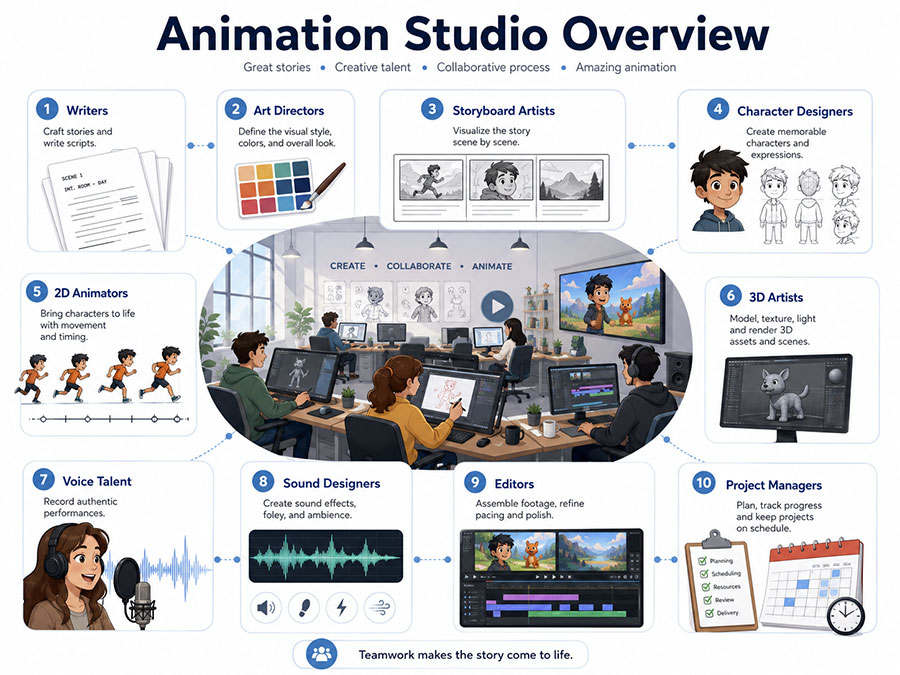
Animation Studio Overview
| Studio Element | Primary Responsibility |
|---|---|
| Writers | Develop the story, dialogue, and narration |
| Art directors | Establish the overall visual style |
| Storyboard artists | Plan each scene and camera angle |
| Character designers | Create the appearance and personality of characters |
| 2D animators | Animate illustrated characters, objects, and environments |
| 3D artists | Model, texture, rig, light, and animate digital assets |
| Voice talent | Record narration and character dialogue |
| Sound designers | Create sound effects and audio environments |
| Editors | Assemble the animation, audio, text, and transitions |
| Project managers | Coordinate timelines, approvals, budgets, and communication |
What Is an Animation Company?
An animation company is a creative production business that develops animated content for entertainment, marketing, education, training, public communication, and digital media.
Animation companies may specialize in:
- 2D animation
- 3D animation
- Character animation
- Motion graphics
- Animated explainer videos
- Product animation
- Logo animation
- Whiteboard animation
- Visual effects
- AI-assisted animation
- Television animation
- Feature-film production
Some animation studios employ hundreds of artists and operate large television or film-production pipelines.
Others are smaller studios focused on business videos, advertising campaigns, branded animation, and digital content.
The size of the animation company does not automatically determine the quality of its work.
The right studio depends on the project’s purpose, audience, style, budget, length, technical requirements, and expected delivery schedule.
What Does an Animation Studio Create?
Modern animation studios work on much more than cartoons and feature films.
Businesses and organizations hire animation companies to produce:
✓ Product demonstrations
✓ Animated explainer videos
✓ Corporate videos
✓ Training and onboarding content
✓ Social media advertisements
✓ Government communication videos
✓ Medical and scientific animation
✓ Industrial and technical animation
✓ Architectural visualization
✓ Logo animation
✓ Educational videos
✓ Television programs
✓ Streaming content
✓ Video-game cinematics
Animation is especially useful when a subject is difficult, expensive, dangerous, or impossible to film.
An animation company can show the internal components of a machine, visualize an unbuilt property, explain a medical process, or transform an abstract service into a clear visual story.
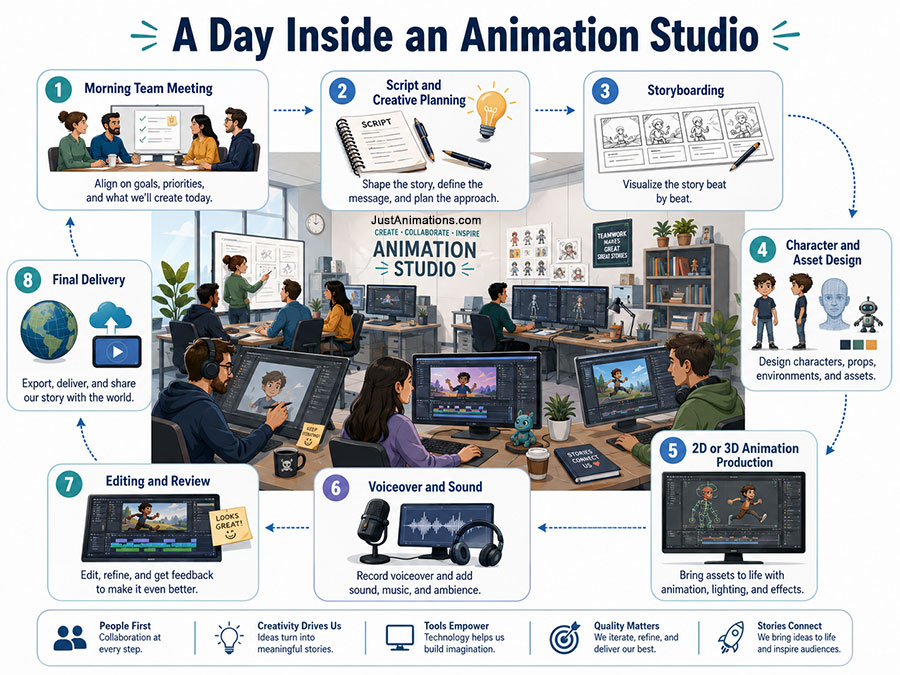
A Day Inside an Animation Studio
No two days are exactly the same inside an animation studio.
One team may be developing character concepts for a new campaign while another is animating a technical product demonstration. A director may be reviewing storyboards while editors prepare a nearly completed video for client approval.
The studio’s daily schedule is usually organized around production milestones.
Morning meetings may focus on priorities, creative decisions, technical problems, and upcoming deadlines.
Artists and animators then work through assigned scenes while directors and project managers review progress.
Later in the day, the animation company may hold internal reviews, present new work to clients, record voiceovers, or prepare finished scenes for rendering and editing.
The Pre-Production Process
Pre-production is one of the most important stages of any animation project.
It establishes what the animation will communicate, how it will look, and how each scene will support the overall objective.
Strong pre-production can prevent expensive revisions later.
Discovery and Creative Planning
The animation studio begins by learning about the project.
The production team may ask:
- Who is the intended audience?
- What should viewers understand?
- What action should they take?
- Where will the animation be shown?
- What style fits the brand?
- How long should the video be?
- Which products, characters, or environments are required?
- What is the available budget?
- When must the project be completed?
These questions help the animation company determine the appropriate production method.
A simple service explanation may work well in 2D animation.
A physical product or industrial process may require 3D animation.
A premium brand campaign may combine animation, motion graphics, live-action footage, and visual effects.
Scriptwriting
The script determines what the viewer will hear and what the animation must show.
Writers turn the original idea into a structured narrative with a beginning, middle, and conclusion.
A business animation script may include:
- The viewer’s problem
- The proposed solution
- Product or service benefits
- Supporting examples
- A clear call to action
An entertainment script may focus more heavily on character development, conflict, dialogue, and emotional progression.
The animation studio reviews the script before detailed visual production begins.
Late script changes can affect the storyboard, voiceover, scene length, animation, editing, and sound design.
Storyboarding
A storyboard is a visual plan for the animation.
It breaks the script into individual scenes and shows:
- Character positions
- Important actions
- Camera angles
- Backgrounds
- On-screen text
- Transitions
- Product views
- General composition
Storyboards do not need to look like final artwork.
Their purpose is to confirm that the story and visual sequence work before the animation company invests time in full production.
For more complicated projects, the storyboard may be turned into an animatic.
An animatic is a timed video made from storyboard images, temporary voiceover, and basic sound. It helps the studio evaluate pacing before detailed animation begins.
Developing the Visual Style
The animation studio may create style frames before producing the full video.
Style frames are polished images that demonstrate how the final animation may look.
They help define:
- Color palette
- Character style
- Typography
- Lighting
- Background detail
- Texture
- Illustration technique
- Brand integration
Approving the style early gives the animation company a clear visual standard to follow across every scene.
Bringing Animated Characters to Life
Character animation is one of the most recognizable parts of animation production.
A successful character needs more than an attractive appearance.
Its design, expressions, posture, voice, movement, and personality must all work together.
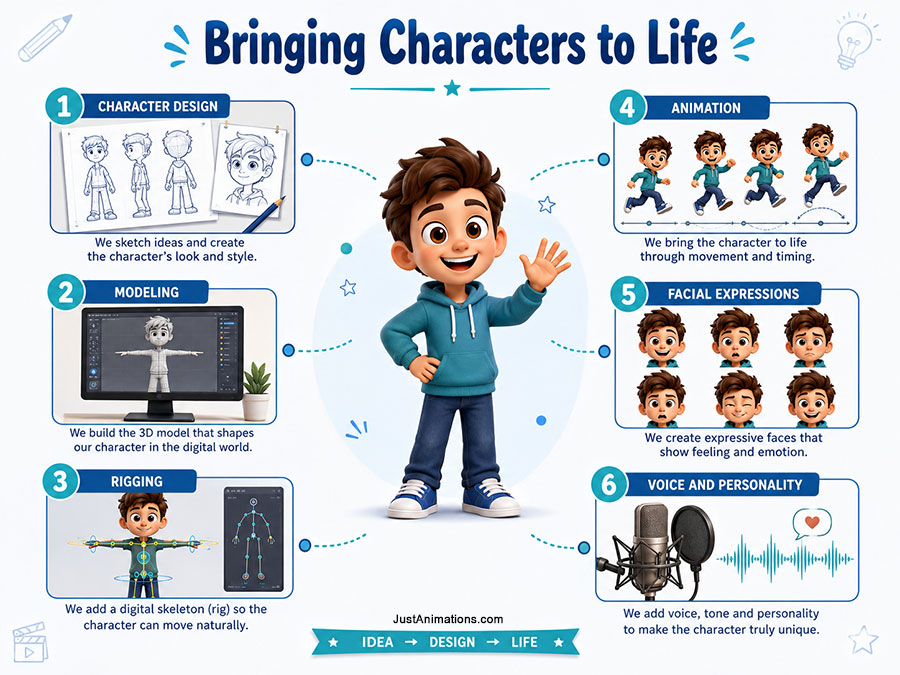
Character Design
The character-design and animation characters process often begins with rough sketches.
Artists explore different:
- Body shapes
- Facial structures
- Proportions
- Clothing
- Hairstyles
- Colors
- Accessories
- Expressions
The animation studio may present several concepts before refining one direction.
Each character should support the story and intended audience.
A children’s character may use exaggerated features and energetic expressions.
A corporate character may use a simpler, more professional design.
A brand mascot should also connect visually or strategically to the organization it represents.
Character Modeling
A 3D animation company must turn the approved character design into a digital model.
Generally 3D artists build the character’s form using specialized modeling software.
The model may include:
- Body structure
- Facial features
- Clothing
- Hair or fur
- Shoes
- Accessories
- Surface details
The character is then textured to establish colors, materials, patterns, and surface appearance.
A 2D animation studio may instead separate the illustrated character into individual layers for the head, arms, hands, legs, eyes, mouth, and other movable parts.
Rigging
Rigging gives a character the controls required for movement.
A digital skeleton is created inside the character.
The rig may control:
- Arms and legs
- Hands and fingers
- Head movement
- Facial expressions
- Eye direction
- Mouth shapes
- Clothing
- Hair
- Props
A well-designed rig allows animators to create natural movement while keeping the character’s proportions consistent.
Character Animation
Character animators use the rig to create movement and performance.
They consider:
- Timing
- Weight
- Balance
- Emotion
- Personality
- Body language
- Facial expression
- Interaction with objects
- Interaction with other characters
A confident character should move differently from a nervous one.
A heavy mechanical character should not move like a light cartoon animal.
The animator’s job is to create movement that feels appropriate and believable within the chosen visual style.
Producing 2D Animation
A 2D animation studio creates movement using flat illustrated assets.
Production methods may include:
- Frame-by-frame animation
- Puppet or rigged animation
- Cutout animation
- Motion graphics
- Character animation
- Illustrated transitions
- Typography animation
Frame-by-frame animation involves drawing individual poses and movements.
Rigged 2D animation uses reusable character parts and digital controls.
Many animation companies combine both methods. Rigging may be used for standard movement, while frame-by-frame animation adds more expressive actions or special effects.
Producing 3D Animation
A 3D animation company works with digital objects that have height, width, and depth.
The main production stages often include:
- Modeling
- Texturing
- Rigging
- Animation
- Lighting
- Rendering
- Compositing
Three-dimensional assets can be viewed from different angles and placed into realistic or stylized environments.
This makes 3D animation useful for:
- Product demonstrations
- Machinery animation
- Architecture
- Medical visualization
- Character animation
- Cinematic advertising
- Technical processes
3D production often requires more technical preparation and rendering than a basic 2D project.
However, completed models can frequently be reused in future videos, still images, advertisements, presentations, and interactive experiences.
Lighting and Rendering
Lighting helps establish visibility, depth, mood, and visual focus.
A scene can feel completely different depending on the lighting choices.
Bright, even lighting may work well for a product demonstration.
Dramatic directional lighting may be better for a cinematic advertisement.
Rendering converts the completed 3D scene into individual video frames.
More detailed models, realistic materials, complex lighting, reflections, shadows, hair, smoke, water, and visual effects can increase rendering time.
Animation studios may use internal computers, dedicated render farms, or cloud-rendering services to process demanding scenes.
Sound and Music: Adding the Finishing Touches
Animation is a visual medium, but sound plays an equally important role in the final experience.
Sound gives movement more impact and helps establish the environment, pace, and emotional tone.
Voiceover
Many business animations use a professional narrator to guide the viewer through the story.
Character-based projects may involve several voice actors.
The animation company may help with:
- Voice casting
- Auditions
- Recording
- Direction
- Editing
- Dialogue cleanup
- Synchronization
Voiceover is often recorded before final animation so character movement and scene timing can follow the approved performance.
Sound Effects
Sound designers create or select effects for actions shown on screen.
These might include:
- Footsteps
- Doors
- Buttons
- Machines
- Vehicles
- Clothing
- Weather
- Impacts
- Digital interfaces
- Environmental sound
Some sounds are recorded specifically for the project.
Foley artists may use everyday objects to reproduce footsteps, movement, impacts, and physical interactions.
Other sounds come from professional libraries and are edited to fit the animation.
Music
Music helps establish emotion and pace.
An animation studio may use:
- Licensed stock music
- Custom-composed music
- Branded audio
- Short musical stings
- Ambient soundscapes
The music should support the story without competing with dialogue or narration.
Editing and Post-Production
Editors assemble the animated scenes, voiceover, sound effects, music, titles, captions, logos, and calls to action.
They adjust:
- Scene length
- Transitions
- Audio levels
- Pacing
- Color
- Text timing
- Visual continuity
The animation company then prepares a review version for internal or client approval.
Final exports may include horizontal, square, and vertical versions for websites, presentations, advertising, YouTube, LinkedIn, Instagram, or other platforms.
Where Does an Animation Studio Spend the Most Production Time?
The animation stage usually requires the greatest amount of production effort, but every stage affects the quality of the finished video.
The following text-based chart provides a general comparison of the relative workload involved in a typical custom animation project.
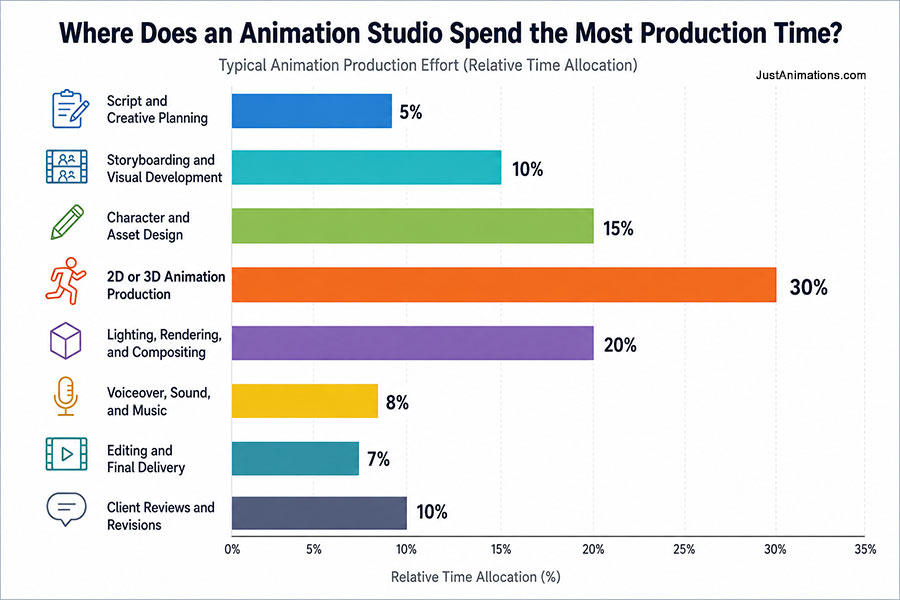
Typical Animation Production Effort
Script and creative planning
█████░░░░░ 5/10
Storyboarding and visual development
██████░░░░ 6/10
Character and asset design
███████░░░ 7/10
2D or 3D animation production
██████████ 10/10
Lighting, rendering, and compositing
███████░░░ 7/10
Voiceover, sound, and music
████░░░░░░ 4/10
Editing and final delivery
█████░░░░░ 5/10
Client reviews and revisions
██████░░░░ 6/10
These scores represent relative production effort rather than fixed percentages.
A character-driven animation company may spend more time on design, rigging, and performance. A 3D animation studio producing realistic products or environments may dedicate more resources to modeling, lighting, rendering, and compositing.
A motion graphics animation company may spend a greater portion of the schedule on typography, transitions, visual timing, and brand integration.
This is why two animated videos of the same length can have very different budgets and production timelines. The number of characters, visual complexity, animation style, realism, revisions, and technical requirements often affect the workload more than video duration alone.
How Animation Studios Manage Client Reviews
Client feedback is normally organized around specific approval stages.
These may include:
✓ Script approval
✓ Storyboard approval
✓ Visual-style approval
✓ Voiceover approval
✓ Initial animation review
✓ Final video review
Approving each stage helps prevent major changes after the next phase begins.
For example, changing a line during script development is relatively simple.
Changing that same line after voice recording, character animation, and lip synchronization may require several production stages to be repeated.
Common Challenges Faced by Animation Companies
Animation companies must balance creativity, technology, budgets, client expectations, and production deadlines.
Tight Deadlines
Animation requires time.
When a deadline is shortened, the animation studio may need to assign additional artists, simplify scenes, reduce complexity, or limit revision rounds.
A realistic production schedule protects quality.
Resource Management
A project may require writers, designers, animators, voice actors, sound designers, editors, and technical specialists.
The animation company must schedule these resources at the correct stages while controlling the budget.
Creative Consistency
Large projects may involve several artists.
The studio must make sure that characters, colors, environments, proportions, lighting, and movement remain consistent across every scene.
Style guides, reference sheets, and regular reviews help maintain that consistency.
Technology and Software
Animation studios must continually update their software, hardware, rendering systems, storage, and production workflows.
New tools can improve efficiency, but introducing technology without proper testing may create production risks.
Client Revisions
Feedback is a normal part of the animation process.
However, unclear or conflicting feedback can delay production.
A strong animation company uses defined approval stages, consolidated feedback, and clear revision policies.
How Animation Has Influenced Popular Culture
Animation has shaped entertainment, advertising, education, gaming, design, and digital communication.
Animated characters can become cultural symbols recognized across generations and geographic markets.
Animation also gives creators the freedom to develop worlds, movements, creatures, and situations that cannot be produced easily through live-action filming.
Its broad appeal comes partly from its flexibility.
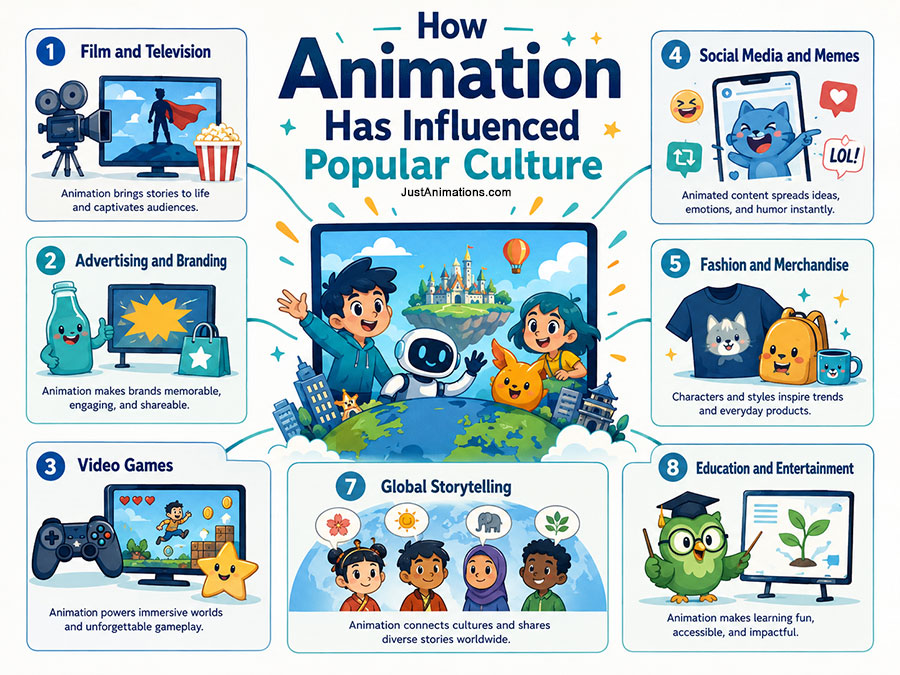
Animation can be:
- Realistic
- Abstract
- Humorous
- Emotional
- Educational
- Cinematic
- Child-friendly
- Technical
- Experimental
Animation studios have also helped brands develop recognizable characters, visual identities, advertisements, and digital experiences.
The Future of Animation Companies
Animation companies are continuing to adapt to new production methods and audience expectations.
Several developments are influencing the industry.
AI-Assisted Animation
Artificial intelligence can support concept development, storyboarding, background creation, voice testing, translation, video generation, and editing.
Professional animation studios can use these tools to accelerate selected tasks while maintaining human creative direction and quality control.
Real-Time Production
Game-engine technology allows animation companies to view and adjust environments, lighting, and camera movement in real time.
This can reduce waiting periods associated with traditional rendering.
Virtual and Augmented Reality
Virtual reality and augmented reality require animated objects, characters, interfaces, and environments that respond to user movement.
These formats create opportunities for training, entertainment, marketing, healthcare, architecture, and product demonstrations.
Personalized Video Content
Animation studios can create modular videos that are adapted for different audiences, industries, languages, products, or locations.
One master animation may be turned into several targeted versions.
Increased Demand for Short-Form Animation
Businesses need animated content for social media, digital advertising, presentations, websites, and mobile platforms.
This is increasing demand for short videos, reusable animation assets, and multiple aspect ratios.
How to Choose an Animation Studio
The best animation studio should have experience with the type of project being produced.
Before hiring an animation company, review:
- Relevant portfolio examples
- Animation styles
- Production process
- Communication
- Project management
- Pricing
- Revision policy
- Ownership terms
- Source-file delivery
- Voiceover and sound capabilities
- Delivery formats
- Production schedule
A television animation studio may not be the best choice for a corporate explainer.
A motion-design company may not be the right fit for a realistic 3D product demonstration.
The strongest animation companies recommend the production method that best supports the audience, message, budget, and intended use.
Conclusion
A day inside an animation studio involves much more than drawing characters or moving digital objects.
Every project requires planning, writing, visual development, animation, sound, editing, technical production, communication, and quality control.
Writers establish the story.
Designers define the visual world.
Animators create movement and performance.
Sound specialists build the audio experience.
Editors assemble every element into a finished production.
Animation companies bring these creative and technical disciplines together through a structured process.
Whether the final project is a short explainer video, product animation, commercial, training video, television series, or feature film, the goal remains the same: transform an idea into a visual experience that audiences can understand, remember, and enjoy.
Frequently Asked Questions
What does an animation studio do?
An animation studio develops animated videos, characters, environments, motion graphics, visual effects, and other digital content. Its services may include strategy, scriptwriting, storyboarding, design, 2D or 3D animation, voiceover, sound design, editing, and final delivery.
What is the difference between an animation studio and an animation company?
The terms animation studio and animation company are often used interchangeably. A studio may refer more specifically to the creative production team or facility, while an animation company describes the overall business providing animation services.
How long does an animation company take to produce a video?
A professional animated video commonly requires six to twelve weeks. Simple motion graphics may be completed sooner, while detailed 3D animation, character projects, television episodes, and feature productions can require several months or longer.
What types of animation do animation companies produce?
Animation companies may produce 2D animation, 3D animation, character animation, motion graphics, logo animation, product animation, whiteboard videos, visual effects, AI-assisted animation, television content, and animated feature films.
How should a business choose an animation studio?
A business should compare portfolio quality, experience with similar projects, communication, production process, pricing, revisions, ownership terms, timeline, and delivery formats. The best animation studio is the one whose capabilities align with the project’s purpose and audience.