A Toronto animation studio can support a much broader set of projects than entertainment alone. Toronto companies, enterprises, agencies, universities, healthcare organizations, manufacturers, nonprofits, government bodies, and public-sector teams all use animation to make complex information easier to understand.
The city has a strong screen-production and digital-media ecosystem, but that does not mean every Toronto animation company is built for the same type of work.
A financial-services company may need motion graphics. A manufacturer may need 3D product visualization. A municipal program may need accessible public-information animation. A SaaS company may need an interface explainer. A real-estate developer may need architectural visualization.
This article focuses on costs, services, and project fit for buyers searching *Toronto animation studio* or *animation studio Toronto*. It complements the Toronto animation studio location page and the enterprise-focused Best Toronto Animation Studio for Enterprise Videos article rather than repeating their intent.
Toronto’s Animation Market Sits Inside a Larger Screen Industry
The City of Toronto maintains resources for the local film, television, digital-media, animation, and visual-effects ecosystem. Its screen-industry resources include links to organizations supporting animation, VFX, production, and interactive digital media.
For animation buyers, that means Toronto offers access to a mature creative market while also serving industries far beyond entertainment.
The best studio fit depends on the actual communication problem.
Which Toronto Animation Service Fits Which Project?
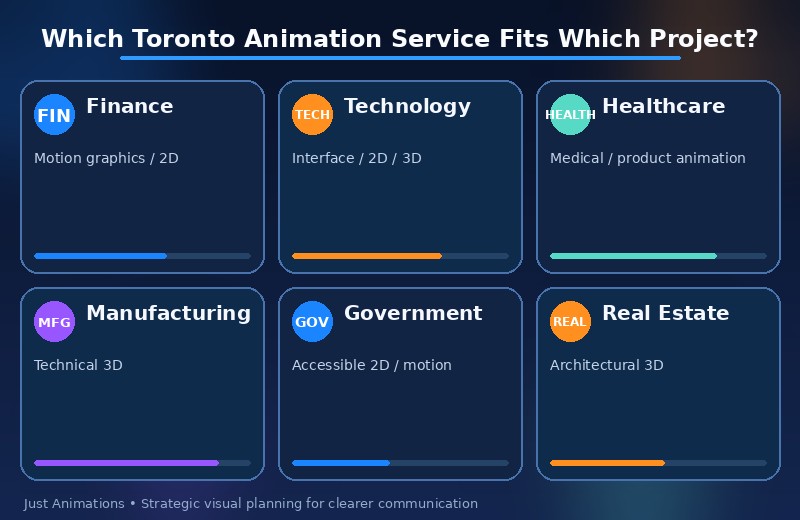
| Project Need | Strong Animation Fit | Typical Buyer |
| Explain a financial or business service | Motion graphics / 2D | Finance, consulting, insurance |
| Demonstrate a physical product | 3D animation | Manufacturing, healthcare, technology |
| Explain software | 2D / interface animation | SaaS, AI, fintech |
| Public information | 2D / motion graphics | Government, public sector, NGOs |
| Property visualization | Architectural 3D | Real estate, development |
| Training | 2D / character / motion graphics | Enterprise, healthcare, government |
The buyer should choose the studio based on the deliverable, not simply because the company is local.
How Much Does a Toronto Animation Studio Cost?
JustAnimations.com is a U.S.-facing `.com` site, so the planning ranges below are expressed in USD for consistency.
Broad professional ranges may include:
| Project Type | Approximate Range (USD) |
| Short branded motion asset | $3,000-$10,000+ |
| 2D explainer | $7,500-$25,000+ |
| Motion-graphics business video | $7,500-$30,000+ |
| 3D product animation | $10,000-$40,000+ |
| Character animation | $15,000-$60,000+ |
| Technical 3D or medical animation | $20,000-$75,000+ |
| Multi-video campaign | $40,000-$200,000+ |
These are planning ranges, not fixed Just Animations prices.
Final cost depends on scope, animation style, asset creation, runtime, revisions, technical requirements, and delivery formats.
Why Toronto Animation Quotes Can Vary
One studio may include the full production process:
- Strategy
- Scriptwriting
- Storyboarding
- Design
- Animation
- Voiceover
- Sound design
- Final versions
Another studio may quote only the animation stage after the client provides all creative materials.
The buyer should compare scope, not just price.
2D Animation for Toronto Businesses and Public Organizations
Professional 2D animation is useful when the subject is abstract or when a simple visual language is more effective than photorealism.
Toronto use cases include:
- Financial education
- SaaS explainers
- Healthcare information
- Corporate training
- University content
- NGO campaigns
- Government communication
2D can combine characters, diagrams, icons, typography, and interfaces into one consistent visual system.
3D Animation for Products, Devices and Real Estate
3D animation becomes valuable when physical depth matters.
Toronto projects may include:
- Medical devices
- Machinery
- Building systems
- Architecture
- Consumer products
- Technology hardware
A product can rotate, open, separate, become transparent, or reveal internal components.
That creates a virtual demonstration that live-action video may not be able to capture.
Motion Graphics for Finance, SaaS and Corporate Communication
Toronto has significant finance, technology, insurance, professional-services, and enterprise activity.
These industries often need to explain information that does not have an obvious physical form.
Motion graphics can make:
- Data
- Workflows
- Reports
- Software
- Business processes
more visually understandable.
Government and Public-Sector Animation in Toronto
Toronto-based public organizations may need animation for:
- Public-service programs
- Transportation
- Infrastructure
- Community outreach
- Policy communication
- Emergency preparedness
- Health information
- Training
The creative priorities are often different from advertising.
Public-sector animation should emphasize:
- Clarity
- Accessibility
- Appropriate tone
- Multilingual planning where needed
- Stakeholder review
The government animation context is especially relevant when the audience includes citizens rather than customers.
Toronto Technology Companies Need More Than Generic Explainers
Technology animation may need to show:
- AI workflows
- APIs
- Dashboards
- Cloud infrastructure
- Automation
- Hardware
The visual approach should depend on what part of the product is most important.
A software workflow may be best in 2D.
A physical device may need 3D.
A complete technology story may combine both.
The technology animation page provides additional service context.
Toronto Manufacturing and Industrial Animation
Manufacturers can use animation when equipment is:
- Too large to move
- Too dangerous to demonstrate
- Difficult to film internally
- Still in engineering development
3D can visualize:
Machine exterior -> internal component -> operation -> output
This is useful for sales, training, trade shows, and technical communication.
Toronto Healthcare Animation
Healthcare companies, hospitals, medical-device firms, and educational organizations may use animation for:
- Anatomy
- Procedures
- Product operation
- Patient education
- Training
Accuracy and review structure are critical.
A visually impressive animation is still a weak healthcare asset if the medical information is incorrect.
Real Estate and Architectural Visualization
Toronto’s development market creates demand for visualization before construction is complete.
Animation can show:
- Exterior design
- Interior spaces
- Amenities
- Neighborhood context
- Lighting
- Camera walkthroughs
Buyers should look for studios with specific architectural and 3D experience rather than assuming any animator can handle spatial accuracy.
What Does a Toronto Animation Project Timeline Look Like?
General planning windows include:
| Project | Typical Timeline |
| Short motion asset | 2-4 weeks |
| 2D explainer | 4-8 weeks |
| Motion-graphics video | 4-8 weeks |
| 3D product animation | 5-10 weeks |
| Technical 3D | 8-16 weeks |
| Multi-video enterprise package | 10-20+ weeks |
Timelines can expand when stakeholder review is complex or technical source files are incomplete.
Toronto Enterprise Projects Need Strong Approval Structure
Large organizations may involve:
- Marketing
- Product
- Legal
- Compliance
- Leadership
- Procurement
A studio should establish who approves:
- Script
- Storyboard
- Visual style
- Rough animation
- Final delivery
This reduces contradictory feedback late in production.
Local Toronto Studio vs Remote Specialist
A local studio can be useful when:
- In-person meetings matter
- Live-action filming is included
- Local talent or locations are required
- The buyer prefers local collaboration
A remote specialist may be better when:
- The project needs a niche skill
- Production is entirely digital
- The strongest portfolio is outside Toronto
Animation is particularly suitable for remote collaboration because most stages can be reviewed digitally.
Toronto’s Animation History Still Matters
Toronto has a long animation-production history, including well-known studios and children’s television production.
The local industry also changes over time. The article Toronto Animation Studio Nelvana Shuts Down After 54 Years provides an example of how the city’s animation landscape continues to evolve.
For buyers, the lesson is not to choose a vendor based only on legacy reputation.
Evaluate the team that will actually produce the work now.
What Should a Toronto Animation Brief Include?
A good brief should contain:
- Organization overview
- Audience
- Project objective
- Main message
- Required services
- Brand guidelines
- Technical references
- Desired style
- Runtime
- Deadline
- Distribution channels
- Budget range
- Stakeholders
For government or public-sector work, also identify:
- Accessibility requirements
- Translation requirements
- Procurement constraints
- Legal or policy review
How to Compare Toronto Animation Studios
Relevant Portfolio
Look for comparable project types, not just visually attractive work.
Communication
The studio should explain the process clearly.
Business Understanding
Can the team identify what the video needs to accomplish?
Technical Capability
Does it have the right 2D, 3D, product, interface, or character skills?
Review Process
Can it manage multiple stakeholders?
Distribution Planning
Can the content be adapted for multiple channels?
Plan for Reuse Before Animation Begins
A strong animation asset can support:
- Website
- Sales presentations
- Trade shows
- Internal training
- Paid campaigns
- Investor communication
A 3D model can be reused for future product content.
A character system can support a video series.
A motion-graphics package can become part of a broader brand system.
Planning reuse can improve return on the initial production investment.
Common Toronto Animation Hiring Mistakes
Choosing the Cheapest Quote Without Comparing Scope
A lower number may include fewer services.
Skipping Storyboarding
Late animation revisions are more expensive.
Ignoring Accessibility
Especially important for public-sector and education content.
Choosing a Style Before Defining the Message
Visual technique should follow the communication goal.
Forgetting Mobile and Social Formats
A 16:9 master may not crop cleanly into vertical video.
What Should Be Included in the Contract?
Confirm:
- Deliverables
- Timeline
- Milestones
- Revision rounds
- Payment schedule
- Ownership
- Licensing
- Source-file terms
- Final formats
For public-sector or enterprise buyers, procurement and privacy requirements may also need to be documented.
The Best Toronto Animation Studio Is the Best Fit for the Audience
Toronto has enough creative depth that buyers can find studios for entertainment, enterprise, public-sector, product, technology, healthcare, and advertising work.
That makes project fit more important than a generic ranking.
The right Toronto animation studio should be able to answer:
- Who is the audience?
- What must they understand?
- Which animation style supports that goal?
- How will stakeholders approve the work?
- Where will the final content be used?
When those questions are answered first, budget and production decisions become much easier to evaluate.
Toronto Private-Sector and Public-Sector Buyers Often Need Different Workflows
A private company may optimize around launch timing, sales usefulness, and campaign performance.
A public-sector organization may need more formal review, accessibility, procurement documentation, and broader audience considerations.
That can affect:
- Timeline
- Script approval
- Versioning
- Accessibility deliverables
- Translation
- Legal review
Studios should understand these differences before estimating the project.
How Toronto Organizations Can Compare Proposals Fairly
When several studios submit proposals, normalize the scope before comparing price.
Check whether each proposal includes:
- Scriptwriting
- Storyboarding
- Voiceover
- Sound design
- Accessibility files
- Alternate language versions
- Social cutdowns
- Source files
A lower price may simply exclude services another proposal includes.
A simple comparison matrix can separate:
Must-have deliverables from optional enhancements.
That makes procurement decisions more transparent and reduces surprises after production begins.
Toronto Animation Can Support a Regional and International Audience
Toronto organizations often serve audiences across Canada, the United States, and international markets.
That makes neutral visual storytelling, flexible typography, localization-ready source files, and multiple aspect ratios valuable from the beginning.
A video designed only for one English-language website placement may be harder to adapt later. A modular animation system can support additional markets without rebuilding every scene.
Toronto Buyers Should Ask About Long-Term File Access
If an organization expects future revisions, it should understand what happens to project files after delivery.
Ask whether the studio retains:
- 3D models
- Character rigs
- Editable design files
- Voice tracks
- Music stems
- Project files
Also ask how long those files are retained and whether future updates require the original studio.
This is especially important for public-sector, healthcare, training, and enterprise content that may need policy, product, or language updates months or years later.
Toronto Animation Projects Should Plan for Cross-Border Use
Many Toronto companies sell into both Canada and the United States. A video may therefore need to work across two markets with different terminology, regulatory references, or business expectations.
Plan for editable text, separate voice tracks, and modular scenes if regional versions are likely. A financial, healthcare, government, or product video may need small wording changes even when the visual sequence remains the same.
Cross-border planning is easier during pre-production than after every scene has been locked. It also helps companies reuse one core animation system across websites, trade shows, sales teams, and regional campaigns.
A Toronto Animation Studio Should Explain What Happens After Delivery
The relationship does not always end when the master file is exported.
Ask whether the studio can support:
- Future updates
- Additional aspect ratios
- New language versions
- Product changes
- New campaign edits
- Archive recovery
This matters when the animation represents a long-lived business asset rather than a one-time advertisement.
A well-scoped project also gives the studio more room to improve creative quality instead of spending time resolving preventable uncertainty.
That planning discipline is what turns animation from a visual extra into a dependable communication asset.
Frequently Asked Questions
How much does a Toronto animation studio cost?
Professional Toronto animation projects can range from several thousand dollars for short motion assets to $25,000-$100,000+ for detailed 3D, character, technical, medical, commercial, and multi-video work. Scope and complexity determine the final quote.
What services do Toronto animation studios offer?
Common services include 2D animation, 3D animation, motion graphics, explainer videos, product animation, medical animation, corporate video, architectural visualization, AI-assisted animation, and public-sector communication.
What animation style is best for a Toronto business?
2D and motion graphics are strong for services, finance, SaaS, training, and public information. 3D is better for products, machinery, medical devices, architecture, and technical visualization. Hybrid projects can combine both.
Do I need a local Toronto animation studio?
Not always. Local studios are useful when in-person collaboration, filming, local talent, or regional knowledge matters. Digital animation can be produced remotely when the team has the right expertise and review process.
How long does a Toronto animation project take?
Short projects may take 2-4 weeks, while 2D explainers and motion graphics often take 4-8 weeks. Detailed 3D, technical, character, or multi-video projects can require 8-20 weeks or more.
Accessibility Is Especially Important for Toronto Public Communication
Animation used by government, healthcare, education, and public-sector organizations should be planned so important information remains available to a broad audience.
That can include:
- Captions
- Clear typography
- Sufficient contrast
- Reduced-motion alternatives
- Descriptive narration where appropriate
- Accessible transcripts
Accessibility should be discussed during the brief rather than treated as a final export task.
Multilingual and Localization Planning
Toronto organizations may communicate with diverse audiences.
If an animation will be produced in multiple languages, plan for that before final layout.
Translated text can be longer than English text. Voiceover timing can change. On-screen labels may need more room.
A localization-ready project should keep:
- Text layers editable
- Voice and music separated
- Visual timing flexible
- Source files organized
This makes future language versions easier and less expensive.
AI-Assisted Animation for Toronto Companies
Toronto technology, marketing, and media teams are increasingly experimenting with generative tools for concept development and short-form content.
AI can support:
- Mood exploration
- Storyboard concepts
- Backgrounds
- Short video variations
- Social ideas
But product accuracy, character consistency, public-sector compliance, and brand control still require review.
The AI animation services page covers service capabilities, while the article AI Animation: The Choice Is Yours provides additional context about choosing AI-assisted or traditional production.
Procurement Questions for Toronto Enterprise and Public-Sector Buyers
Larger organizations should ask vendors to clarify:
- Who owns the final animation and working files?
- Which subcontractors or specialists may be involved?
- How are confidential materials handled?
- How many revision rounds are included?
- Can the studio meet accessibility requirements?
- How are multilingual versions handled?
- What happens if the schedule changes?
- Which final formats are delivered?
- Can the work be reused across departments?
- Who is responsible for final technical approval?
These questions help procurement teams compare proposals on more than price.
Toronto Studio Selection Should Reflect Long-Term Use
A company may initially commission one explainer but later need a complete library of related content.
When selecting a studio, consider whether the team can support:
- Ongoing product updates
- New campaign versions
- Training modules
- Event content
- Social edits
- Localization
A repeatable production relationship can be more valuable than constantly rebuilding a visual system with new vendors.