2D vs. 3D animation is one of the most important decisions a business can make when planning an animated video. Both styles can explain ideas, tell stories, promote products, and support marketing campaigns, but they do it in very different ways. 2D animation is often simpler, faster, more stylized, and easier to use for explainer videos, educational content, social media ads, and service-based messaging. 3D animation offers more depth, realism, detail, and visual impact, making it a stronger choice for product demos, technical visuals, architecture, medical animation, machinery, and premium brand presentations.
The right choice depends on your goal.
Are you trying to explain something quickly?
Show a product in realistic detail?
Create a playful brand video?
Demonstrate how a machine works?
Build a polished visual experience for a high-value audience?
Understanding the differences between 2D and 3D animation helps you choose the style that fits your message, budget, timeline, and audience. This guide breaks down what each animation style does best, when to use each one, and how to decide which approach is right for your business.
What is 2D Animation?
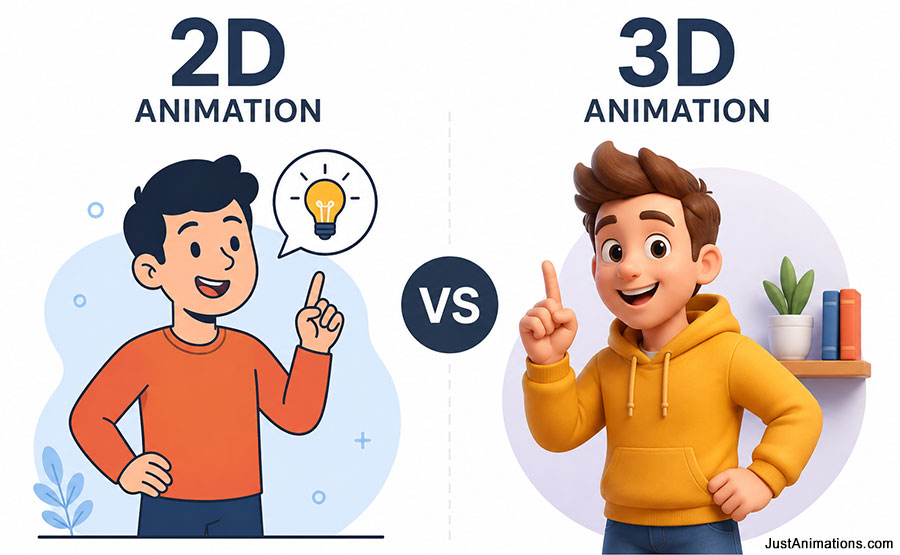
2D animation refers to the creation of moving images in a two-dimensional space. This is the classic form of animation; think of the old Disney films like The Lion King or Snow White. In 2D animation, characters and objects are created in a flat space, with only height and width (no depth), and each frame is drawn by animators or generated by software to create motion.
Key Characteristics of 2D Animation:
- Flat and Cartoon-Like: 2D animation focuses on creating flat images that move fluidly. The absence of depth gives it that recognizable “cartoon” look.
- Stylized and Simple: 2D is often stylized, meaning it has a certain artistic flair and simplicity that can make your animation stand out in a unique way.
- Frame-by-Frame Creation: Traditional 2D animation is drawn frame by frame. However, digital advancements have made this process faster and more efficient through software tools.
When to Use 2D Animation:
2D animation is best when you’re looking for a creative, often whimsical, visual approach. It excels at storytelling and is often used for explainer videos, product ads, and educational content. If you want a fast and cost-effective solution that delivers clear, concise messaging, 2D is an excellent choice.
Benefits of 2D Animation:
- Cost-Effective: Generally, 2D animation is more affordable than 3D. It requires fewer resources, simpler software, and shorter production time.
- Quick Turnaround: Because it’s less complex than 3D, 2D animation can be produced relatively quickly, making it ideal for businesses working on tight deadlines.
- Stylized Appeal: If your brand leans toward a more playful or artistic aesthetic, 2D animation offers limitless creative freedom.
- Simplicity: It’s excellent for explaining abstract or complex ideas in a way that’s easy to digest.
Drawbacks of 2D Animation:
- Limited Depth: The lack of depth and realism may not work for brands that want a more lifelike representation.
- Less Immersive: While 2D can be charming, it’s not as immersive as 3D animation, especially when you need to demonstrate real-world physics or detailed product functionality.
What is 3D Animation?
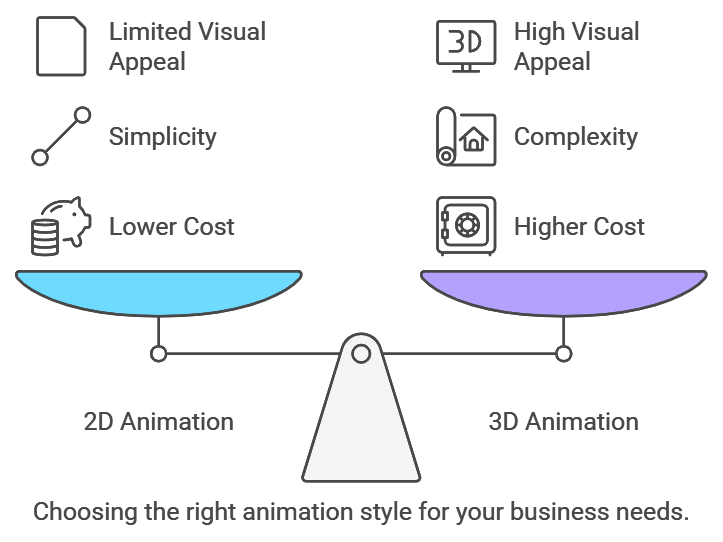
3D animation takes place in a three-dimensional space, meaning it includes height, width, and depth. In 3D animation, objects and characters appear more lifelike, as they have realistic depth and can be viewed from multiple angles. Think of Pixar movies like Toy Story or high-end video game graphics. 3D animation uses complex modeling, lighting, and rendering techniques to bring characters, products, and environments to life.
Key Characteristics of 3D Animation:
- Realistic and Detailed: 3D animation mimics the real world with more depth and realism, making it feel more immersive.
- Complexity: The process involves creating 3D models, adding textures, applying physics-based movement, and rendering.
- Multi-Angle Views: Characters and objects can be rotated and viewed from different perspectives, adding a dynamic feel to the animation.
When to Use 3D Animation:
3D animation is perfect when you need to show products in realistic detail, especially in industries like tech, automotive, architecture, and gaming. It’s also the best option when you want to create immersive and dynamic environments. Whether you’re showcasing a product prototype, demonstrating the functionality of complex machinery, or creating a visual experience that feels real, 3D is the go-to.
Benefits of 3D Animation:
- Highly Realistic: If your goal is to showcase a product in lifelike detail, 3D animation offers depth, texture, and realism that 2D can’t match.
- Immersive Experience: 3D animation allows for full interaction with objects, creating a highly immersive experience for viewers.
- Flexibility: You can rotate, scale, and modify 3D objects, giving you the flexibility to make changes without having to redo the entire animation.
- Visual Impact: The level of visual depth and realism in 3D animation creates a high-end, professional feel that elevates your brand.
Drawbacks of 3D Animation:
- Higher Costs: 3D animation tends to be more expensive due to the complexity of modeling, rendering, and the technology involved.
- Longer Production Times: Because of the detailed process, 3D animation usually takes more time to produce compared to 2D animation.
- Not Always Necessary: For simple messages or playful branding, 3D animation may be overkill when a straightforward 2D animation would suffice.
Comparing 2D vs 3D Animation: Which Should You Choose?
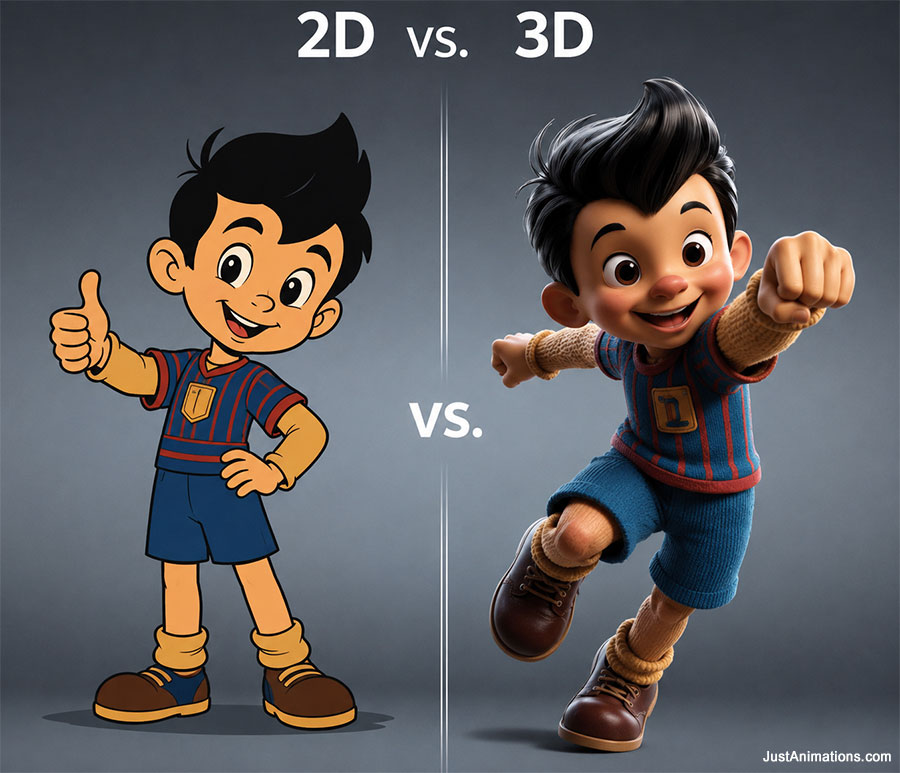
Both 2D animation and 3D animation have their own strengths and weaknesses. To determine which style is best for your business, you’ll need to think about the message you want to convey, your budget, your timeline, and the audience you’re targeting. Let’s break it down.
Comparing 2D vs 3D Animation: Which Should You Choose?
| Decision Factor | Choose 2D Animation If… | Choose 3D Animation If… | Best Fit |
|---|---|---|---|
| Message clarity | You need to explain a simple idea, service, or process quickly | You need to show how something physically looks, moves, or functions | 2D for clarity, 3D for detail |
| Budget | You need a more affordable animation option | You have a larger budget for modeling, lighting, rendering, and polish | 2D is usually more cost-effective |
| Timeline | You need a faster turnaround | You have more time for production, revisions, and rendering | 2D is usually faster |
| Visual style | You want a flat, clean, cartoon, or illustrated look | You want realism, depth, camera movement, and lifelike visuals | Depends on brand tone |
| Product demonstration | You only need to explain the benefit or concept | You need to show the product from multiple angles or in real-world use | 3D is stronger for products |
| Explainer videos | You want a simple, easy-to-follow educational video | The explainer involves a technical object, machine, or detailed product | 2D for most explainers |
| Technical accuracy | The message can be simplified visually | The audience needs to see accurate form, scale, movement, or mechanics | 3D is better for precision |
| Brand personality | Your brand is playful, simple, friendly, or educational | Your brand is premium, technical, futuristic, or product-focused | 2D for approachable, 3D for premium |
| Audience engagement | You want fast understanding and broad accessibility | You want stronger visual impact and immersion | Both can work |
| Best use cases | Explainers, training, social ads, service videos, education | Product demos, architecture, medical animation, machinery, tech visuals | Match style to purpose |
Quick Choice Chart
2D Animation
██████████ Best for clarity
█████████░ Best for speed
████████░░ Best for lower budgets
█████████░ Best for explainers
██████░░░░ Best for realism
3D Animation
██████████ Best for realism
█████████░ Best for product demos
█████████░ Best for technical visuals
██████░░░░ Best for speed
█████░░░░░ Best for lower budgets
Simple Rule
Choose 2D animation when the goal is to explain something clearly, quickly, and affordably.
Choose 3D animation when the goal is to show depth, realism, product detail, movement, or technical function.
Choose a hybrid 2D and 3D animation style when your business needs both simple messaging and premium visual impact.
Message Complexity
- Use 2D if you’re trying to explain a concept quickly and clearly, without needing to dive into intricate details. 2D is perfect for explainer videos, educational content, and simple product introductions. It’s also great for storytelling when you want to simplify and clarify your message.
- Use 3D when your product or service is complex, detailed, and needs a high level of visualization. If you need to show how your product moves, functions, or interacts in a real-world environment, 3D will give you that extra layer of realism that resonates with your audience.
Budget
- 2D Animation is usually the more affordable option. If you’re a small business or startup, 2D can deliver high-quality visuals without breaking the bank. It’s a great solution for brands that need animation on a regular basis but don’t have a large budget to work with.
- 3D Animation, while more expensive, delivers a level of visual sophistication that might be worth the investment if you need a high-impact presentation or product demo. However, the extra costs come from the detailed modeling, rendering, and animation processes involved.
Timeline
- 2D Animation wins in the speed department. Since it requires less technical complexity, it’s much faster to produce, especially when time is of the essence. If you need an animated ad or explainer video turned around quickly, 2D is your best bet.
- 3D Animation requires more time. Creating 3D models, textures, and environments is a labor-intensive process. If you have a longer production timeline and need something polished, 3D can offer unmatched visual results.
Conclusion: Choosing Between 2D And 3D Animation
Choosing between 2D and 3D animation comes down to the goal of the video.
If your message needs to be simple, clear, fast, and easy to understand, 2D animation is often the better choice.
It works well for explainer videos, educational content, social media ads, service videos, brand storytelling, and internal training.
It is usually more cost-effective.
It is faster to produce.
And it gives brands a flexible, stylized way to communicate without overcomplicating the message.
If your product needs depth, realism, detail, or a premium visual experience, 3D animation may be the better option.
It works especially well for product demos, machinery, medical devices, architecture, technology, manufacturing, automotive, real estate, and technical presentations.
3D animation can show how something looks, moves, functions, and fits into a real environment.
That makes it powerful when the viewer needs to understand a product visually before they buy, invest, or take the next step.
The important thing is not to choose 2D or 3D because one sounds more impressive.
Choose the style that supports the message.
A simple service explainer may perform better in 2D.
A complex product demonstration may need 3D.
A premium campaign may use both.
Many modern animation projects now combine 2D, 3D, motion graphics, and AI-assisted workflows to create a style that is clear, polished, and practical for the audience.
At the end of the day, animation should make your message easier to understand.
Not harder.
The right animation style should help your audience see the value faster, remember the message longer, and feel more confident about your brand.
For businesses that are unsure which direction to take, working with an animation studio like Just Animations can help clarify the best approach. The right partner can review your goals, audience, budget, timeline, and creative needs before recommending whether 2D animation, 3D animation, or a hybrid style makes the most sense.
Bring Your Ideas to Life with 2D and 3D Animation
At Just Animations, we specialize in both 2D and 3D animation, helping you bring your vision to life with the style that best suits your business needs. No matter what your animation needs are, we’re here to help you make the right choice. Reach out to our team to learn more and find out which style is best suited for your new animation project.
FAQ
What Is The Main Difference Between 2D And 3D Animation?
The main difference between 2D and 3D animation is depth. 2D animation uses flat visuals with height and width, while 3D animation adds depth, realism, lighting, camera movement, and more lifelike object movement.
Is 2D Animation Better Than 3D Animation?
2D animation is not always better than 3D animation. It depends on the project. 2D is often better for simple explainers, educational videos, social media content, and stylized storytelling. 3D is usually better for product demos, technical visuals, architecture, medical animation, machinery, and realistic presentations.
Is 3D Animation More Expensive Than 2D Animation?
Yes, 3D animation is usually more expensive than 2D animation because it often requires modeling, texturing, lighting, rigging, animation, rendering, and more technical production time. However, the added cost can be worth it when realism and product detail are important.
When Should A Business Use 2D Animation?
A business should use 2D animation when it needs to explain a concept clearly, promote a service, create an explainer video, produce social media content, train viewers, or communicate a message in a simple and engaging way.
When Should A Business Use 3D Animation?
A business should use 3D animation when it needs to show a product, object, environment, prototype, machine, medical device, building, or technical process in realistic detail. 3D animation is useful when the audience needs to see depth, movement, and function.
Is 2D Animation Faster To Produce Than 3D Animation?
In most cases, 2D animation is faster to produce than 3D animation because it usually has fewer technical production steps. 3D animation often takes longer because it requires detailed models, lighting, camera movement, rendering, and more production refinement.
Can A Video Use Both 2D And 3D Animation?
Yes. Many business videos use a hybrid animation style that combines 2D animation, 3D animation, motion graphics, and visual effects. This can be useful when a company wants the clarity of 2D with the realism and polish of 3D.
Which Animation Style Is Best For Explainer Videos?
2D animation is often the best choice for explainer videos because it is clear, flexible, cost-effective, and easy for viewers to understand. However, 3D animation may be better if the explainer needs to show a detailed product, technical process, or physical object.
Which Animation Style Is Best For Product Demos?
3D animation is usually best for product demos because it can show the product from multiple angles, highlight features, demonstrate movement, and create a more realistic presentation. For simpler product benefits, 2D animation can also work well.
How Do I Choose Between 2D And 3D Animation?
Choose 2D animation if your priority is clarity, speed, affordability, or stylized storytelling. Choose 3D animation if your priority is realism, depth, product detail, or technical demonstration. Choose a hybrid style if your project needs both simple messaging and premium visuals.