3D character animation often used with three-dimensional characters explaining products, representing brands, guiding customers, entertaining audiences, and creating stories that would otherwise be difficult or impossible to film.
Businesses use 3D character animation for advertising, explainer videos, training, gaming, entertainment, product launches, social media, interactive experiences, virtual events, and branded storytelling.
However, creating an effective character requires more than building a digital model.
The character needs a recognizable appearance, appropriate proportions, realistic or stylized materials, controlled movement, facial expressions, and a personality that supports the message.
This guide explains how 3D character design works, what the production process includes, how much 3D character animation may cost, and how to choose a professional animation studio.
Inside the World of 3D Character Animation
3D character animation is the process of designing a dimensional digital character and making it move within a three-dimensional environment.
A typical project may include:
✓ Character concept development
✓ 3D modeling
✓ Digital sculpting
✓ Texturing and materials
✓ Hair and clothing
✓ Character rigging
✓ Facial controls
✓ Body animation
✓ Lip synchronization
✓ Lighting
✓ Rendering
✓ Compositing
✓ Sound and editing
Rigging gives the model an internal digital skeleton and a system of controls.
Animators use those controls to pose the body, move the limbs, change facial expressions, and create a believable performance.
From Sketch to Screen: The Building Blocks of a 3D Character
| Production Element | What It Does | Why It Matters |
|---|---|---|
| Character concept | Defines personality and appearance | Creates a recognizable visual direction |
| 3D modeling | Builds the character’s digital form | Determines shape, proportions, and detail |
| Texturing | Adds colors, materials, and surface detail | Makes the model visually believable |
| Rigging | Creates the skeleton and movement controls | Allows the character to be animated |
| Facial setup | Controls eyes, mouth, brows, and expressions | Supports emotion and dialogue |
| Animation | Creates poses, gestures, and movement | Gives the character personality |
| Lighting | Controls visibility, mood, and depth | Integrates the character into each scene |
| Rendering | Produces the finished image frames | Determines final visual quality |
| Compositing | Combines characters, environments, and effects | Creates the finished scene |
| Sound design | Adds voice, music, and effects | Strengthens performance and emotional impact |
What Makes a Strong 3D Character Design?
3D animation characters design is the process of developing a character’s appearance, proportions, clothing, colors, materials, personality, and visual identity before or during digital modeling.
The process may begin with:
- Written character descriptions
- Reference images
- Mood boards
- Pencil sketches
- Silhouette studies
- Color explorations
- Expression sheets
- Two-dimensional concept art
Designers need to consider more than whether the character looks attractive.
They must determine:
✓ Who the character represents
✓ What role the character plays
✓ How the audience should feel about it
✓ Whether the character needs to speak
✓ How expressive it should be
✓ What movements it will perform
✓ Where the character will appear
✓ Whether it will be reused
✓ How closely it should follow the brand
A character created for a mobile application may need simple shapes, efficient geometry, and readable facial expressions.
A cinematic character may require detailed anatomy, realistic skin, hair simulation, complex clothing, and subtle facial movement.
A business mascot may need to remain recognizable across videos, websites, social media posts, presentations, advertising, and still images.
Where Character Design Ends and Animation Begins
The terms 3D character design and 3D character animation are related, but they do not mean the same thing.
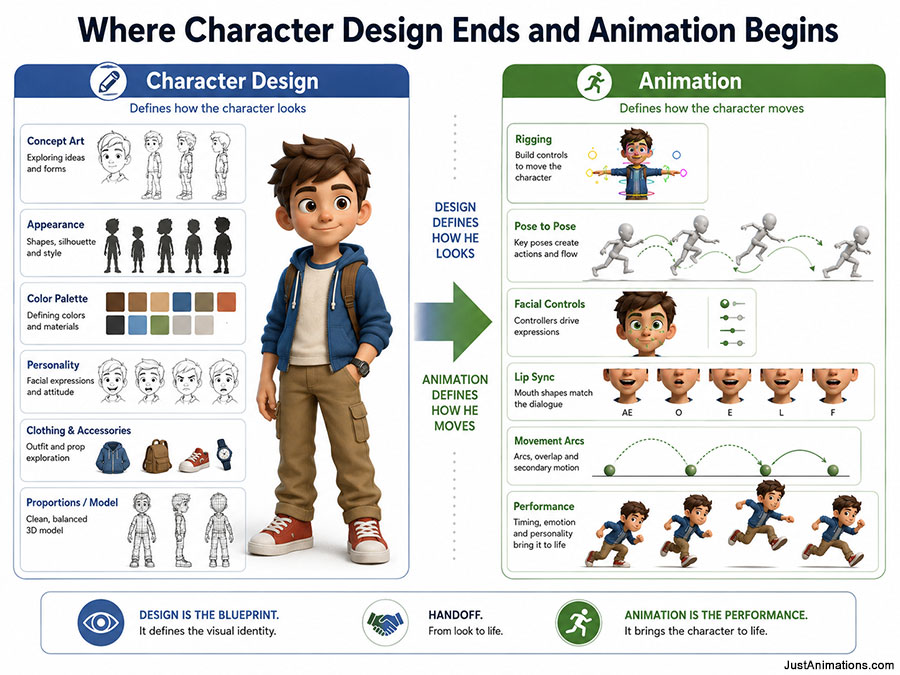
| 3D Character Design | 3D Character Animation |
|---|---|
| Defines how the character looks | Defines how the character moves |
| Includes concept art and visual development | Includes posing, timing, and performance |
| Establishes clothing, colors, and proportions | Establishes gestures, expressions, and actions |
| Produces a character model | Uses a rigged model in animated scenes |
| Can result in a static character | Produces moving video or interactive content |
A company may commission 3D character design without immediately creating a complete animated video.
For example, the character may first be used in marketing artwork, packaging, a website, an application, or a presentation.
The same model can later be rigged and animated when the company is ready to produce video content.
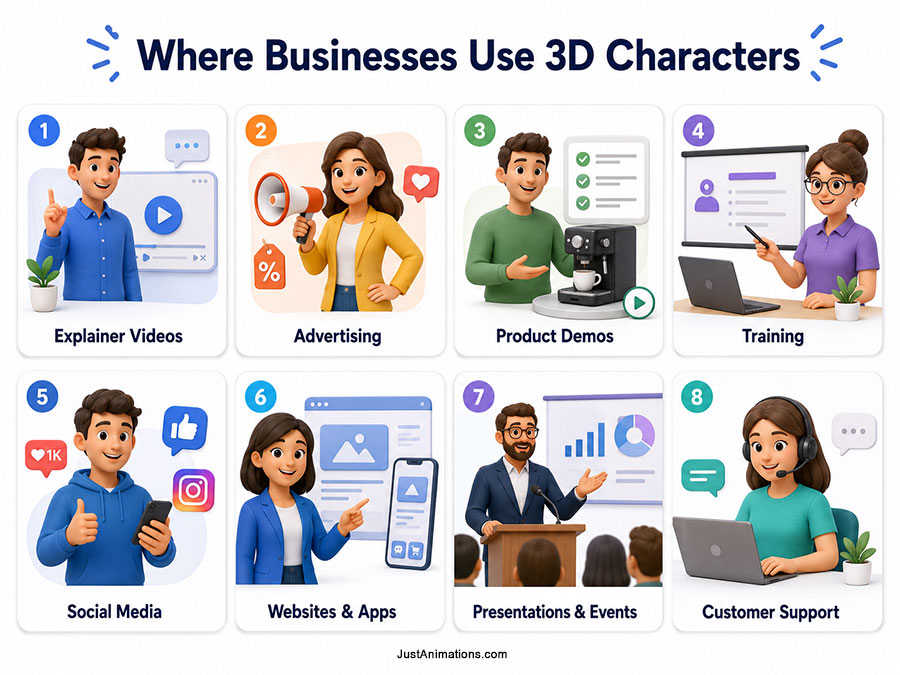
Where Businesses Use 3D Characters
Three-dimensional characters can serve practical communication, marketing, training, and entertainment purposes.
Building Recognizable Brand Mascots
A three-dimensional mascot can become a recurring representative for a company.
The character may appear in:
✓ Advertisements
✓ Explainer videos
✓ Social media posts
✓ Onboarding content
✓ Customer-support materials
✓ Event displays
✓ Websites
✓ Mobile applications
✓ Training programs
✓ Sales presentations
A reusable character can help different campaigns feel connected.
The audience may begin to associate the character with the company, product, service, or message.
Guiding Viewers Through Explainer Videos
Characters can guide viewers through a process, service, product, or customer journey.
Instead of presenting information through text and charts alone, a 3D character can demonstrate a problem, react to a situation, and show how a solution works.
Characters can also make technical information feel more approachable.
Supporting Product Marketing
A character may interact with a physical product, software platform, device, vehicle, or service.
This can make technical or abstract information easier to understand.
The character may demonstrate product features, represent a typical customer, or walk viewers through a use case.
Improving Training and Educational Content
Three-dimensional characters can demonstrate:
- Workplace procedures
- Safety requirements
- Customer-service situations
- Healthcare instructions
- Equipment use
- Employee conduct
- Emergency responses
- Technical processes
A character can repeat the same process consistently without arranging another live-action recording session.
Creating Games and Interactive Experiences
Game characters require production-ready models, efficient geometry, rigs, animation cycles, facial systems, and technical preparation for the intended game engine.
Interactive characters may respond to user actions rather than following one fixed video timeline.
They may require:
✓ Walking cycles
✓ Running cycles
✓ Idle movements
✓ Reactions
✓ Facial expressions
✓ Interchangeable actions
✓ Real-time performance optimization
Producing Film and Entertainment Content
Cinematic characters may require:
- Advanced modeling
- Realistic materials
- Detailed facial rigs
- Hair and cloth simulation
- Motion capture
- Visual effects
- Complex environments
- Extensive rendering
Entertainment productions may also need several characters performing within the same scene.
Designing Characters for AR and VR
Characters created for augmented and virtual reality must perform within an interactive environment.
They may need to:
✓ React to users
✓ Move in real time
✓ Maintain efficient file sizes
✓ Work across several viewing angles
✓ Respond to gestures
✓ Operate within a mobile application or headset
This requires different technical planning than creating a character for a standard video.
How a 3D Character Comes to Life
Full-service animation studios may manage the project from the initial idea through final delivery.
Each production stage affects the quality, schedule, and cost of the finished character.
1. Establishing the Character’s Purpose
The studio begins by learning about the company, audience, project goal, visual preferences, platforms, schedule, and budget.
Important questions include:
- What should the character communicate?
- Who will watch the animation?
- Is the character realistic or stylized?
- Does it need to speak?
- Will it appear in one video or several campaigns?
- Does the client need the model and source files?
- Will the character be used interactively?
- Will it become a permanent brand mascot?
The answers affect every later production decision.
2. Exploring the Character’s Appearance
Artists explore the character’s visual direction before beginning detailed modeling.
This may include:
- Reference boards
- Silhouette options
- Body proportions
- Facial features
- Clothing
- Accessories
- Color palettes
- Personality poses
- Expression studies
Approving the concept early reduces the risk of rebuilding a detailed model later.
This is also the stage when stakeholders should provide feedback about branding, tone, age, personality, clothing, and cultural considerations.
3. Building the Digital Model
Modelers convert the approved design into a dimensional digital form.
The model may begin with simple geometry and gradually gain more detail.
Production requirements affect the approach.
A character for a mobile game may need efficient geometry that performs smoothly in real time.
A close-up cinematic character may require detailed anatomy, skin, wrinkles, pores, fabric, and facial structure.
4. Preparing the Model for Movement
Detailed digital sculptures may contain more geometry than an animation system can efficiently manage.
Retopology reorganizes the model into a cleaner surface structure that deforms more predictably when animated.
Good topology is especially important around:
- Eyes
- Mouth
- Shoulders
- Elbows
- Knees
- Hands
- Hips
- Other bending areas
Poor topology can create serious production problems.
✗ Unnatural folds
✗ Broken facial expressions
✗ Collapsing joints
✗ Visible surface distortions
✗ Difficult rigging
✗ Unstable movement
5. Adding Surfaces, Materials, and Texture
Artists create the character’s surface appearance.
This can include:
- Skin
- Fur
- Hair
- Fabric
- Metal
- Plastic
- Scales
- Glass
- Dirt
- Wear
- Branding details
A stylized character may use simplified materials and clean colors.
A realistic character may require several layered maps controlling color, reflection, roughness, transparency, and surface depth.
6. Giving the Character a Digital Skeleton
Rigging creates the internal skeleton and control system.
The rig determines how the character bends, twists, walks, gestures, and changes expression.
A basic rig may control:
- Torso
- Head
- Arms
- Hands
- Legs
- Feet
An advanced rig may also include:
✓ Fingers
✓ Facial muscles
✓ Eyes and eyelids
✓ Jaw and lips
✓ Hair
✓ Clothing
✓ Wings
✓ Tails
✓ Mechanical parts
✓ Secondary movement controls
The complexity of the rig should match what the character needs to do.
A simple mascot does not necessarily need the same rigging system as a realistic cinematic character.
7. Testing How the Character Bends and Moves
Skinning determines how the character’s surface follows the skeleton.
Artists test poses to identify problems such as:
✗ Collapsing elbows
✗ Distorted shoulders
✗ Unnatural knees
✗ Clothing intersections
✗ Incorrect facial movement
✗ Loss of volume at joints
✗ Body parts passing through one another
The team adjusts the model, rig, or skin weights until movement appears natural.
This testing should happen before large amounts of animation are completed.
8. Creating Facial Expressions and Speech
A speaking or emotionally expressive character needs dedicated facial controls.
These may support:
✓ Smiles
✓ Frowns
✓ Blinks
✓ Brow movement
✓ Eye direction
✓ Mouth shapes
✓ Cheek movement
✓ Lip synchronization
✓ Emotional transitions
Facial complexity can significantly affect production costs.
A simple mascot may need only a few expressions, while a cinematic human character may require a detailed facial-performance system.
9. Mapping the Story Before Animation Begins
Storyboards show the main scenes, camera angles, actions, and sequence.
An animatic places the storyboard frames on a timeline with temporary audio.
This allows the studio and client to evaluate:
✓ Video length
✓ Story flow
✓ Scene order
✓ Camera movement
✓ Dialogue timing
✓ Character actions
✓ Transitions
✓ Overall pacing
Approving the animatic before detailed production reduces expensive revisions.
Starting final animation without an approved animatic can create avoidable problems.
✗ Scenes may run too long
✗ Dialogue may not fit
✗ Camera angles may need to be rebuilt
✗ Character actions may change late
✗ Rendering time may be wasted
10. Creating the Character’s Performance
Animators create the performance using:
- Poses
- Keyframes
- Motion capture
- Procedural systems
- Physics simulations
- A combination of techniques
Keyframe animation gives artists direct control over timing, exaggeration, emotion, and style.
Motion capture can provide a realistic performance foundation, but the captured movement may still require cleanup, adjustment, retargeting, and artistic refinement.
11. Lighting and Rendering the Final Scenes
Lighting establishes mood, depth, atmosphere, and visual focus.
Rendering converts the 3D scenes into finished image frames.
Rendering time depends on:
- Resolution
- Character detail
- Lighting
- Hair and fur
- Reflections
- Motion blur
- Visual effects
- Number of frames
- Rendering system
- Available computing power
A short, highly realistic sequence may require more computing time than a longer stylized animation.
12. Combining the Final Picture and Sound
The final stage combines:
✓ Rendered characters
✓ Environments
✓ Visual effects
✓ Typography
✓ Color adjustments
✓ Voiceover
✓ Music
✓ Sound effects
✓ Editing
The studio then exports the required formats.
Deliverables may include:
- 4K or 1080p video
- Vertical social media video
- Square video
- Transparent-background animation
- Character turntable
- Still images
- Short advertising edits
- Animation loops
- Game-ready character files
- Editable source files
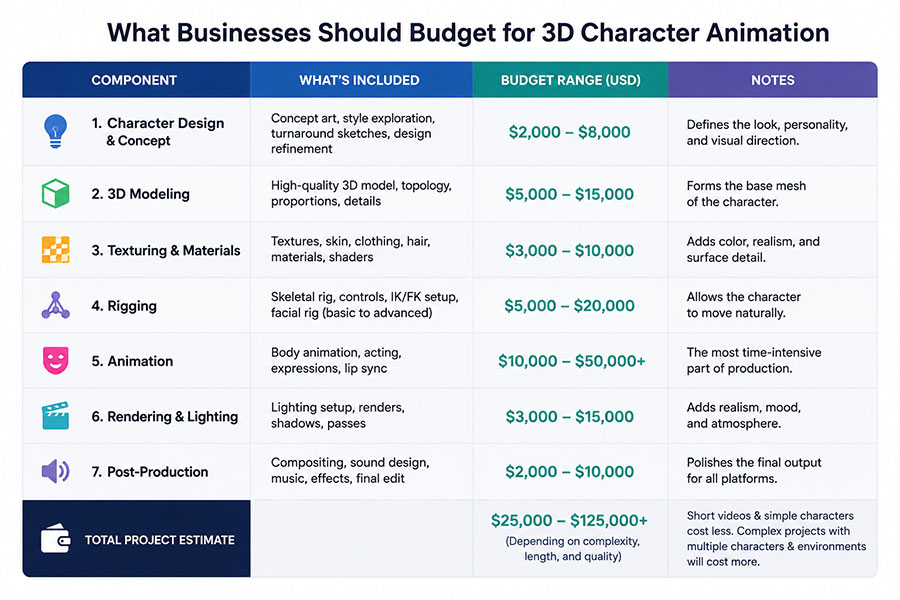
What Businesses Should Budget for 3D Character Animation
The cost depends on the character’s design, modeling detail, rigging requirements, number of scenes, animation length, visual quality, and number of final deliverables.
The following are general planning estimates in USD. They are not fixed studio rates.
| 3D Character Project | Approximate Budget Range |
|---|---|
| Basic 3D character concept and model | $5,000–$15,000 |
| Detailed production-ready character model | $10,000–$30,000 |
| Character model with professional rig | $15,000–$40,000 |
| Short 10–20 second character animation | $15,000–$50,000 |
| Custom 30–60 second character video | $25,000–$75,000 |
| Premium 60–90 second branded animation | $40,000–$125,000+ |
| Multi-character or cinematic production | $75,000–$250,000+ |
| Game, series, or long-term character program | $100,000–$500,000+ |
A studio should provide a custom quote after reviewing the character design and production requirements.
Two animations of the same length may have substantially different costs.
A simple stylized mascot speaking against a plain background will usually cost less than a realistic human character moving through several detailed environments.
Why 3D Character Budgets Rise
Several creative and technical decisions can increase the cost of production.
Greater Character Detail
A simple mascot with limited facial features costs less than a photorealistic person with realistic skin, hair, clothing, muscles, and subtle expressions.
Every additional detail requires more design, modeling, testing, rendering, and revision time.
Additional Original Characters
Each original character may require its own:
✓ Concept development
✓ Design approval
✓ Model
✓ Textures
✓ Rig
✓ Facial system
✓ Movement testing
Background characters may be simplified or developed from reusable systems.
Dialogue and Facial Performance
Dialogue and detailed emotional acting require more facial controls, mouth shapes, lip synchronization, animation, and approval time.
A character that only walks and gestures is usually less complex than one delivering a complete spoken performance.
Hair, Fur, and Clothing
Hair, fur, capes, dresses, loose fabric, and layered clothing may require specialized simulation.
These elements can increase both production and rendering time.
Longer or More Complex Animation
Longer videos contain more poses, transitions, shots, and rendered frames.
However, duration is not the only factor.
A detailed 15-second cinematic may cost more than a simple 60-second character explainer.
Several Detailed Environments
Every location may require:
- Modeling
- Textures
- Lighting
- Props
- Scene setup
- Camera planning
- Rendering
Using one controlled environment is usually more economical than creating several original worlds.
Photorealistic Rendering
Photorealistic rendering generally requires more production and computing resources than a clean, stylized appearance.
Realism may require advanced:
- Materials
- Skin shading
- Hair systems
- Reflections
- Shadows
- Lighting
- Simulations
- Compositing
Late Revision Requests
Revisions become more expensive after modeling, rigging, or animation has been completed.
Changing the character’s shirt color during concept development is relatively simple.
Changing its entire body shape after rigging and animation have begun may require several production stages to be repeated.
Late changes can result in:
✗ Remodeling
✗ New textures
✗ Rig rebuilding
✗ Skinning adjustments
✗ Reanimated scenes
✗ Additional rendering
✗ Higher project costs
Accelerated Production Schedules
A shorter schedule may require:
✓ A larger production team
✓ Parallel workflows
✓ Faster stakeholder approvals
✓ Additional rendering resources
✓ Extended production hours
Rush production may be possible, but it should be discussed before the project begins.
How Long Does a 3D Character Project Usually Take?
A single custom character and short animation may require approximately six to twelve weeks.
A more complex production can take several months.
| Production Stage | Typical Timeline |
|---|---|
| Discovery and concept development | 1–2 weeks |
| Character design approval | 1–3 weeks |
| 3D modeling and texturing | 2–4 weeks |
| Rigging and testing | 1–3 weeks |
| Storyboards and animatic | 1–2 weeks |
| Character animation | 2–6 weeks |
| Lighting and rendering | 1–3 weeks |
| Sound, revisions, and delivery | 1–2 weeks |
Some stages can overlap.
The schedule may increase when several client stakeholders need to approve each production milestone.
Businesses can help keep production on schedule by:
✓ Consolidating stakeholder feedback
✓ Approving milestones promptly
✓ Defining intended uses early
✓ Supplying brand assets before production
✓ Assigning one primary decision-maker
Businesses should avoid:
✗ Requesting major changes after approval
✗ Sending conflicting feedback from several departments
✗ Delaying approvals for extended periods
✗ Changing the script during final animation
✗ Adding new deliverables near completion
Top Animation Studios Specializing in 3D Character Design
The best animation studio depends on whether the project is a business explainer, branded mascot, advertisement, cinematic trailer, game, interactive experience, or entertainment production.
This article is published by Just Animations.
Our company is listed first based on its accessibility to business clients and its ability to manage custom projects from character concept through final delivery.
1. Just Animations
Best for custom 3D characters created for businesses and organizations
Just Animations develops characters for branded videos, explainers, product demonstrations, training, advertising, social media, and digital campaigns.
Projects may include:
✓ Character concept art
✓ 3D modeling
✓ Texturing
✓ Rigging
✓ Facial controls
✓ Character animation
✓ Voiceover
✓ Sound design
✓ Multiple video formats
The production process is structured around the audience, message, brand, and intended use of the character.
As the animation studio of Thought Media, Just Animations also understands how the finished character can support websites, digital marketing, social media, presentations, advertising, and broader communication campaigns.
Best fit: Businesses, companies, enterprises, government agencies, NGOs, and public-sector organizations seeking a managed custom-production process.
2. Blur Studio
Best for cinematic 3D characters and premium entertainment production
Blur Studio is a Los Angeles production company whose work spans game cinematics, commercials, feature films, visual effects, and original entertainment.
Blur is particularly relevant for projects requiring:
- Realistic or highly detailed characters
- Cinematic action
- Fantasy and science-fiction environments
- Game trailers
- Entertainment properties
- High-end visual effects
Its work is generally suited to major entertainment, gaming, and cinematic productions.
Best fit: Gaming, entertainment, media, and premium cinematic projects with substantial budgets.
3. BUCK
Best for design-led 3D characters and branded animation
BUCK is a global creative company working across design, animation, branding, advertising, and entertainment.
Its projects may include:
- Character concept development
- Modeling
- Rigging
- 3D animation
- 2D animation
- Lighting
- Editorial
- Mixed-media production
BUCK is well suited to:
✓ Stylized characters
✓ Branded films
✓ Advertising
✓ Character systems
✓ Visual identity campaigns
✓ Mixed 2D and 3D production
Best fit: Brands seeking distinctive design and character animation rather than purely realistic CGI.
4. Nexus Studios
Best for character animation combined with storytelling and technology
Nexus Studios works across animated film, branded content, entertainment, character development, and interactive experiences.
Its capabilities include:
✓ Character and world building
✓ Creative strategy
✓ Story development
✓ 2D animation
✓ 3D animation
✓ Visual effects
✓ Interactive production
✓ Complete project management
Nexus is particularly relevant when an animated character needs to move beyond a standard video and become part of an interactive or immersive experience.
Best fit: Branded characters, animated campaigns, interactive experiences, AR, VR, and entertainment projects.
5. Tendril
Best for design-driven 3D character animation and visual experimentation
Tendril is a design-driven animation, visual-effects, and digital-innovation studio creating work for brands, technology companies, and entertainment clients.
Its capabilities include:
- Character concept development
- Modeling
- Rigging
- 3D animation
- Lighting
- Rendering
- Compositing
- Visual effects
Tendril’s work often combines polished design with experimental visual direction.
Best fit: Technology brands, product launches, advertising, stylized characters, and visually experimental 3D production.
Finding the Right Studio for Your Character
Do not select an animation company solely because its demo reel looks impressive.
Review how closely its experience aligns with your actual project, audience, production requirements, and intended platforms.
Examine the Character Design Work
Look for:
✓ Strong silhouettes
✓ Clear facial expressions
✓ Appropriate proportions
✓ Detailed clothing and materials
✓ Visual originality
✓ Brand consistency
✓ Several different character styles
Watch for:
✗ Repetitive character designs
✗ Characters that look nearly identical
✗ Weak expressions
✗ Inconsistent proportions
✗ Generic template-like artwork
✗ Portfolios unrelated to your project
The character should remain recognizable from different angles and in different poses.
A strong portfolio should also show that the studio can adapt its design style rather than producing the same type of character for every client.
Watch How the Characters Move
A well-designed model may still feel lifeless when poorly animated.
Look for:
✓ Convincing weight
✓ Natural balance
✓ Deliberate timing
✓ Clear gestures
✓ Believable facial acting
✓ Controlled eye movement
✓ Accurate lip synchronization
✓ Emotional performance
Avoid animation that shows:
✗ Floating feet
✗ Stiff body movement
✗ Robotic gestures
✗ Empty facial expressions
✗ Incorrect physical weight
✗ Distracting lip synchronization
Characters should appear to think, react, and move with intention.
Understand What the Studio Actually Provides
Confirm whether the quote includes:
✓ Concept development
✓ Character design
✓ Modeling
✓ Texturing
✓ Rigging
✓ Facial setup
✓ Storyboards
✓ Animation
✓ Rendering
✓ Sound
✓ Revisions
✓ Final files
Some studios provide complete production.
Others may expect the client to supply scripts, character designs, voiceovers, models, or other assets.
Explain Every Planned Use Before Production
A character created only for video may not automatically be suitable for:
✗ A game
✗ A mobile application
✗ An augmented-reality experience
✗ A virtual-reality environment
✗ A real-time engine
✗ An interactive website
✗ Live virtual production
Explain every planned use before modeling begins.
The studio can then create the correct geometry, textures, rig, and file structure.
Clarify Ownership Before Signing
Ask who will own:
- Character design
- 3D model
- Rig
- Textures
- Animation files
- Final videos
- Source files
- Future reuse rights
Ownership and licensing terms should appear in the contract.
Some studios provide only the finished video unless source files are specifically included.
Before signing, confirm:
✓ Commercial usage rights
✓ Character ownership
✓ Reuse rights
✓ Source-file access
✓ Music licensing
✓ Voiceover licensing
✓ Modification rights
Do not assume the following are automatically included:
✗ Editable project files
✗ Exclusive character ownership
✗ Unlimited future usage
✗ Rights to resell the character
✗ Game or application rights
✗ Rights to modify licensed assets
Match the Technical Files to the Final Platform
Confirm the required:
- File formats
- Polygon count
- Texture resolution
- Character scale
- Rig type
- Rendering engine
- Frame rate
- Video resolution
- Transparent backgrounds
- Game-engine compatibility
Technical requirements should be identified before the model is built.
15 Questions That Protect Your Budget and Character Rights
Ask the following questions before hiring a 3D character animation studio:
- Is the character completely custom?
- Who will create the concept art?
- How many design concepts are included?
- How many revision rounds are included?
- Is the character being designed for video, gaming, or both?
- Does the quote include modeling and textures?
- Is body rigging included?
- Is facial rigging included?
- Can the character speak?
- Are hair and clothing simulations required?
- Who owns the model and character rights?
- Are editable source files included?
- Can the character be reused in future videos?
- What formats will be delivered?
- What could increase the final cost?
Clear answers help prevent:
✗ Scope changes
✗ Ownership disputes
✗ Technical incompatibility
✗ Unexpected charges
✗ Missed deadlines
✗ Incomplete deliverables
Realistic or Stylized? Choosing the Right Direction
A realistic 3D character is not automatically better than a stylized 3D character.
The best direction depends on the audience, message, brand, and intended use.
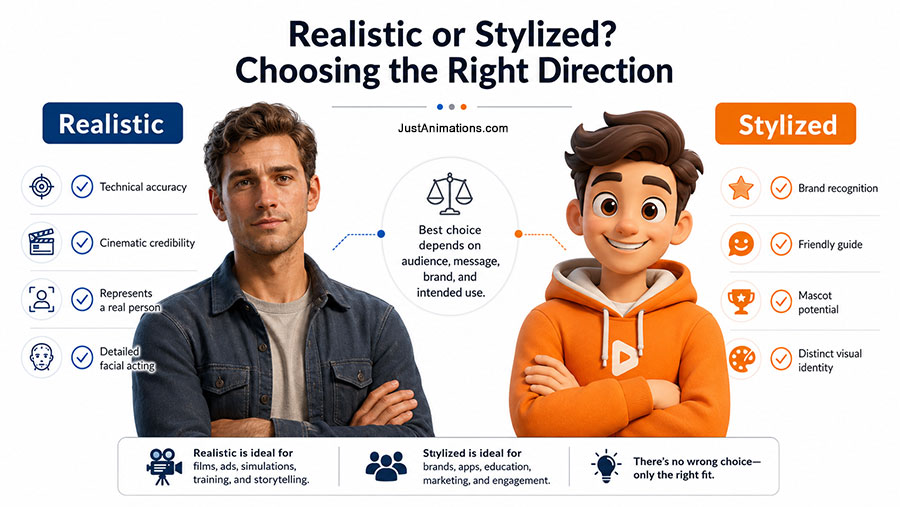
Choose a Realistic Character When:
✓ Technical accuracy matters
✓ The subject involves healthcare or science
✓ The production needs cinematic credibility
✓ The character represents a real person
✓ Close-up facial acting is required
✓ The audience expects a realistic environment
Choose a Stylized Character When:
✓ Brand recognition is important
✓ The audience needs a friendly guide
✓ The project targets families or broad audiences
✓ The character will become a mascot
✓ A distinctive identity matters more than realism
✓ The animation should feel approachable or entertaining
Stylized characters can still deliver sophisticated animation.
They may also remain visually relevant longer because they are not competing directly with real human appearance.
Turning One Character Into a Long-Term Brand Asset
A professionally designed and rigged character can become a reusable brand asset.
It may later appear in:
✓ New videos
✓ Social media clips
✓ Product demonstrations
✓ Presentations
✓ Training modules
✓ Website graphics
✓ Advertisements
✓ Interactive tools
✓ Still images
✓ Event content
✓ Sales materials
✓ Mobile applications
Reusing a finished character can reduce the cost of future production because the design, model, textures, and rig already exist.
New scenes will still require animation, lighting, rendering, sound, and editing.
Businesses planning long-term reuse should request:
✓ A flexible professional rig
✓ High-resolution textures
✓ Multiple expressions
✓ Standard poses
✓ Character turnarounds
✓ Source-file ownership
✓ Several delivery formats
When Motion Capture Makes Sense
Motion capture is one option for recording realistic body movement.
It is not required for every 3D character project.
Keyframe Animation May Be Better When:
✓ The character is highly stylized
✓ Movement needs exaggeration
✓ The character has unusual proportions
✓ Precise artistic control is required
✓ The production involves fantasy actions
✓ The performance needs a cartoon-like style
Motion Capture May Be Useful When:
✓ Realistic human motion is important
✓ The character performs complicated physical actions
✓ A long sequence contains substantial movement
✓ A performer’s timing needs to be preserved
✓ The production includes dance, sports, or fight choreography
Motion capture should not be treated as a completely automatic process.
Captured movement may still contain:
✗ Tracking errors
✗ Unwanted shaking
✗ Incorrect hand movement
✗ Foot sliding
✗ Body intersections
✗ Unnatural retargeting
Many professional productions combine motion capture with manual animation.
The recorded performance provides a foundation, while animators correct errors, improve poses, adjust timing, and strengthen the character’s performance.
Where AI Fits in 3D Character Production
AI-assisted tools can support:
✓ Concept exploration
✓ Reference generation
✓ Motion capture
✓ Facial tracking
✓ Animation retargeting
✓ Lip synchronization
✓ Background generation
✓ Repetitive production tasks
However, a production-ready character still requires careful decisions about:
- Topology
- Rigging
- Materials
- Deformation
- Movement
- Brand consistency
- Intellectual-property rights
- Final production quality
Automatically generated models may contain:
✗ Broken geometry
✗ Inconsistent topology
✗ Unusable textures
✗ Difficult rigging structures
✗ Unclear ownership rights
✗ Visual inconsistencies
✗ Limited editability
Businesses should ask studios:
- Which AI tools will be used?
- Were training-data and licensing concerns reviewed?
- Who owns the generated assets?
- Will artists correct and refine the output?
- Can the finished files be reused commercially?
- Are source files included?
AI can accelerate parts of production, but it does not replace professional creative direction and technical quality control.
When the Investment Makes Business Sense
3D character animation can be worthwhile when the character will:
✓ Support an important campaign
✓ Explain a complex subject
✓ Become a long-term mascot
✓ Appear across several platforms
✓ Represent a product or service
✓ Improve training content
✓ Create a memorable brand identity
✓ Support an interactive experience
The strongest value often comes from reuse.
A character developed for one explainer video may later support:
- Advertising
- Employee onboarding
- Social media
- Presentations
- Training
- Events
- Product launches
- Interactive experiences
A 3D character may be a poor investment when:
✗ The project has no defined communication goal
✗ The character will be used only once without strategic value
✗ The budget cannot support custom production
✗ Stakeholders cannot agree on the character direction
✗ A simple motion graphic would communicate the message better
✗ The organization has not clarified ownership or future use
A well-designed character is not simply a one-time visual.
It can become part of the organization’s long-term identity and communication strategy.
Bringing the Right Character to Life
3D character animation combines artistic design with technical production.
The process may include concept art, modeling, texturing, rigging, facial controls, animation, lighting, rendering, compositing, and sound.
Costs vary substantially according to:
- Visual style
- Character detail
- Animation length
- Number of characters
- Environments
- Facial complexity
- Rendering quality
- Final deliverables
Before hiring a studio, define:
✓ The intended audience
✓ The project objective
✓ The available budget
✓ The production schedule
✓ The required platforms
✓ Ownership requirements
✓ Future uses of the character
The right 3D character animation studio should be able to:
✓ Explain its production process
✓ Show relevant character work
✓ Provide clear milestone approvals
✓ Define what is included in the price
✓ Confirm ownership and usage rights
✓ Deliver technically appropriate files
✓ Create a character that supports the message
Questions Businesses Ask About 3D Character Animation
What is 3D character animation?
3D character animation is the process of creating a dimensional digital character and making it move using a rig, keyframes, motion capture, or other animation techniques. The process may include modeling, texturing, rigging, facial animation, lighting, rendering, and sound.
How much does 3D character animation cost?
A basic 3D character model may cost approximately $5,000–$15,000. A professionally modeled and rigged character may cost $15,000–$40,000, while a complete custom character-animation video may range from $25,000 to more than $125,000.
What is included in 3D character design?
3D character design may include creative planning, reference research, concept art, silhouette development, body proportions, facial features, clothing, colors, materials, 3D modeling, textures, and presentation poses.
How long does it take to create a 3D character animation?
A custom character and short animated video may take approximately six to twelve weeks. Complex cinematic characters, several environments, multiple characters, or detailed facial animation may require several months.
How do you choose a 3D character animation studio?
Review the studio’s character design, modeling, movement, facial performance, production process, pricing, technical capabilities, ownership terms, and experience with projects similar to yours.
r to yours.