Las Vegas is one of the most competitive trade show cities in the world. For exhibitors, that is both the opportunity and the problem. The audience is already there. The buyers, partners, investors, media teams, and decision-makers are walking the show floor. But they are also surrounded by noise, lights, screens, booths, demos, sales teams, giveaways, and dozens of companies trying to earn the same few seconds of attention.
That is why Las Vegas 3D animation for trade shows and exhibits has become such a powerful marketing tool. A strong 3D animation can stop people in the aisle, explain a product quickly, support a sales conversation, and make a booth feel more premium before a visitor ever speaks to a representative.
For companies exhibiting in Las Vegas, especially at large conventions, product launches, manufacturing shows, technology expos, medical events, construction shows, automotive events, and enterprise conferences, animation is not just decorative. It can become one of the most useful assets in the entire exhibit strategy.
Why 3D Animation Works So Well At Las Vegas Trade Shows
Trade shows are fast-moving environments. Visitors rarely stop because a company has a brochure. They stop because something catches their eye, explains value quickly, or feels relevant enough to explore.
3D animation works well because it can show what traditional booth materials cannot.
A machine can be shown operating from the inside. A medical device can be explained without relying only on physical samples. A building system can be visualized before construction. A software platform can be represented through animated workflows, dashboards, data movement, and user outcomes. A product that is too large, too expensive, too complex, or too difficult to transport can still become the centerpiece of the booth.
This is especially valuable in Las Vegas, where many trade show attendees are moving between large exhibit halls, meetings, receptions, and scheduled demos. Animation helps simplify the message so the booth team does not need to explain every detail from scratch.
The Main Advantage: Visual Clarity
One of the biggest reasons brands use 3D animation for trade shows is clarity. Many companies sell products or services that are difficult to explain in a few seconds.
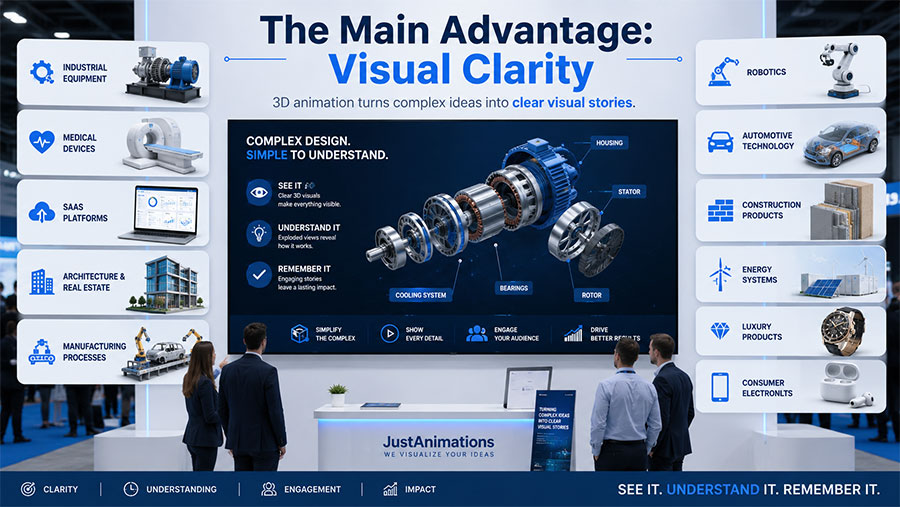
That includes:
- Industrial equipment
- Medical devices
- SaaS platforms
- Engineering systems
- Architecture and real estate developments
- Manufacturing processes
- Robotics
- Automotive technology
- Aerospace components
- Construction products
- Energy systems
- Luxury products
- Consumer electronics
A well-produced 3D animation can turn a complicated idea into a simple visual story. Instead of asking booth visitors to imagine how something works, the animation shows them.
This is useful for both technical and non-technical audiences. Engineers may want detail. Executives may want business value. Buyers may want outcomes. Investors may want scale. A strong animation can support all of those conversations by giving everyone a shared visual reference.
How 3D Animation Helps Booths Stand Out
Las Vegas exhibit halls are visually intense. Large LED screens, custom booth builds, branded lighting, touchscreen displays, and product demos are everywhere. A flat static graphic often struggles to compete.
3D animation gives a booth motion, depth, and energy.
It can be used on:
| Trade Show Asset | How 3D Animation Helps |
|---|---|
| Large LED booth screens | Attracts attention from a distance |
| Product demo stations | Explains key features visually |
| Touchscreen displays | Lets visitors explore product benefits |
| Sales presentations | Supports deeper booth conversations |
| Private meeting rooms | Helps executives understand value quickly |
| Social media clips | Extends the event beyond the show floor |
| Post-show email follow-up | Reinforces the product story after the event |
The best trade show animation is not just “cool looking.” It is designed around booth behavior. It needs to work when there is noise, foot traffic, limited time, and no guarantee that the visitor will hear every word of a sales pitch.
Types Of 3D Animation Used For Trade Shows
Different companies need different types of animation depending on what they are exhibiting. For Las Vegas trade shows and exhibits, the most common formats include product animation, process animation, booth loop animation, interactive animation, and launch videos.
Product Animation
Product animation shows a product from multiple angles, highlights features, demonstrates movement, and explains internal components. This is especially useful when the physical product is too large, too small, too delicate, or too complex to fully demonstrate on-site.
Process Animation
Process animation explains how something works. This might include a manufacturing workflow, logistics system, medical procedure, construction sequence, environmental technology, or energy process.
Booth Loop Animation
A booth loop is usually a shorter animated video designed to run continuously on a screen. It needs to be visually strong even without audio. The goal is to attract attention, create curiosity, and encourage people to stop.
Launch Animation
A launch animation is often used when a company is introducing a new product, concept, or service at a major event. These animations are usually more cinematic and polished because they support a high-stakes reveal.
Interactive 3D Animation
Interactive 3D assets allow visitors to rotate, explore, or choose different product views. These can be useful for touchscreen displays, sales demos, and custom exhibit experiences.
Why Las Vegas Exhibitors Should Plan Animation Early
A common mistake is treating animation as a last-minute booth add-on. The better approach is to plan animation alongside the exhibit strategy.
The animation should align with:
- Booth screen sizes
- Display locations
- Visitor flow
- Sales team talking points
- Product launch timing
- Brand visuals
- Event goals
- Post-show follow-up campaigns
For example, a widescreen animation designed for a large LED wall may need a different layout than a vertical animation used on a standing display. A booth loop may need strong visuals and minimal text, while a private meeting video can include more detail and a stronger narrative.
Planning early also allows the animation studio to build versions for different uses. One core 3D animation project can often be repurposed into a booth video, short social clips, sales presentation visuals, email follow-up content, website media, and post-event advertising assets.
What Makes A Strong Trade Show Animation?
A strong trade show animation Las Vegas is not just about rendering quality. It needs strategy.
The animation should answer a simple question quickly: why should this visitor care?
That means the structure matters. A good trade show animation usually includes:
- A strong opening visual
- A clear product or service problem
- A simple explanation of the solution
- A visual breakdown of key features
- A business outcome or benefit
- A polished closing brand moment
The mistake many companies make is trying to explain everything. At a trade show, the goal is not to deliver a full technical manual. The goal is to create enough understanding and interest for the visitor to start a conversation.
Industries That Benefit Most From Las Vegas 3D Animation
Las Vegas hosts a wide range of conventions and business events, which makes 3D animation useful across many industries.
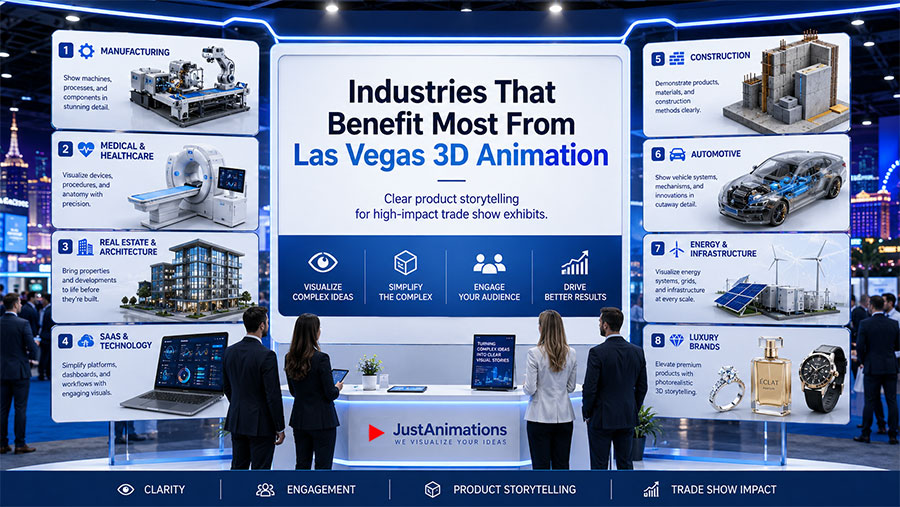
Some of the strongest fits include:
| Industry | Best Animation Use Case |
|---|---|
| Manufacturing | Machinery demos, internal mechanisms, factory workflows |
| Medical and healthcare | Device explainers, procedure visuals, technology demos |
| Real estate and architecture | Property walkthroughs, development previews, construction phasing |
| Automotive | Product launches, vehicle systems, aftermarket parts |
| Technology and SaaS | Platform workflows, AI systems, data visualization |
| Construction | Equipment demos, safety training, site planning |
| Energy and infrastructure | Grid systems, sustainability concepts, technical processes |
| Luxury brands | Premium product storytelling and cinematic brand visuals |
For enterprise exhibitors, the value is often even higher. When a company is investing heavily in booth space, travel, staff, sponsorships, and event production, a strong animation can help maximize that investment by improving how clearly the brand communicates.
Budget Considerations For Trade Show Animation
The cost of 3D animation for trade shows depends on complexity. A short looping animation with simple product movement may cost far less than a cinematic product launch video with detailed modeling, textures, environments, camera movement, and multiple deliverables.
Common budget factors include:
| Budget Factor | Why It Affects Cost |
|---|---|
| 3D modeling | Complex products require more detailed digital builds |
| Animation length | Longer videos require more production time |
| Visual realism | High-end rendering increases production demands |
| Number of versions | Booth, social, web, and presentation cuts add scope |
| Technical accuracy | Engineering or medical accuracy may require extra review |
| Deadline | Rush timelines can increase production pressure |
For serious exhibitors, the question should not only be “How much does the animation cost?” The better question is “How much value can the animation create across the event, sales process, website, and follow-up campaign?”
A strong 3D animation can continue working long after the trade show ends.
Why Work With A Professional 3D Animation Studio?
Trade show animation studio Las Vegas businesses trust has to do more than look good. It has to support a business outcome.
A professional animation studio understands how to combine visual storytelling, product clarity, brand presentation, technical accuracy, and marketing strategy. This matters because trade show visitors do not have unlimited patience. If the animation is confusing, too slow, too generic, or too visually cluttered, it can lose the audience quickly.
Just Animations works with businesses that need polished animated content for product marketing, enterprise communications, trade shows, brand videos, and sales presentations. For Las Vegas trade shows and exhibits, the goal is to create animation that feels premium, communicates clearly, and gives booth teams stronger visual tools to support conversations.
How To Use Animation Before, During, And After The Event
One of the biggest advantages of 3D animation Las Vegas trade show vendors leverage is that it can be used across the full event cycle.
Before the event, short animated teasers can help promote the booth, announce a product launch, or invite prospects to schedule a meeting.
During the event, the animation can run on booth screens, support live demos, help sales teams explain products, and create a more premium exhibit experience.
After the event, the same animation can be used in follow-up emails, landing pages, sales decks, social posts, paid ads, and investor presentations.
This is where animation becomes more than a booth asset. It becomes part of the company’s broader sales and marketing system.
Final Thoughts
Las Vegas trade shows are built around attention, timing, and presentation. Exhibitors only have a short window to make people stop, understand, and remember them.
That is why Las Vegas 3D animation for trade shows and exhibits can be so valuable. It helps companies simplify complex products, create stronger booth visuals, support sales conversations, and extend the impact of the event long after the show is over.
For brands investing in a serious Las Vegas trade show presence, 3D animation is no longer just an optional creative extra. It is a practical tool for standing out, explaining value, and making the exhibit experience more effective.
FAQ
What Is Las Vegas 3D Animation For Trade Shows?
Las Vegas 3D animation for trade shows refers to custom animated video or interactive 3D content created for companies exhibiting at conventions, expos, and business events in Las Vegas. It is often used on booth screens, product demo displays, launch presentations, and follow-up marketing materials.
Why Should Exhibitors Use 3D Animation At Trade Shows?
Exhibitors use 3D animation because it helps explain products quickly, attract attention, and make complex ideas easier to understand. It is especially useful when a product is technical, large, internal, digital, or difficult to demonstrate physically.
What Types Of Companies Need Trade Show Animation?
Manufacturing companies, medical device brands, SaaS companies, automotive businesses, construction firms, architecture firms, real estate developers, energy companies, and luxury brands can all benefit from trade show animation.
How Long Should A Trade Show Animation Be?
A booth loop is often short, usually around 15 to 60 seconds, because it needs to capture attention quickly. More detailed product videos or private meeting presentations may be 60 to 120 seconds or longer depending on the complexity of the product or service.
Can A 3D Trade Show Animation Be Reused After The Event?
Yes. A 3D trade show animation can often be reused for websites, sales decks, social media, email follow-up, investor presentations, advertising, and future events. This makes it a valuable long-term marketing asset beyond the original trade show.