Logo animation is an important aspect of memorability of a brand. A logo is often one of the first visual elements people associate with a business.
However, most traditional logos are designed to remain completely still.
Logo animation adds controlled movement, timing, sound, and visual storytelling to an existing brand identity. A symbol may assemble from several pieces, a wordmark may reveal itself one letter at a time, or a familiar logo element may move in a way that reflects the company’s personality.
When it is designed strategically, an animated logo can attract attention, strengthen brand recognition, and create a more memorable introduction or conclusion for digital content.
The animation should not replace the static logo.
It should extend the identity into video, websites, presentations, social media, advertisements, apps, and other digital environments where movement can improve the experience.
Quick Answer: Does Logo Animation Improve Brand Recall?
Logo animation can improve brand recall by giving viewers more visual information to remember than a static image alone.
Movement creates a sequence.
The viewer does not simply see the final logo. They see how the logo appears, changes, connects, or resolves. That short visual story can make the brand more distinctive and easier to recognize during future interactions.
Research on animated brand logos has found that motion can influence attention, brand personality, and consumer response. However, the animation must align with the identity and message of the brand. Motion that feels inconsistent with the business may weaken rather than strengthen the intended impression.
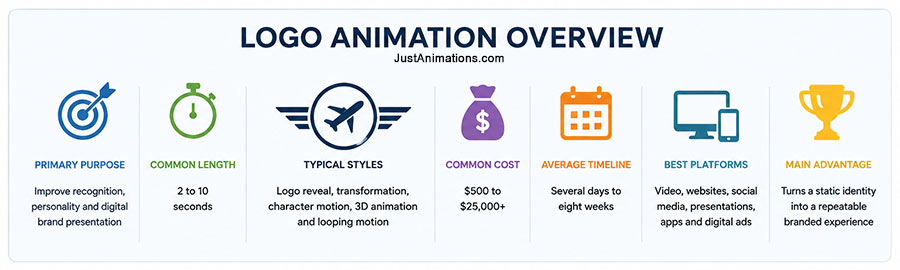
Logo Animation Overview
| Project Element | Typical Requirement |
|---|---|
| Primary purpose | Improve recognition, personality and digital brand presentation |
| Common length | 2 to 10 seconds |
| Typical styles | Logo reveal, transformation, character motion, 3D animation and looping motion |
| Common cost | $500 to $25,000+ |
| Average timeline | Several days to eight weeks |
| Best platforms | Video, websites, social media, presentations, apps and digital advertising |
| Main advantage | Turns a static identity into a repeatable branded experience |
What Is Logo Animation?
Logo animation is the process of adding movement to a company’s logo, wordmark, symbol, mascot, or other visual identity element.
The animation may be extremely simple.
For example, a line may draw itself around the logo before the full brand name appears.
A more complex animation might involve 3D modelling, particles, environments, characters, lighting, sound effects, or a cinematic camera movement.
Common logo animation elements include:
- Shape movement
- Letter animation
- Logo assembly
- Color transitions
- Object transformations
- Masking and reveals
- Character movement
- Lighting effects
- Sound effects
- Musical stings
- Tagline animation
The objective is not simply to make the logo move.
The movement should communicate something meaningful about the organization.
Why Can Animated Logos Be More Memorable?
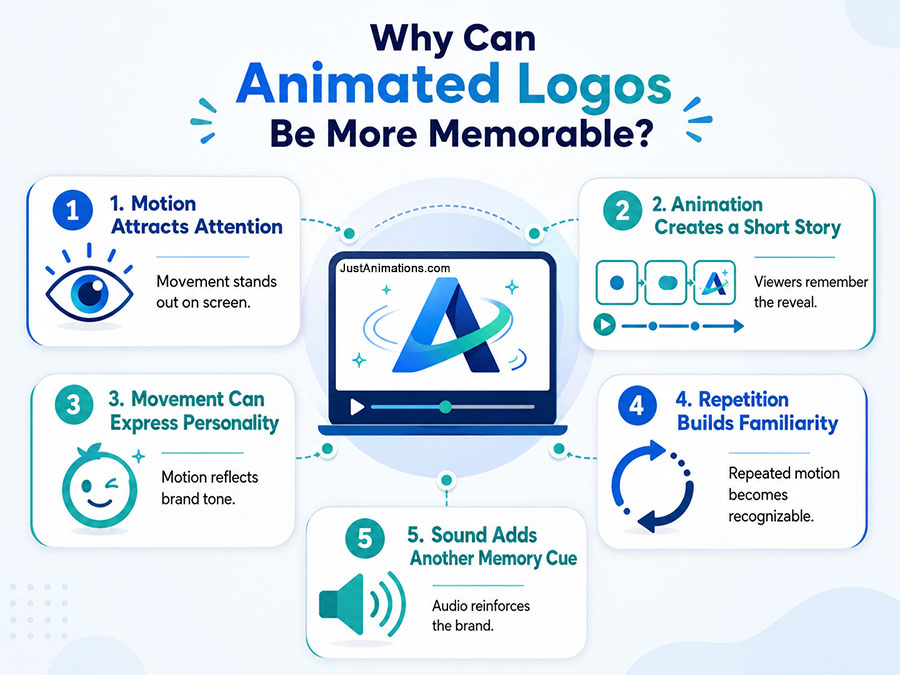
Motion Attracts Attention
A moving object can stand out within an otherwise static screen.
This is particularly useful in social feeds, presentation slides, video introductions, digital advertisements, and website interfaces where several visual elements may compete for attention.
A 2023 study examining consumer responses to different animated logo styles found that agent-like animation generated greater attention, stronger perceptions of animacy, and more positive brand attitudes than mechanical object animation in the study conditions.
This does not mean every logo should behave like a character.
It demonstrates that the type of movement can affect how people interpret and respond to the brand.
Animation Creates a Short Story
A static logo presents the completed identity immediately.
An animated logo creates a beginning, middle, and end.
The viewer may watch separate pieces connect, an icon transform, or a product-related shape become the final logo. Even if the animation lasts only three seconds, the sequence provides an additional memory cue.
The viewer may remember:
- The final logo
- The direction of movement
- The transformation
- The sound effect
- The timing
- The emotional tone
These elements work together to create a more complete brand experience.
Movement Can Express Personality
A logo can move quickly, slowly, smoothly, playfully, precisely, dramatically, or mechanically.
Each choice communicates a different personality.
A children’s brand may use energetic, elastic motion.
A financial company may use controlled and dependable movement.
A technology company may use clean transformations, connected nodes, or precise geometric motion.
A luxury brand may use slower movement, restrained effects, and elegant transitions.
Research into animated brand identities suggests that motion works best when the animation style supports the personality the brand is already trying to communicate.
Repetition Builds Familiarity
A logo animation can appear at the beginning or end of every branded video.
When the same movement, timing, and sound are repeated consistently, they can become recognizable brand assets.
The audience may begin recognizing the brand before the full logo is displayed.
This is similar to how a familiar sound, color combination, or visual transition can become associated with a particular company.
Sound Adds Another Memory Cue
Logo animation can be paired with a short sound effect or musical signature.
The sound should be recognizable without becoming distracting.
A soft chime may support a professional or technology brand.
A mechanical sound may fit an industrial company.
A playful bounce or pop may suit an entertainment or children’s brand.
The audio should remain short enough that it does not delay the main content.
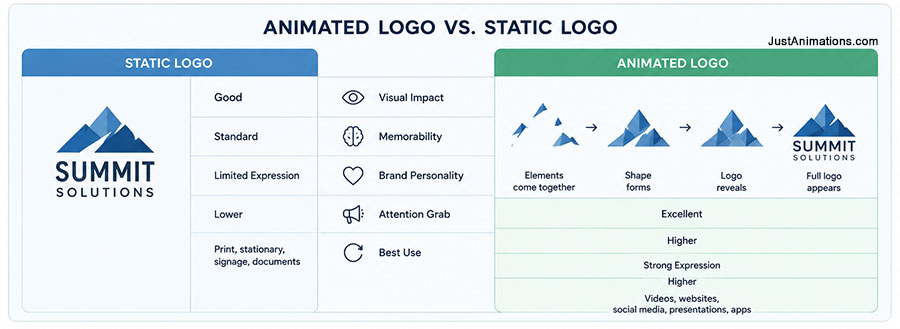
Animated Logo vs. Static Logo
An animated logo and a static logo serve different purposes.
Businesses usually need both.
| Requirement | Static Logo | Animated Logo |
|---|---|---|
| Printed materials | Excellent | Not applicable |
| Website header | Excellent | Selective use |
| Video introductions | Basic | Excellent |
| Social media video | Basic | Excellent |
| Presentation opening | Good | Excellent |
| Email signatures | Excellent | Limited |
| Mobile app loading screen | Good | Excellent |
| Digital advertisements | Good | Excellent |
| Brand personality | Limited movement | Stronger expression |
| File simplicity | Very simple | Requires multiple formats |
The static logo should remain the foundation of the identity.
The animated version becomes an additional asset for environments that support motion.
Common Types of Logo Animation
Logo Reveal
A logo reveal gradually introduces the logo using masks, lines, particles, light, or other effects.
This is one of the most common approaches for video intros and outros.
Logo Assembly
Different pieces of the logo move into position and form the final design.
This approach works well when the logo already contains multiple shapes, letters, or connected components.
Logo Transformation
One object transforms into another before becoming the final logo.
For example, a building outline may become the symbol of a construction company.
A product shape may transform into the logo of a manufacturer.
Wordmark Animation
Letters appear, slide, stretch, rotate, or connect to form the company name.
This approach can work well for brands whose identity relies heavily on typography.
Character Logo Animation
A mascot or character interacts with the logo.
The character may wave, walk into the frame, move part of the wordmark, or react to another animated element.
3D Logo Animation
The logo is recreated as a three-dimensional object with depth, lighting, reflections, and camera movement.
3D animation can create a more cinematic presentation, but it normally requires additional production time and rendering.
Looping Logo Animation
A short movement repeats continuously.
Loops are often used on websites, digital displays, loading screens, social posts, event screens, and user interfaces.
The loop should transition smoothly so the starting and ending points are not distracting.
Where Can Businesses Use Animated Logos?
A single animated logo can be adapted for several platforms.
Common uses include:
✓ Video intros and outros
✓ YouTube channels
✓ Social media videos
✓ Website landing pages
✓ Digital advertisements
✓ Mobile app loading screens
✓ Sales presentations
✓ Trade show displays
✓ Online courses and webinars
✓ Internal training videos
✓ Event screens
✓ Digital signage
✓ Product demonstrations
The animation may need different layouts for each platform.
A horizontal version may work well for presentations and YouTube.
A square version may be better for social media.
A vertical version may be required for Stories, Reels, Shorts, or TikTok.
How Long Should a Logo Animation Be?
Most logo animations should be short.
A simple logo reveal may only require two to five seconds.
A cinematic introduction may last five to ten seconds, but longer animations can frustrate viewers when they are placed before every video.
| Application | Recommended Length |
|---|---|
| Social media outro | 2–4 seconds |
| Website logo motion | 2–5 seconds |
| Standard video intro | 3–6 seconds |
| Presentation opening | 3–8 seconds |
| Cinematic brand introduction | 5–10 seconds |
| Loading animation | Short continuous loop |
The best length depends on how often the animation will be seen.
An animation used repeatedly should usually be shorter than one created for a single brand launch or promotional campaign.
How Much Does Logo Animation Cost?
Logo animation costs vary widely because template-based movement and fully customized brand animation are very different services.
Current industry pricing examples range from a few hundred dollars for basic asset animation to several thousand dollars for custom studio work. Premium 3D, particle-driven, cinematic, or multi-format motion identity systems can cost substantially more.
| Logo Animation Type | Estimated Cost |
|---|---|
| Basic template animation | $50–$500 |
| Simple custom freelance animation | $500–$2,500 |
| Professional custom 2D animation | $2,000–$7,500 |
| Advanced logo animation with sound | $3,500–$10,000 |
| Custom 3D logo animation | $5,000–$25,000+ |
| Complete motion identity system | $10,000–$50,000+ |
These figures are general planning estimates.
A complete motion identity system may include several animations rather than one video file.
For example, the business may receive:
- Primary animated logo
- Short intro
- Short outro
- Transparent version
- Black background version
- White background version
- Square social version
- Vertical version
- Looping icon
- Animated tagline
- Sound design
- Usage guidelines
Logo Animation Cost Comparison
Basic template animation
██ $50–$500
Simple custom animation
████ $500–$2,500
Professional 2D logo animation
████████ $2,000–$7,500
Advanced animation with sound
████████████ $3,500–$10,000
Custom 3D logo animation
████████████████ $5,000–$25,000+
Motion identity system
████████████████████ $10,000–$50,000+
The number of concepts, animation complexity, sound design, 3D rendering, revisions, and required file formats all affect the final price.
What Affects Logo Animation Pricing?
Condition of the Existing Logo
A clean vector logo is easier to prepare for animation.
A low-resolution JPG or PNG may need to be recreated before production begins.
Animation Complexity
Simple fades and shape movements require less production than custom character movement, simulations, particles, 3D materials, or cinematic environments.
Number of Concepts
Some projects begin with one approved direction.
Others require several motion concepts before a final approach is selected.
Sound Design
Custom sound effects or a musical signature may require an audio specialist.
Licensed music can also affect the project cost.
Number of Versions
Each aspect ratio, background option, duration, and platform may require a separate export or animation adjustment.
Revisions
Changing the speed of a completed animation is usually manageable.
Changing the entire movement concept after production has begun may require substantial rework.
The Logo Animation Production Process
1. Brand Review
The animation studio reviews the logo, brand guidelines, audience, positioning, and intended uses.
2. Creative Direction
The team identifies how the logo should move and what the motion should communicate.
3. Motion Concepts
Several written concepts, sketches, style frames, or rough animations may be prepared.
4. Storyboard or Animatic
The sequence and timing are mapped before the final animation is produced.
5. Asset Preparation
Logo elements are separated and prepared for motion.
A 3D project may also require modelling, texturing, and lighting.
6. Animation
The logo movement, timing, transitions, and effects are created.
7. Sound Design
Music or sound effects are synchronized with the visual movement.
8. Revisions
The business reviews the animation and requests changes within the agreed scope.
9. Export and Delivery
The final animation is exported in the required sizes, formats, resolutions, and background variations.
What Makes a Good Animated Logo?
A good animated logo should still look and feel like the original brand.
The movement should enhance the identity rather than distract from it.
Effective logo animation is usually:
- Short
- Clear
- Distinctive
- Easy to recognize
- Consistent with the brand personality
- Legible at small sizes
- Suitable for repeated use
- Adaptable to different platforms
- Effective with and without sound
The movement should also resolve clearly into the final static logo.
Viewers need enough time to recognize and understand the completed mark.
Common Logo Animation Mistakes
Adding Motion Without a Purpose
Movement should communicate a brand characteristic or support the structure of the logo.
Random effects may make the animation feel generic.
Making the Animation Too Long
A logo should not delay the content viewers actually came to see.
Using Too Many Effects
Particles, flashes, rotation, distortion, and camera movement can become overwhelming when used together.
Research published in 2025 indicates that unpredictability may support attention only up to a point, suggesting that excessive or chaotic movement can become counterproductive.
Ignoring the Existing Brand Style
A conservative brand should not suddenly use cartoon movement unless the company is intentionally changing its identity.
Depending Entirely on Sound
Many people watch digital content without audio.
The logo animation should remain understandable when muted.
Delivering Only One File
A single MP4 may not work across websites, presentations, social media, transparent video, and mobile applications.
Which Logo Animation Files Should Be Delivered?
Businesses should request the formats needed for their current and future platforms.
Common deliverables include:
| File Format | Common Use |
|---|---|
| MP4 | Video, websites and presentations |
| MOV with transparency | Professional video editing |
| WebM | Transparent or lightweight website video |
| GIF | Simple website and email animation |
| Lottie JSON | Websites, apps and user interfaces |
| SVG animation | Scalable website motion |
| PNG sequence | Editing and compositing |
| 4K video | Large screens and high-resolution production |
| Source file | Future editing and adaptation |
Not every project requires every format.
The delivery list should be determined before the animation is quoted.
How to Choose a Logo Animation Company
Review whether the studio understands branding as well as motion design.
An impressive animation may still be ineffective if it does not fit the company’s identity.
Ask the studio:
- Is the animation completely custom?
- How many concepts are included?
- Does the price include sound design?
- How many revision rounds are included?
- Will transparent files be delivered?
- Are vertical and square versions included?
- Will we receive a looping variation?
- Who owns the final animation?
- Can the source files be provided?
- Can the animation be adapted for future campaigns?
A logo animation company should also be willing to simplify the concept when a restrained approach will represent the brand more effectively.
Just Animations can develop animated logo reveals as individual assets or as part of a larger video animation project, allowing the movement to remain consistent with the rest of the company’s visual communication.
Conclusion
Logo animation turns a static visual identity into a short and repeatable brand experience.
It can help attract attention, communicate personality, support brand recognition, and create a more polished presentation across video, social media, websites, apps, presentations, and advertising.
However, movement alone does not guarantee stronger brand recall.
The animation must be distinctive, easy to understand, and aligned with the identity of the business.
The most effective animated logos do not overwhelm the viewer with unnecessary effects.
They use a few carefully selected movements to reveal the logo, reinforce the brand’s personality, and leave the viewer with a clear final image.
Frequently Asked Questions
What is logo animation?
Logo animation is the process of adding movement, transitions, effects, and sometimes sound to a static company logo. It is commonly used in videos, websites, presentations, apps, social media content, and digital advertisements.
Does an animated logo improve brand recall?
An animated logo can improve brand recall by creating additional visual and auditory cues around the brand. Movement, timing, transformation, and sound can make the logo presentation more distinctive, provided the animation matches the brand identity.
How much does a professional logo animation cost?
A professional logo animation may cost from approximately $500 to more than $25,000. Simple 2D animations usually cost less, while advanced 3D animation, custom sound design, multiple concepts, and complete motion identity systems require larger budgets.
How long should an animated logo be?
Most animated logos should be approximately two to six seconds long. Cinematic brand introductions may be longer, while frequently repeated video intros and social media outros should usually remain short.
What files should I receive with a logo animation?
Common logo animation files include MP4, transparent MOV, WebM, GIF, Lottie JSON, SVG animation, and high-resolution video. The exact formats depend on whether the animation will be used for websites, video editing, mobile apps, presentations, social media, or digital displays.