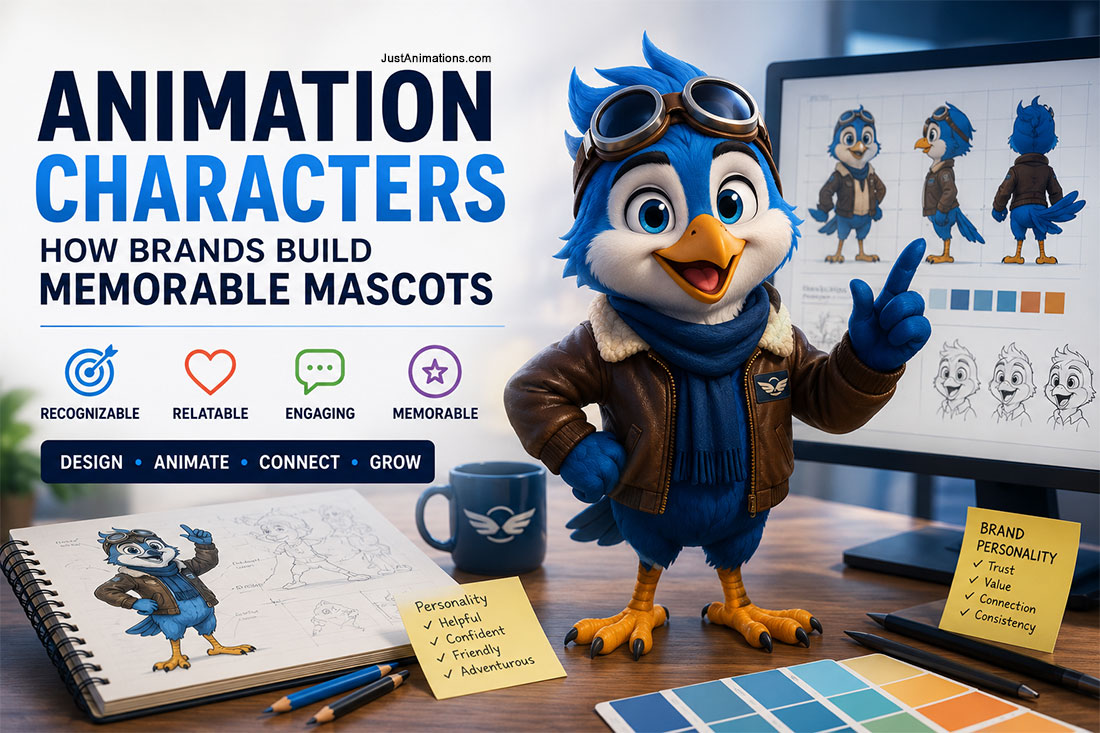
Animation characters can give a business a recognizable face, voice, and personality.
Instead of communicating only through a logo, color palette, or corporate spokesperson, a brand can use an animated mascot to explain services, introduce products, guide customers, appear in advertisements, and create stories around the organization.
The strongest brand mascots become more than decorative illustrations.
They become reusable brand assets that audiences can recognize across video animation, websites, social media, packaging, presentations, advertisements, merchandise, and live events.
However, a memorable mascot requires more than drawing a friendly animal or placing eyes on a product.
The character must represent the brand clearly, remain visually distinctive, and be flexible enough to support years of marketing content.
Quick Answer: How Do Brands Build Memorable Mascots?
Brands build memorable mascots by creating animation characters with a distinctive appearance, clear personality, recognizable silhouette, consistent behavior, and meaningful connection to the company.
A successful mascot should answer several questions:
- Who is this character?
- What does the character represent?
- How does the character behave?
- What role does it play for customers?
- Why does it belong to this particular brand?
- How will it appear across different media?
Research into brand anthropomorphism shows that humanizing a brand can help people form stronger associations and more personal relationships with it. However, the character’s appearance, role, and communication style must fit the audience and brand positioning.
Brand Mascot Overview
| Project Element | Typical Requirement |
|---|---|
| Primary purpose | Give the brand a recognizable personality and visual representative |
| Common character types | Human, animal, object, product, creature or abstract character |
| Animation styles | 2D, 3D, motion graphics, frame-by-frame and hybrid animation |
| Typical project cost | $3,000 to $100,000+ |
| Average timeline | 4 to 20 weeks |
| Common uses | Video, websites, social media, advertising, packaging, apps and events |
| Main advantage | Creates a reusable character that can support long-term brand recognition |
What Is a Brand Mascot?
A brand mascot is a character used to represent a company, organization, product, service, campaign, or public initiative. If it’s a cartoon then its cartoon characteristics must be distinct.
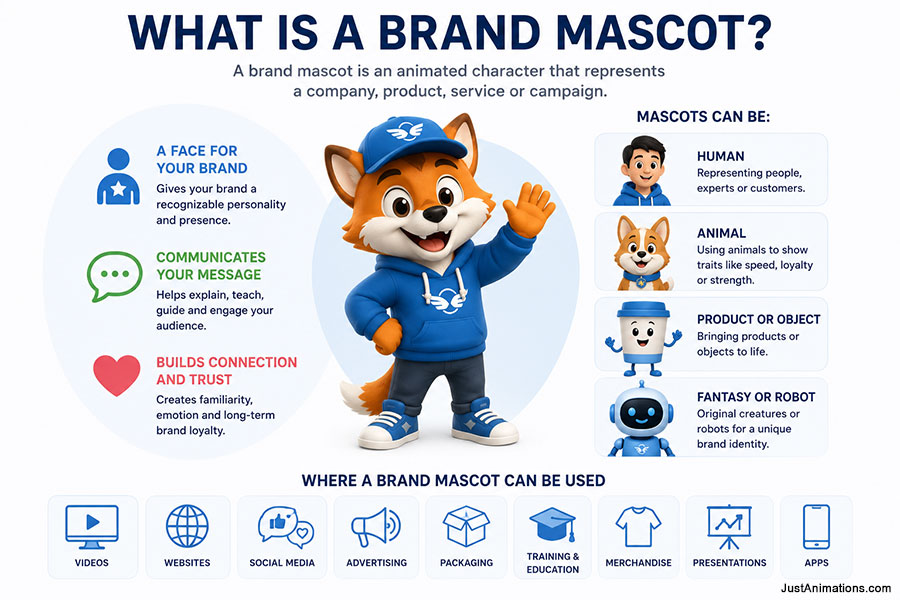
The mascot may be:
- A person
- An animal
- A product brought to life
- A machine or device
- An imaginary creature
- A simplified object
- An abstract shape
- A group of related characters
The character may appear only in illustrations, or it may be developed into a complete animated personality with a name, voice, backstory, expressions, movements, and relationships with other characters.
Animated mascots in advertising are a form of brand anthropomorphism. They give human-like qualities, emotions, intentions, or behavior to a company or non-human object.
Marketers have long used visual features, human names, personification, and mascots to encourage audiences to interpret brands as social characters rather than anonymous organizations.
Why Are Brand Mascots Memorable?
They Give the Brand a Face
A company may offer a useful product but still feel distant or difficult to recognize.
A mascot gives the organization a consistent visual representative.
Instead of remembering only a company name, viewers may remember the character’s face, clothing, colors, voice, or movement.
Research into brand identity elements indicates that distinctive visual assets can become valuable memory cues once audiences form strong and unique associations with them.
They Make Abstract Services More Concrete
Some companies sell services that cannot easily be photographed.
Insurance, software, consulting, finance, logistics, healthcare administration, cybersecurity, and public services may involve complicated processes rather than physical products.
A mascot can make these concepts easier to visualize.
The character can:
- Guide viewers through a process
- Represent the customer
- Demonstrate a problem
- Explain how a service works
- Introduce different service categories
- React to common customer frustrations
- Present the solution
This gives the audience something visible and relatable to follow.
They Express Brand Personality
A mascot can communicate personality more directly than a logo.
Its posture, facial expressions, language, clothing, movement, and reactions can make the brand feel:
- Helpful
- Intelligent
- Dependable
- Adventurous
- Playful
- Experienced
- Innovative
- Friendly
- Efficient
- Protective
Brand anthropomorphism research suggests that people do not respond to every humanized brand in the same way. The role assigned to the character, such as mentor, partner, expert, or helper, can influence how the audience interprets the brand relationship.
They Support Repetition
The same mascot can appear repeatedly without requiring the business to introduce a new concept in every campaign.
Over time, customers may begin recognizing the character before reading the company name.
The mascot can become part of the brand’s distinctive asset system alongside the logo, typography, colors, sound, and visual style.
They Can Create Emotional Connections
Animation characters can display emotion in ways that logos and product photographs cannot.
A mascot can appear concerned when presenting a customer problem, confident when explaining a solution, and excited when demonstrating the outcome.
Anthropomorphic brand cues can increase perceived warmth, social presence, and feelings of connection in certain contexts. However, results depend on the product, audience, cultural setting, and character role.
What Makes a Brand Mascot Memorable?
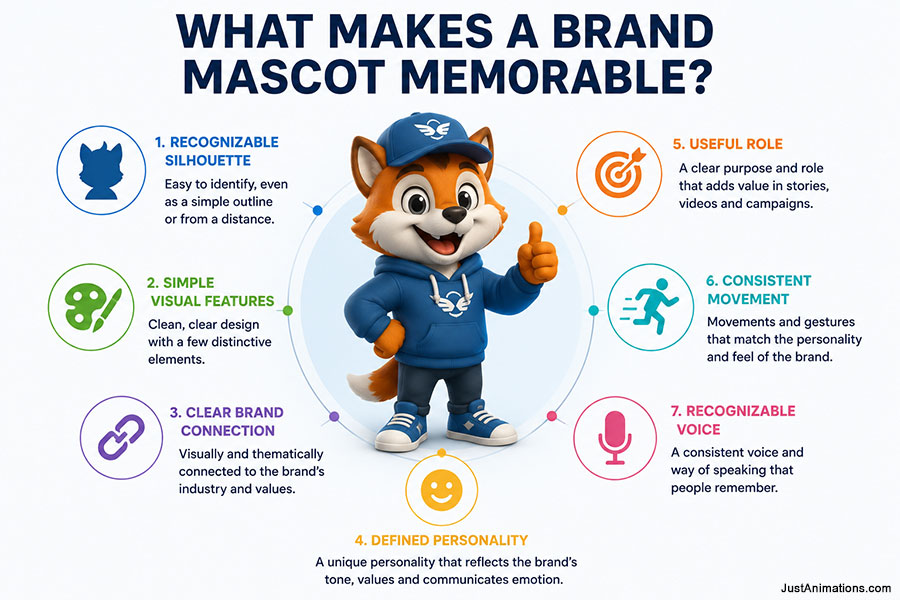
1. A Recognizable Silhouette
A memorable animation character should remain identifiable even when shown as a simple outline.
The character should not depend entirely on small details.
A distinctive head shape, body proportion, hairstyle, hat, ears, clothing item, or accessory can make the mascot easier to recognize from a distance.
Simple silhouettes also make the character easier to adapt for:
- Small social media icons
- App interfaces
- Embroidery
- Stickers
- Merchandise
- Website graphics
- Animated transitions
- Printed materials
2. Simple Visual Features
More detail does not automatically make a character more memorable.
Too many accessories, colors, textures, patterns, and facial details can make the design difficult to reproduce consistently.
A strong mascot usually has a small number of defining features.
These might include:
- One primary body shape
- Two or three brand colors
- A recognizable face
- A signature outfit
- A distinctive prop
- One unusual physical feature
The character can still be detailed in premium animation, but its basic identity should remain clear in a simplified version.
3. A Clear Brand Connection
The mascot should make sense for the organization.
A construction company might use a knowledgeable builder, strong animal, animated tool, or safety-focused guide.
A technology company might use a robot, digital assistant, intelligent creature, or character formed from connected geometric shapes.
A healthcare brand might use a calm guide, protective character, medical object, or approachable human representative.
The connection does not need to be literal.
However, the business should be able to explain why the character represents the brand.
4. A Defined Personality
A mascot needs personality rules.
Without them, the character may act differently in every campaign.
The brand should define characteristics such as:
| Personality Question | Example |
|---|---|
| Is the mascot serious or playful? | Helpful with light humor |
| Is it an expert or learner? | Experienced guide |
| Does it speak formally or casually? | Clear and conversational |
| Is it energetic or calm? | Confident and controlled |
| Does it solve problems or cause them? | Helps customers succeed |
| How does it respond to mistakes? | Patient and encouraging |
These decisions influence writing, voice acting, facial expressions, animation, and campaign concepts.
5. A Useful Role
The mascot should have a job within the brand’s communication.
It might act as:
- A guide
- A teacher
- A product expert
- A customer representative
- A problem solver
- A safety advisor
- An entertainer
- A narrator
- A digital assistant
- A campaign spokesperson
A clearly defined role makes it easier to decide how the character should behave.
Research has found that audiences can respond differently depending on whether an anthropomorphized brand behaves like a partner, servant, mentor, or authority figure. The most appropriate role depends on the audience and the relationship the company wants to create.
6. Consistent Movement
The way an animated mascot moves should match its personality.
A young, energetic character may move quickly and use exaggerated expressions.
An experienced advisor may use slower gestures and controlled movement.
A machine character may use precise mechanical motion.
A soft, friendly creature may use rounded poses and gentle transitions.
Movement becomes part of the character identity.
Even when two mascots have similar appearances, their timing, expressions, and body language can make them feel completely different.
7. A Recognizable Voice
Not every mascot needs dialogue.
However, a speaking character should have a consistent vocal identity.
The voice should reflect:
- Approximate age
- Personality
- Energy level
- Geographic market
- Brand formality
- Intended audience
- Emotional tone
The company should also determine whether the same voice actor will be used in future campaigns.
Changing the voice repeatedly can weaken character consistency.
Types of Brand Mascots
Human Characters
Human mascots may represent customers, employees, experts, technicians, founders, or fictional brand representatives.
They work well when credibility, guidance, or customer identification is important.
Animal Characters
Animals can communicate recognizable qualities quickly.
For example, audiences may associate certain animals with speed, intelligence, strength, protection, loyalty, or curiosity.
The character should not rely entirely on a generic stereotype. Its design and personality still need to be distinctive.
Product Characters
A product can be given a face, arms, legs, expressions, and a voice.
This approach keeps the product at the center of the brand story.
It can work particularly well for food, household products, tools, technology, automotive products, and consumer goods.
Object Characters
An object related to the service can become the mascot.
Examples might include an animated house, light bulb, computer, delivery box, medical item, or construction tool.
Imaginary Creatures
A completely original creature gives the company greater creative freedom.
Its appearance can combine several ideas without carrying the existing associations of a familiar animal.
Robots and Digital Assistants
Technology companies often use robots, avatars, and digital assistants to represent automation, artificial intelligence, software, and customer support.
The design should still feel unique. A generic smiling robot may be difficult to distinguish from hundreds of similar characters.
2D vs. 3D Mascot Animation
The best animation style depends on the brand, platforms, production schedule, and budget.
| Requirement | 2D Mascot | 3D Mascot |
|---|---|---|
| Initial production cost | Lower | Higher |
| Simple explainer videos | Excellent | Good |
| Realistic lighting and depth | Limited | Excellent |
| Social media illustrations | Excellent | Excellent |
| Fast pose creation | Good | Excellent after rigging |
| Frame-by-frame expression | Excellent | Good |
| Product integration | Good | Excellent |
| Cinematic advertising | Good | Excellent |
| Website graphics | Excellent | Excellent |
| Future character reuse | Excellent | Excellent |
A 2D mascot may feel illustrative, graphic, friendly, or highly stylized.
A 3D mascot can be placed into realistic environments, viewed from any camera angle, and reused for still images, video, product visualization, interactive experiences, and digital displays.
Some brands use a hybrid system.
The primary advertising characters animation may be 3D, while simplified 2D versions are used for icons, diagrams, social posts, and printed materials.
Where Can Brands Use Animation Characters?
A well-designed mascot can support many types of communication.
Common applications include:
✓ Explainer videos
✓ Product demonstrations
✓ Website landing pages
✓ Social media content
✓ Digital advertisements
✓ Customer onboarding
✓ Safety and training videos
✓ Educational content
✓ Mobile apps
✓ Chat interfaces
✓ Presentations
✓ Packaging
✓ Event displays
✓ Email campaigns
✓ Stickers and merchandise
The mascot does not need to be the center of every campaign.
Selective use can prevent the character from becoming repetitive or distracting.
How Much Does Mascot Design and Animation Cost?
The cost depends on whether the business needs a single illustration, a complete character system, or an ongoing animated campaign.
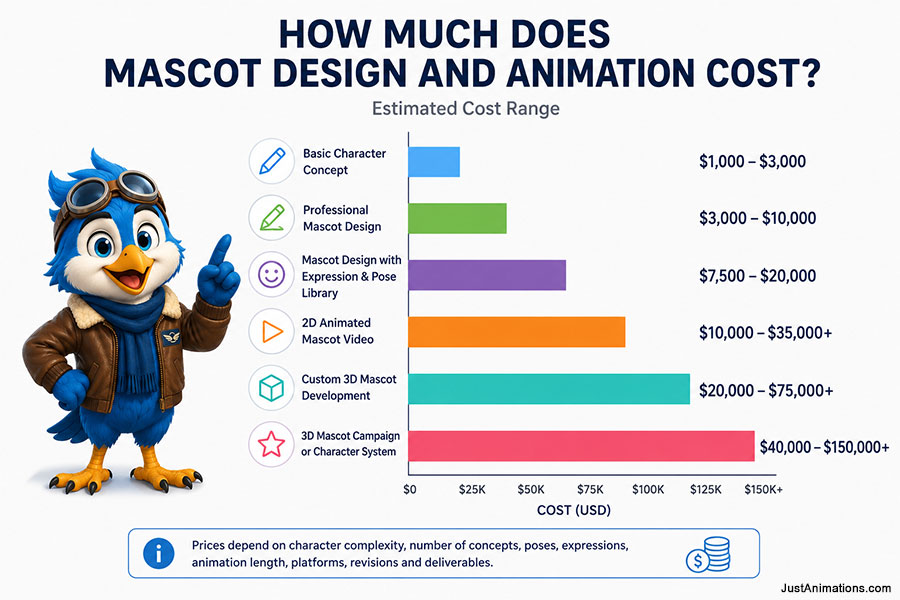
| Mascot Project | Estimated Cost |
|---|---|
| Basic character concept | $1,000–$3,000 |
| Professional custom mascot design | $3,000–$10,000 |
| Mascot design with expression and pose library | $7,500–$20,000 |
| 2D animated mascot video | $10,000–$35,000+ |
| Complete 2D character system | $15,000–$50,000+ |
| Custom 3D mascot development | $20,000–$75,000+ |
| 3D mascot campaign or character system | $40,000–$150,000+ |
These are general planning ranges rather than fixed prices.
The final budget may depend on:
- Number of initial concepts
- Character complexity
- 2D or 3D production
- Number of poses
- Number of expressions
- Character rigging
- Clothing and accessories
- Voice acting
- Video length
- Number of environments
- Sound design
- Revision rounds
- Required file formats
- Ownership and licensing terms
Mascot Project Cost Comparison
Basic character concept
██ $1,000–$3,000
Professional mascot design
████ $3,000–$10,000
Pose and expression library
████████ $7,500–$20,000
2D animated mascot project
████████████ $10,000–$35,000+
Custom 3D mascot
████████████████ $20,000–$75,000+
Complete character campaign
████████████████████ $40,000–$150,000+
Investing in a complete character system can make future campaigns more efficient because approved models, rigs, poses, colors, voices, and personality guidelines can be reused.
The Brand Mascot Development Process
1. Brand Discovery
The animation studio reviews the organization’s positioning, audience, services, competitors, tone, and visual identity.
The team also determines what role the mascot will play.
2. Character Strategy
The brand defines:
- Character type
- Personality
- Audience relationship
- Communication role
- Visual symbolism
- Long-term applications
This stage prevents the project from becoming a purely decorative design exercise.
3. Concept Sketches
Artists explore different body shapes, faces, proportions, outfits, accessories, and visual directions.
The early concepts should be evaluated for brand fit rather than illustration quality alone.
4. Character Refinement
The selected concept is developed in greater detail.
Colors, clothing, facial features, proportions, and accessories are finalized.
5. Expression and Pose Development
The studio creates a range of expressions and poses.
These may include:
- Happy
- Concerned
- Confident
- Surprised
- Thinking
- Explaining
- Celebrating
- Pointing
- Walking
- Using the product
6. Character Modelling or Rigging
A 2D character may be separated into movable layers and prepared with an animation rig.
A 3D character must be modelled, textured, and rigged with controls for the body and face.
7. Animation Testing
Short motion tests help establish how the character walks, speaks, reacts, and changes expression.
8. Voice and Sound Development
The business may select a voice actor and define the character’s audio style.
9. Final Asset Production
The mascot is delivered in the formats required for animation, print, digital media, presentations, apps, and future campaigns.
10. Character Guidelines
The final guide explains how the mascot should look, speak, move, and behave.
What Should a Mascot Style Guide Include?
A mascot style guide helps different designers, animators, marketers, and agencies use the character consistently.
It may include:
- Official character name
- Character biography
- Personality traits
- Communication role
- Approved colors
- Body proportions
- Facial expressions
- Standard poses
- Clothing rules
- Props and accessories
- Voice direction
- Approved vocabulary
- Movement principles
- Incorrect uses
- Background requirements
- Minimum display sizes
- File-format instructions
This document becomes particularly important when the character is used by several departments or outside partners.
Mascot Ownership and Intellectual Property
A business should establish ownership before the character is introduced publicly.
The production agreement should clearly address:
- Ownership of the final character
- Ownership of sketches and rejected concepts
- Copyright assignment
- Trademark rights
- Source files
- Animation rigs
- 3D models
- Voice recordings
- Music and sound effects
- Merchandise rights
- Licensing rights
- Geographic restrictions
- Future modification rights
Characters may involve several forms of intellectual property protection, including copyright, trademarks, and registered designs, depending on the jurisdiction and intended use. WIPO materials describe how character names, likenesses, designs, slogans, and merchandise may be protected through overlapping IP rights.
Businesses should obtain jurisdiction-specific legal advice before registering, licensing, or merchandising a major mascot.
Common Mascot Design Mistakes
Creating a Generic Character
A generic robot, superhero, animal, or smiling person may look professional but remain difficult to associate with one company.
The design needs at least one distinctive visual idea.
Focusing Only on Appearance
A mascot without a personality or role may be difficult to use after the launch campaign.
The business needs to know what the character does.
Making the Design Too Complicated
Excessive detail can create inconsistency and increase animation costs.
Ignoring the Audience
A character designed for children may not work for enterprise buyers.
A highly technical mascot may not work for a general consumer audience.
Making the Mascot Too Dominant
The character should support the product and message rather than distract from them.
Changing the Character Constantly
Uncontrolled changes to facial features, colors, proportions, personality, or voice can weaken recognition.
Using Anthropomorphism During Sensitive Situations
Humanized brands may be judged more harshly when customers believe the company has acted irresponsibly. Research has shown that anthropomorphism can intensify negative reactions during product wrongdoing because people may assign greater intention and responsibility to the brand.
A playful mascot may therefore be inappropriate for serious apologies, safety incidents, legal disputes, or sensitive customer communications.
How to Choose a Character Animation Studio
Look for an animation studio that understands branding, storytelling, and animation production.
A strong illustration portfolio does not automatically demonstrate that the team can build a character for long-term business use.
Ask potential studios:
- How do you connect the character to our brand strategy?
- How many initial concepts are included?
- Will we receive expression and pose sheets?
- Can the mascot be animated in future videos?
- Will the design work in both large and small formats?
- Do you provide a complete character style guide?
- Who owns the character and source files?
- Are animation rigs and 3D models included?
- Can you produce both 2D and 3D versions?
- Can the mascot be adapted for social media and websites?
- How are additional poses and animations priced?
- Can the character be prepared for merchandise?
Just Animations can develop original animation characters as part of an explainer video, branded campaign, educational series, or long-term mascot system.
The objective should be to create a character that looks distinctive in the first campaign and remains useful for future brand communication.
Conclusion
Animation characters can make a company more recognizable, relatable, and visually consistent.
A memorable mascot combines a clear silhouette, simple defining features, brand relevance, recognizable personality, and useful communication role.
The design should also be supported by movement rules, voice direction, approved poses, file formats, and ownership agreements.
The strongest brand mascots are not created for a single advertisement.
They are developed as long-term intellectual and creative assets that can appear across video, social media, websites, packaging, presentations, apps, events, and merchandise.
When the character is strategically designed and consistently used, it can become one of the most recognizable elements of the brand.
Frequently Asked Questions
What is a brand mascot?
A brand mascot is a human, animal, object, product, or imaginary character used to represent a company, organization, service, or campaign. The mascot may appear in illustrations, animation, packaging, advertising, websites, social media, presentations, and merchandise.
How do animation characters improve brand recognition?
Animation characters give audiences additional visual and emotional cues to associate with the company. A recognizable face, silhouette, voice, personality, colour system, and movement style can make the brand easier to identify across different platforms.
How much does it cost to create an animated mascot?
A professional custom mascot design may cost approximately $3,000 to $20,000. A complete 2D or 3D animated character system can range from $15,000 to more than $100,000, depending on the number of concepts, poses, expressions, models, animations, videos, and deliverables required.
Should a brand mascot be created in 2D or 3D?
A 2D mascot is often suitable for explainer videos, illustrations, websites, social posts, and educational content. A 3D mascot may be better for cinematic advertising, realistic environments, product integration, multiple camera angles, and reusable high-resolution visual assets.
What files should a business receive for a brand mascot?
The business may need vector illustrations, transparent PNG files, expression sheets, pose sheets, animation-ready source files, 2D rigs, 3D models, textures, character rigs, video files, voice recordings, and a mascot style guide. Ownership and future usage rights should also be clearly documented.