Animation psychology examines how movement, timing, visual change, characters, color, composition, and storytelling influence human attention, understanding, emotion, and perception.
Motion is difficult for the visual system to ignore.
Something moves.
Something appears.
A shape suddenly changes direction.
A character turns toward the viewer.
A product separates into components.
Text enters the screen.
The eye notices the change.
That makes animation useful for businesses, advertisers, filmmakers, educators, technology companies, enterprises, government agencies, NGOs, and public-sector organizations trying to communicate in environments where audiences have limited attention.
But there is an important distinction:
Motion can capture attention. It does not automatically hold attention, improve understanding, create memory, or persuade someone.
Those outcomes depend on how motion is designed.
Good animation directs attention toward information that matters.
Poor animation competes with the information.
Understanding the psychology of animation helps explain why one animated sequence feels intuitive and engaging while another feels chaotic, distracting, or exhausting.
Why Does Motion Capture Human Attention?
Motion captures human attention because the visual system is highly sensitive to change and movement within the environment.
Detecting movement has obvious survival value.
Something moving in peripheral vision might represent:
- Another person
- An animal
- A falling object
- A threat
- An opportunity
- A change in the environment
Humans therefore do not experience motion as just another visual property.
Movement can become an attentional signal.
Research into visual attention has investigated this relationship for decades. One classic study indexed by the U.S. National Library of Medicine examined visual motion and attentional capture, while a later systematic review examined research specifically concerning animation’s psychological and cognitive effects on visual attention.
For animation, this creates an enormous communication opportunity.
Movement can tell the viewer:
Look here.
The real challenge is deciding what they should see once they look.
Animation Psychology at a Glance
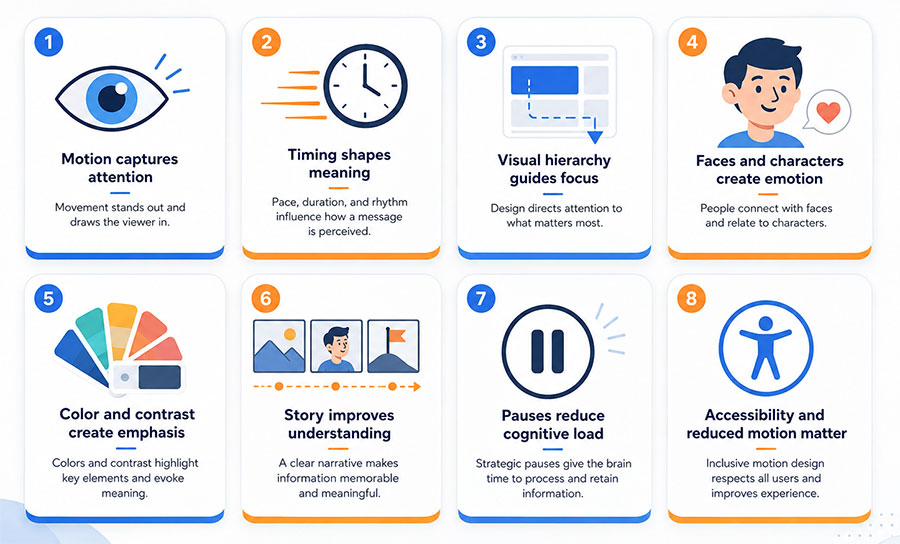
| Animation Principle | Psychological Role | Practical Use |
|---|---|---|
| Motion | Attracts visual attention | Introduce important content |
| Contrast | Creates visual priority | Highlight products or messages |
| Timing | Controls perception and emphasis | Make actions feel natural or important |
| Anticipation | Prepares the viewer for change | Direct attention before an action |
| Visual hierarchy | Establishes what matters first | Guide viewing order |
| Faces | Provide socially meaningful cues | Character storytelling |
| Direction | Guides the eye | Move viewers between information |
| Color | Creates differentiation and association | Brand and information hierarchy |
| Repetition | Reinforces patterns | Branding and learning |
| Story | Connects information over time | Explain cause, consequence, and change |
| Audio | Reinforces events and emotion | Increase perceived impact |
| Pauses | Give processing time | Improve clarity |
| Simplicity | Reduces competing information | Explain complex concepts |
| Interaction | Gives feedback | Websites and interfaces |
| Controlled motion | Reduces distraction | Accessibility and UX |
The strongest animation usually combines several of these principles.
Attention Is Not the Same as Engagement
These terms are often used interchangeably in marketing.
They are not the same.
Attention
The viewer notices something.
Engagement
The viewer continues interacting with or processing it.
Understanding
The viewer comprehends what is being communicated.
Memory
Some portion of the information remains available later.
Persuasion
The communication influences an attitude, preference, or action.
Animation can contribute to all five.
But capturing attention is only the beginning.
Imagine an advertisement where a giant animated object suddenly flies across the screen.
It may capture attention immediately.
But if the viewer remembers the object and not:
- The product
- The company
- The message
- The benefit
then attention was captured without being converted into useful communication.
The goal is not simply:
Make people look.
It is:
Make people look at the right thing for the right reason.
The Psychology of Change Detection
Visual systems constantly process changes in the environment.
Animation creates deliberate change through:
- Position
- Size
- Shape
- Color
- Opacity
- Rotation
- Depth
- Lighting
- Expression
When an object changes while surrounding elements remain stable, it gains visual importance.
Consider a screen containing ten gray circles.
Nothing moves.
Then one circle becomes orange and expands.
Your attention will probably shift toward it.
Animation designers can use this principle to establish hierarchy.
For example:
Static interface → one button pulses
The button becomes important.
Or:
Static machine → one component rotates
The component becomes the focus.
Motion communicates hierarchy before the viewer reads anything.
Peripheral Vision and Motion
People do not only detect movement directly in front of them.
Motion in peripheral vision can also attract attention.
This helps explain why movement can be so powerful in:
- Digital advertising
- Trade-show displays
- Websites
- Large LED walls
- Retail displays
- Presentations
Imagine walking through a trade show.
Several booths contain static posters.
One display contains a large 3D product that separates into floating components.
The movement can attract the eye before the visitor consciously understands what is being shown.
This is one reason businesses use motion graphics and 3D product animation in high-competition visual environments.
But movement that occurs everywhere simultaneously loses this advantage.
If everything moves, nothing receives priority.
Motion Creates Visual Hierarchy
Visual hierarchy determines the order in which information is noticed.
A static design can establish hierarchy through:
- Size
- Color
- Contrast
- Position
- Typography
Animation adds another variable:
time.
Now a designer can control not only where something appears, but when it appears.
Consider this sequence:
Second 1
Product appears.
Second 2
Feature opens.
Second 3
Label appears.
Second 4
Benefit appears.
The viewer receives information sequentially.
Compare that with displaying the product, feature, three arrows, five labels, a paragraph, logo, price, and call to action simultaneously.
The second version forces the audience to decide where to look.
Animation can make that decision for them.
Why Sequential Information Can Be Easier to Follow
Complex information often becomes harder to understand when everything is presented at once.
Animation can divide the information into meaningful stages.
For example, explaining a software workflow:
Customer submits request
↓
Platform receives data
↓
AI analyzes information
↓
Approval system evaluates result
↓
Employee receives notification
The audience sees the process unfold.
Animation therefore gives businesses a way to communicate relationships over time, not merely static relationships in space.
This is particularly useful for:
- Technology
- Manufacturing
- Healthcare
- Finance
- Education
- Government
- Logistics
- Engineering
Animation and Cognitive Load
Animation does not automatically make complex information easier.
It can also make information harder to process.
Human working memory is limited.
If a screen contains:
- Constant background movement
- Multiple moving characters
- Fast typography
- Data changing
- Voiceover
- Music
- Icons
- Camera movement
the viewer may struggle to determine what deserves attention.
This is where cognitive load becomes important.
Effective animation should reduce unnecessary processing.
Helpful Animation
✓ Reveals information in sequence
✓ Highlights the relevant component
✓ Uses movement to show cause and effect
✓ Gives viewers processing time
✓ Removes irrelevant details
Harmful Animation
✗ Moves everything simultaneously
✗ Changes scenes before information can be understood
✗ Adds decorative movement with no purpose
✗ Uses distracting backgrounds
✗ Makes text difficult to read
The purpose of animation should be to organize information rather than simply increase visual activity.
Why Pauses Matter in Animation
Movement attracts attention.
But constant movement creates fatigue.
Stillness gives motion meaning.
Consider:
Move → pause → move
The pause allows the audience to process what just happened.
It can also create emphasis.
A product rotates.
It stops.
A feature label appears.
The viewer has time to inspect the feature.
Then the animation continues.
Without the pause, the viewer may spend the entire sequence trying to catch up.
This is particularly important in:
- Educational animation
- Technical animation
- Product demonstrations
- Government communication
- Data visualization
The Psychology of Anticipation
Anticipation prepares viewers for an upcoming action.
Traditional animators have used anticipation for generations.
Before a character jumps, the character crouches.
Before an object launches forward, it may move slightly backward.
Before a door opens dramatically, the handle turns.
The preparation tells the viewer:
Something is about to happen here.
Psychologically, anticipation helps direct attention toward the location where the important action will occur.
This can make movement easier to understand.
Why Natural Motion Feels Better
Viewers have spent their entire lives observing movement.
They understand intuitively that:
- Heavy objects accelerate differently from light objects
- Objects slow when friction is involved
- People prepare before large movements
- Flexible materials continue moving after the main object stops
When animation ignores these expectations, movement may feel artificial.
That is why animation often uses principles such as:
- Ease in
- Ease out
- Follow-through
- Overlapping action
- Acceleration
- Deceleration
These principles do not simply make movement prettier.
They help movement correspond with expectations formed through real-world experience.
Timing Changes Meaning
The same movement can communicate completely different things depending on timing.
Imagine a circle moving from left to right.
Fast
It may feel:
- Energetic
- Urgent
- Aggressive
Slow
It may feel:
- Calm
- Premium
- Heavy
- Deliberate
Uneven
It may feel:
- Mechanical
- Nervous
- Unstable
Timing therefore contributes to emotional meaning.
This matters in branding.
A luxury product should probably not move like an arcade-game interface.
An energetic sports brand should probably not use the same pacing as a government public-information video.
Animation Psychology and Emotion
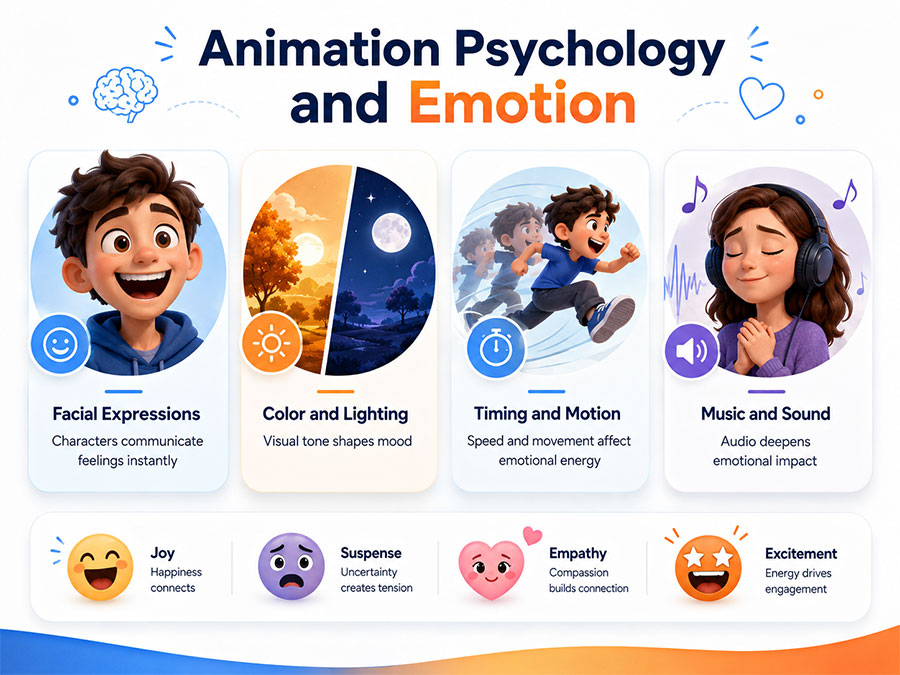
Animation can influence emotion through combinations of:
- Movement
- Music
- Color
- Facial expression
- Camera position
- Composition
- Timing
- Sound
Consider a character slowly lowering their eyes while the animation becomes quieter and darker.
Compare that with the same character jumping upward as bright shapes explode around the screen.
The physical character could be identical.
The emotional communication is completely different.
Animation gives creators precise control over these signals.
Why Faces Attract Attention
Humans are highly responsive to faces.
Faces communicate:
- Emotion
- Attention
- Intention
- Identity
- Social information
Character animation can therefore create immediate social meaning.
A character looking toward an object may also guide the viewer’s attention toward that object.
Imagine:
Character → looks right → product appears on right
The character’s gaze becomes part of the visual hierarchy.
This technique can be used subtly in:
- Explainer videos
- Advertising
- Educational content
- Public information
- Character storytelling
Facial Expressions and Emotional Interpretation
Small changes in expression can dramatically change how an animated character is perceived.
Consider:
- Eyebrow position
- Eye direction
- Mouth shape
- Head angle
- Posture
A character does not need to speak for audiences to infer emotion.
This can be particularly useful in animation designed for international audiences because some emotional information can be communicated visually without relying entirely on language.
However, cultural context still matters.
Designers should not assume every gesture or expression has identical meaning for every audience.
Why Characters Can Make Abstract Ideas Easier to Follow
Many business subjects do not have an obvious physical appearance.
What does:
- Insurance
- Cybersecurity
- Consulting
- Cloud computing
- Human resources
- Financial planning
look like?
Character animation can provide a human context.
Instead of explaining:
“The platform improves employee onboarding.”
the animation can show:
New employee → confusing process → platform → simplified experience
The character creates a perspective from which the audience can understand the problem.
Color Psychology in Animation
Color can influence:
- Attention
- Differentiation
- Mood
- Brand recognition
- Information hierarchy
But color psychology is frequently oversimplified.
Statements such as:
“Blue always means trust.”
or:
“Red always causes urgency.”
are too absolute.
Color meaning depends on:
- Culture
- Context
- Brand
- Contrast
- Surrounding colors
- Audience expectations
The more defensible use of color in animation is as a communication system.
For example:
Blue = normal state
Orange = component being discussed
Red = warning
Consistency teaches the viewer what colors mean within the animation.
Contrast Directs Attention
Contrast makes something visually different from its surroundings.
It can involve:
- Color
- Brightness
- Size
- Movement
- Shape
- Depth
Consider a dark screen with one bright object.
The bright object becomes dominant.
Now animate it.
Its priority becomes even stronger.
Combining contrast and motion can therefore create extremely powerful visual focus.
Use that power carefully.
Directional Motion Guides the Eye
Movement can physically lead viewers through a composition.
An object may travel:
Left → right
then stop beside text.
An arrow may draw itself toward a product feature.
A line may travel through a diagram.
A camera may move from an exterior product view toward an internal component.
The viewer follows the path.
This makes animation especially useful for explaining:
- Processes
- Flow
- Sequence
- Relationships
- Cause and effect
Camera Movement and Attention
Camera movement changes what the audience perceives as important.
Zoom In
Signals:
Look closer.
Pull Back
Signals:
Understand the larger context.
Pan
Signals:
Move your attention over here.
Orbit
Signals:
Understand the object’s dimensional form.
Push Through
Signals:
Enter the system.
3D animation gives creators extensive camera freedom.
But every camera move should have a reason.
Unnecessary movement can produce visual excitement without better understanding.
Motion Psychology in 3D Product Animation
3D product animation provides a particularly clear example of attention-directed motion.
Imagine a complex machine.
Stage 1
Machine rotates slowly.
Viewer understands the overall form.
Stage 2
Rotation stops.
Viewer receives a stable reference.
Stage 3
One panel becomes transparent.
Attention moves toward the interior.
Stage 4
Internal component glows.
Attention narrows further.
Stage 5
Component rotates.
Viewer understands function.
The sequence creates a controlled path through the product.
Without animation, the same information might require several separate diagrams.
Animation and Pattern Recognition
Humans learn patterns.
Animation can establish repeated visual rules.
For example:
Whenever a feature is important:
Blue line appears → camera moves closer → label enters
After several repetitions, the audience understands the pattern.
Consistent animation systems can improve clarity because viewers do not need to relearn the visual language in every scene.
This is especially useful for:
- Long explainers
- Training videos
- Product series
- Corporate communications
- Multi-video campaigns
Repetition and Brand Recognition
Repeated motion can also become part of a brand identity.
A company might repeatedly use:
- A particular logo transition
- A characteristic camera move
- A recognizable shape animation
- A specific text reveal
- A consistent timing style
Over time, movement can become as recognizable as:
- Color
- Typography
- Logo
- Sound
This is sometimes described as motion branding.
Animation Psychology and Memory
Animation can support memory when movement helps organize or explain meaningful information.
However:
More animation does not automatically mean better memory.
A viewer might remember an impressive visual effect while forgetting the message attached to it.
The goal should be to connect memorable movement to meaningful information.
For example:
Product opens → unique feature appears → benefit statement
Now the memorable visual and the business message are connected.
Why Stories Are Easier to Follow Than Disconnected Facts
Humans naturally interpret sequences through:
- Cause
- Goal
- Conflict
- Change
- Consequence
Storytelling gives information structure.
Compare:
Disconnected Facts
- Product is lightweight.
- Product is durable.
- Product is portable.
with:
Animated Story
Worker carries heavy equipment → struggles → new lightweight product appears → carries it easily → product survives a drop
The facts become events.
The viewer understands how the benefits affect someone.
The animation is not merely listing information.
It is demonstrating meaning.
Visual Storytelling Creates Cause and Effect
Animation is particularly effective at showing relationships.
Cause
User presses button.
Effect
Machine starts.
Cause
Sensor detects object.
Effect
Conveyor stops.
Cause
Customer submits information.
Effect
Software analyzes it.
Motion allows audiences to watch one event produce another.
This is one of the reasons animation can simplify complicated processes.
Why Explainer Animation Can Be Effective
Explainer animation works best when it selectively reveals information.
Instead of saying:
“Here are ten things you need to understand.”
the animation says:
“Look at this first.”
Then:
“Now look at this.”
Then:
“Here is how they connect.”
That structure can make otherwise complicated information feel more manageable.
The production principles in How to Make an Animation Video: Step-by-Step Production show why scripting and storyboarding are important before movement is created.
Animation Psychology in Advertising
Advertising has one of the most obvious uses for animation and attention.
An advertisement frequently has only seconds to:
- Be noticed.
- Establish relevance.
- Communicate a benefit.
- Connect that benefit with a brand.
Animation can support each stage.
Capture
Movement earns visual attention.
Focus
Composition directs attention toward the product.
Explain
Animation demonstrates the benefit.
Brand
Colors, typography, characters, and motion reinforce identity.
Act
The final sequence directs attention toward the next step.
Advertising teams can combine these principles through advertising animation across broadcast, social media, websites, digital campaigns, product launches, and event displays.
Why Animation Helps Show Product Benefits
Some benefits are difficult to film.
Imagine trying to photograph:
- Airflow
- Data transmission
- Cybersecurity
- Heat transfer
- Internal mechanical movement
- Microscopic action
Animation can make invisible processes visible.
The psychological advantage is not simply that the animation looks interesting.
It creates a visual representation the audience can reason about.
Animation Psychology for Social Media
Social media environments create extreme competition for attention.
Users scroll continuously.
Motion can interrupt that pattern.
But there are several challenges:
- Screen sizes are small
- Videos may autoplay silently
- Attention may last only briefly
- Text can become difficult to read
- Many other videos are moving simultaneously
Effective social animation therefore benefits from:
✓ Immediate visual meaning
✓ Large focal subjects
✓ Strong contrast
✓ Short text
✓ Fast context
✓ Captions where appropriate
A complicated 15-second introduction may fail before the main message appears.
Website Animation and Human Attention
Animation can guide visitors through a website.
Useful examples include:
- Button feedback
- Menu transitions
- Product demonstrations
- Scroll-triggered explanations
- Animated diagrams
- Data visualization
However, website animation is one of the areas where restraint becomes especially important.
A page where everything moves can make it harder for visitors to:
- Read
- Navigate
- Find important information
- Complete tasks
Our guide to Website Animation Services: Costs, Types, and Studio Guide examines how web animation should support a communication or user-experience purpose rather than simply make a page move.
Motion as Interface Feedback
Animation can confirm that something happened.
Examples:
Button pressed → button changes
File uploaded → progress animation appears
Menu selected → panel transitions
Item added → cart responds
This feedback reduces uncertainty.
Without it, users may wonder:
Did the system receive my action?
Motion therefore has a functional role in interfaces.
The Psychology of Smooth Transitions
Abrupt interface changes can make users feel as though they have jumped to an unrelated state.
Transitions can show continuity.
For example:
Small card → expands into full page
The animation visually explains:
This page came from that card.
Motion creates a relationship between states.
This can make digital interfaces easier to follow.
When Animation Becomes Distracting
The same characteristics that make animation powerful can make it disruptive.
Motion attracts attention.
Therefore motion can steal attention from:
- Text
- Forms
- Navigation
- Important instructions
Common problems include:
✗ Constant pulsing
✗ Auto-playing background motion
✗ Excessive parallax
✗ Multiple independent animations
✗ Fast flashing
✗ Motion during reading
✗ Repeated unnecessary transitions
The designer must ask:
Does this movement help the viewer understand or act?
If not, it may be decoration competing with communication.
Animation Accessibility Matters
Not every viewer experiences motion comfortably.
Some people can experience distraction, dizziness, nausea, headaches, or other adverse reactions from certain motion effects.
For interactive web experiences, the World Wide Web Consortium documents techniques for respecting the operating system’s reduced-motion preference through W3C guidance for using prefers-reduced-motion.
That means responsible animation design should consider:
- Whether movement is essential
- Whether motion can be reduced
- Whether users can pause it
- Whether content remains understandable without it
- Whether flashing or extreme motion is necessary
Accessibility is part of effective communication.
Motion Should Not Manipulate Users
Animation can influence attention.
That creates an ethical responsibility.
Motion should not deliberately make it difficult for users to:
- Decline something
- Find important information
- Understand pricing
- Navigate away
- Recognize consequences
The goal should be to guide attention toward useful information—not exploit attentional reflexes.
This matters especially in:
- Financial services
- Healthcare
- Government
- Children’s content
- Ecommerce
- Subscription interfaces
Ethical animation respects the audience’s ability to make informed decisions.
Animation Psychology in Education
Educational animation can be powerful because some concepts involve change over time.
Examples include:
- Cell division
- Planetary motion
- Engine operation
- Supply chains
- Historical expansion
- Chemical reactions
Static diagrams often show:
Before
and:
After
Animation can show:
How before became after.
That difference matters.
However, educational animation should usually allow enough time for viewers to process each stage.
Fast animation can disappear before learners understand it.
Animation Psychology in Healthcare
Healthcare animation may explain:
- Anatomy
- Procedures
- Medical devices
- Disease processes
- Treatment
- Medication
Movement can show relationships that are difficult to communicate with static diagrams.
But healthcare animation should prioritize:
- Accuracy
- Clarity
- Appropriate pacing
- Appropriate emotional tone
Dramatic motion should never obscure important information.
Animation Psychology for Government Communication
Government agencies and public-sector organizations frequently need to communicate complicated information to broad audiences.
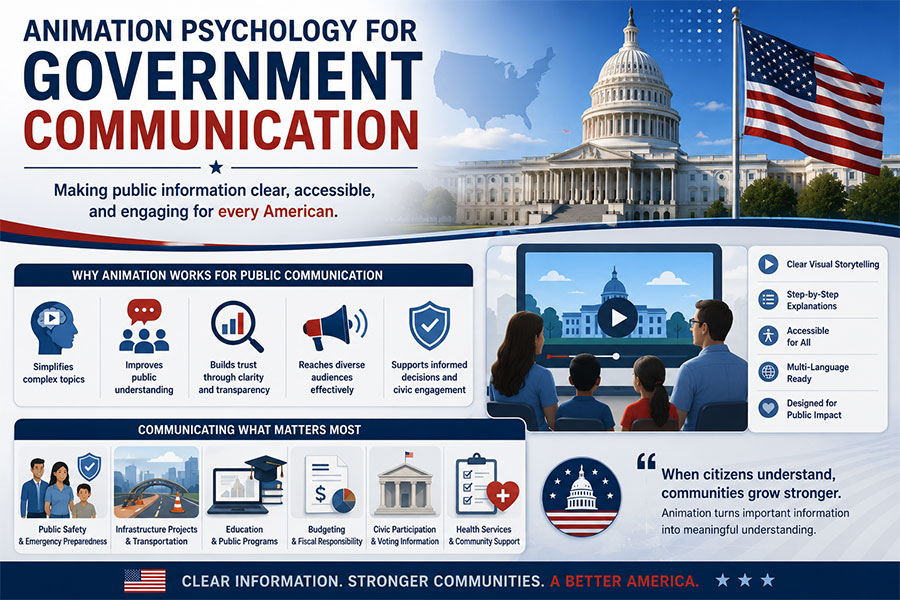
Animation can help explain:
- Programs
- Procedures
- Public services
- Infrastructure
- Emergency preparation
- Policy
- Transportation
A strong public-sector animation should focus less on spectacle and more on:
✓ Clear sequencing
✓ Accessible language
✓ Visual hierarchy
✓ Appropriate pacing
✓ Inclusive design
Motion should make public information easier to understand.
Animation Psychology in Manufacturing and Engineering
Technical animation often involves a large amount of information.
Motion can isolate one process at a time.
For example:
Machine exterior
↓
Housing becomes transparent
↓
Component highlighted
↓
Component moves
↓
Flow path appears
↓
Performance data displayed
The animation determines the order in which the viewer encounters information.
This can be much clearer than showing a complete engineering diagram immediately.
Animation Psychology for Product Demos
Product demonstrations benefit from attention control.
A good sequence might be:
1. Establish the Product
Show the entire object.
2. Focus
Move closer to the important area.
3. Reveal
Open or separate the component.
4. Demonstrate
Show what the component does.
5. Explain
Add a concise label.
6. Reassemble
Return to the overall product.
The viewer always knows:
- Where they are
- What they are looking at
- Why it matters
Choosing an Animation Style Based on Psychology
Different animation styles create different perceptual experiences.
Motion Graphics
Excellent for:
- Hierarchy
- Data
- Typography
- Fast communication
2D Character Animation
Excellent for:
- Emotion
- Stories
- Human situations
- Abstract services
3D Animation
Excellent for:
- Spatial understanding
- Products
- Environments
- Realistic movement
Whiteboard Animation
Useful for:
- Sequential explanation
- Teaching
- Process
Kinetic Typography
Useful for:
- Verbal emphasis
- Short messaging
- Advertising
Our guide to 15 Animation Styles: Choosing the Best Style of Animation compares these and other approaches in greater detail.
Is Fast Animation More Attention Grabbing?
It can be.
But faster does not automatically mean better.
Fast motion may:
✓ Create energy
✓ Capture attention
✓ Communicate urgency
But it can also:
✗ Reduce comprehension
✗ Make text unreadable
✗ Create fatigue
✗ Feel chaotic
The correct speed depends on the communication objective.
Is More Motion Better?
No.
One of the most useful principles in motion psychology is:
Movement becomes powerful through contrast with stillness.
If every object moves continuously, the audience has no clear focal point.
Consider:
Weak
Six icons bouncing.
Background moving.
Text sliding.
Camera zooming.
Logo rotating.
Strong
Everything remains still.
One product component rotates.
The eye immediately understands what matters.
Selective movement is often stronger than constant movement.
Should Text Move?
Yes—when the movement contributes to hierarchy or meaning.
Useful text animation can:
- Introduce information sequentially
- Connect labels to objects
- Emphasize keywords
- Reinforce pacing
But text should usually become stable long enough to read.
A sentence that continues moving while the viewer tries to read it creates unnecessary effort.
Should Backgrounds Move?
Sometimes.
Subtle background motion can create:
- Atmosphere
- Depth
- Energy
But background animation should remain visually subordinate to foreground information.
If viewers pay more attention to the background particles than the product, the hierarchy has failed.
Sound and Animation Psychology
Sound can reinforce visual attention.
For example:
Object lands → impact sound
The auditory event strengthens the visual event.
Sound can also create expectation.
A rising tone suggests that something is approaching.
Silence can create anticipation.
Music can influence emotional interpretation.
Sound and motion should therefore be designed together whenever the final environment allows audio.
The Role of Surprise
Unexpected change captures attention.
Animation can use surprise through:
- Transformations
- Scale changes
- Unusual transitions
- Impossible movement
- Reveals
But surprise should connect to the message.
An impressive transformation that has nothing to do with the product may be remembered more strongly than the advertisement itself.
The strongest surprise says:
“I didn’t expect that—and now I understand something important.”
Curiosity and Incomplete Information
Animation can deliberately delay information.
A product might appear only partially.
The camera moves closer.
A cover opens.
The viewer wants to see what is inside.
This creates curiosity.
However, the reveal should happen quickly enough that curiosity does not become frustration.
Good pacing manages the gap between:
Question
and:
Answer.
Why Before-and-After Animation Works
Before-and-after structures are easy to understand because they create contrast.
Before
Problem.
Transformation
Animation demonstrates change.
After
Improved state.
This works well for:
- Software
- Construction
- Products
- Healthcare
- Business processes
The motion becomes the bridge between the two states.
How to Use Animation Psychology in Storyboarding
Psychological principles should be considered before animation begins.
During storyboarding, ask:
- Where should the viewer look first?
- What changes?
- What remains still?
- What information appears next?
- Does the viewer have time to understand it?
- Does movement explain something?
- What emotion should the scene create?
- Is the motion appropriate for the audience?
- Can unnecessary elements be removed?
- What should the viewer remember afterward?
This turns animation psychology into a practical production tool.
A Simple Attention Framework for Animation
Use this sequence:
ATTRACT
Use motion, contrast, composition, or change to earn attention.
DIRECT
Guide the eye toward the correct information.
EXPLAIN
Use movement to demonstrate relationships, processes, or meaning.
PAUSE
Give the audience time to process.
REINFORCE
Repeat or summarize the important idea.
MOVE ON
Transition only when the viewer has enough information.
This structure can work across:
- Advertising
- Product videos
- Explainers
- Education
- Websites
- Public-sector communication
Common Animation Psychology Mistakes
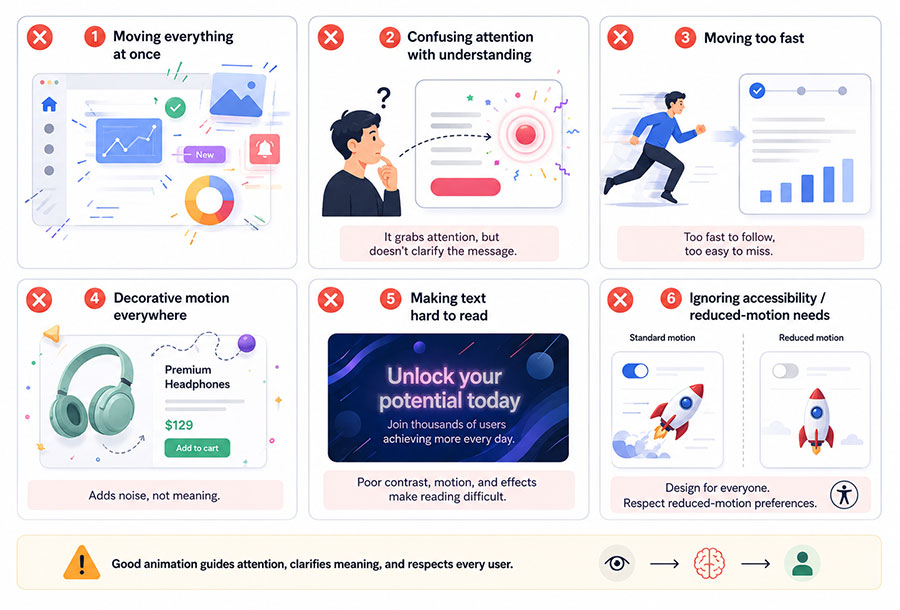
1. Moving Everything
Creates competition rather than hierarchy.
2. Confusing Attention With Understanding
Looking does not mean comprehending.
3. Moving Too Fast
Audiences need processing time.
4. Using Decorative Motion Everywhere
Movement should contribute to communication.
5. Ignoring Stillness
Pauses create emphasis.
6. Making Text Difficult to Read
Typography needs stability.
7. Using Emotion Without Relevance
Emotional animation should support the message.
8. Forgetting Accessibility
Some viewers need reduced motion.
9. Using Surprise Without Meaning
Spectacle can overshadow the message.
10. Ignoring the Audience
Animation for children, engineers, executives, consumers, and public-sector audiences may require different pacing and visual approaches.
What Makes Animation Psychologically Effective?
Psychologically effective animation usually has:
✓ A clear focal point
✓ Purposeful movement
✓ Appropriate pacing
✓ Visual hierarchy
✓ Meaningful transitions
✓ Controlled cognitive load
✓ Relevant emotional cues
✓ Enough processing time
✓ Strong connection between motion and message
✓ Accessibility considerations
It should not feel like movement was added simply because the medium allows it.
Animation Psychology Is About Controlling Attention
Animation gives creators something static design cannot:
Control over change through time.
That allows a designer to decide:
Look here first.
Then:
Look here.
Then:
Watch what happens.
Then:
Understand why it matters.
That is the core psychological advantage of animation.
Motion can capture attention because humans are sensitive to environmental change.
But effective animation goes further.
It transforms attention into:
- Understanding
- Emotion
- Recognition
- Story
- Action
The best animation does not make every element move.
It makes the right element move at the right moment.
That distinction is what turns motion from decoration into communication.
Frequently Asked Questions
Why does animation capture human attention?
Animation captures attention because the human visual system is highly sensitive to movement and change in the environment. Motion can create an immediate attentional signal, especially when it contrasts with otherwise stable visual information. Effective animation uses this response to direct viewers toward meaningful information rather than creating movement everywhere.
What is animation psychology?
Animation psychology is the study and practical application of how movement, timing, visual hierarchy, color, characters, facial expressions, storytelling, sound, and other animated elements influence attention, perception, understanding, emotion, and viewer behavior.
Does animation improve memory?
Animation can support memory when movement helps organize, explain, or reinforce meaningful information. However, animation does not automatically improve memory. Excessive or irrelevant movement can distract viewers, while purposeful animation can connect memorable visual events with important messages.
Can too much animation reduce attention?
Yes. Excessive animation can divide attention between competing elements and increase cognitive load. When everything moves, viewers may struggle to identify what matters. Selective movement, pauses, visual hierarchy, and controlled pacing usually provide clearer communication.
How can businesses use animation psychology?
Businesses can use animation psychology to guide viewers toward products, benefits, processes, data, calls to action, and other important information. Motion can help explain complex concepts, demonstrate products, structure stories, reinforce branding, support advertising, improve digital experiences, and make otherwise invisible processes easier to understand.