Visual storytelling in animation is the use of movement, composition, timing, characters, color, camera language, transitions, environments, and visual symbolism to communicate meaning through images over time.
A character does not need to say:
“I am nervous.”
Their eyes can shift toward the door.
Their shoulders can tighten.
Their hand can hesitate before touching the handle.
The camera can move closer.
The music can disappear.
The room can suddenly feel much larger around them.
Nothing has been explained verbally.
Yet the audience understands that something has changed.
That is visual storytelling.
Animation gives creators unusually precise control over this language because almost everything on screen can be deliberately designed:
- Where the viewer looks
- How quickly an object moves
- When a character reacts
- How large something appears
- Which colors dominate
- How the camera travels
- What changes between scenes
- What remains still
- What information is revealed
- What information is withheld
For businesses, filmmakers, advertisers, enterprises, technology companies, manufacturers, government agencies, NGOs, and public-sector organizations, this creates opportunities well beyond entertainment.
Animation storytelling can make a product easier to understand.
It can turn an abstract process into a visible journey.
It can make data feel consequential.
It can show relationships that cannot be photographed.
It can communicate without depending entirely on narration.
The key is understanding that motion itself carries meaning.
The question is not simply:
“What should we animate?”
It is:
“What should the audience understand from the way it moves?”
Motion Doesn’t Just Move Objects—It Changes Meaning
Take a simple object:
A red ball.
Place it in the center of the screen.
Nothing happens.
The ball is simply an object.
Now animate it.
Version 1
The ball slowly rises.
It may feel:
- Light
- Magical
- Calm
- Mysterious
Version 2
The ball shoots upward instantly.
It may feel:
- Powerful
- Energetic
- Surprising
Version 3
The ball shakes before moving.
Now the audience anticipates something.
Version 4
The ball slowly rolls toward the edge of a cliff.
Now there is tension.
Version 5
The ball bounces toward a character who turns away.
Now movement becomes part of a relationship.
The graphic object did not change.
Its motion changed its meaning.
This is one of the foundations of visual storytelling in animation.
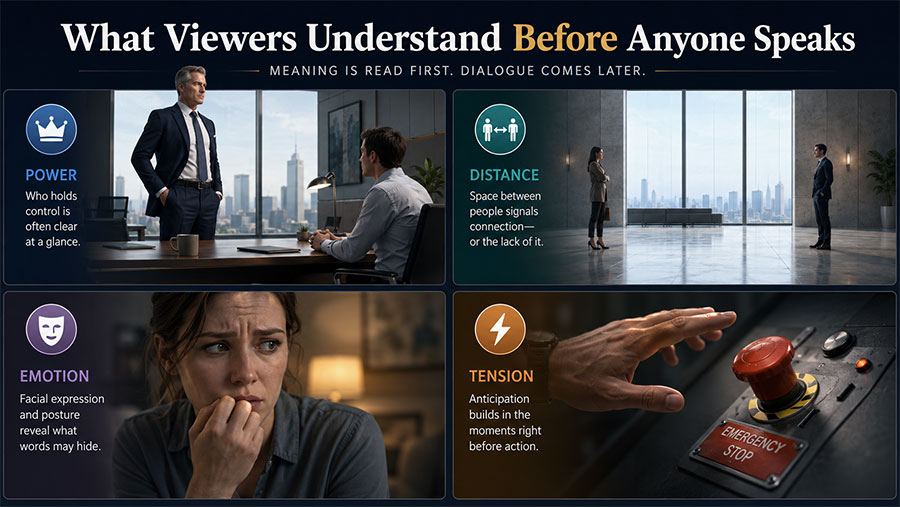
What Viewers Understand Before Anyone Speaks
Audiences constantly interpret visual information.
They notice:
- Distance
- Scale
- Direction
- Posture
- Speed
- Contrast
- Facial expression
- Environment
- Repetition
- Change
A filmmaker can therefore communicate an enormous amount before dialogue begins.
Imagine two characters standing in an office.
Version A
They stand beside one another at equal height.
The camera is at eye level.
The lighting is even.
The scene may feel neutral.
Version B
One character is seated.
The other stands over them.
The camera looks upward toward the standing character.
Now a power relationship may be implied.
Version C
The characters stand on opposite sides of a large table.
The space between them dominates the frame.
Now the composition may suggest disagreement or emotional distance.
The script could remain exactly the same.
The visual storytelling changes how the scene is interpreted.
The Visual Language of Animation
An animated sequence can communicate through several visual systems simultaneously.
| Visual Tool | What It Can Communicate |
|---|---|
| Composition | Importance, balance, isolation, relationships |
| Scale | Power, vulnerability, importance |
| Camera distance | Context versus emotional intimacy |
| Camera angle | Authority, neutrality, weakness |
| Movement | Energy, intention, direction |
| Timing | Weight, urgency, emotion |
| Character acting | Thoughts, feelings, reactions |
| Color | Mood, differentiation, emphasis |
| Lighting | Atmosphere, focus, depth |
| Environment | Context, culture, situation |
| Sound | Emotion, rhythm, impact |
| Transitions | Relationship between ideas or scenes |
| Visual metaphor | Abstract concepts |
| Repetition | Patterns, themes, brand recognition |
| Contrast | Difference, change, priority |
| Stillness | Emphasis, anticipation, reflection |
Strong animation usually combines several of these rather than depending on one technique.
Composition Decides What Matters Before Anything Moves
Visual storytelling begins before animation.
A single still frame already contains information.
Composition determines:
- Where subjects appear
- How large they are
- How they relate
- Where empty space exists
- What the viewer notices first
Imagine a character standing in an enormous empty room.
If the character occupies only 5% of the screen, the environment becomes dominant.
That can communicate:
- Isolation
- Vulnerability
- Scale
Move the camera closer until the character’s face fills the frame.
Now the environment disappears.
The audience focuses on:
- Emotion
- Expression
- Thought
Nothing about the story itself necessarily changed.
The composition changed what information mattered.
Empty Space Can Tell Part of the Story
Negative space is not necessarily unused space.
It can create meaning.
A character positioned on the far left while staring toward empty space on the right creates expectation.
The audience may wonder:
What are they looking at?
A product placed against a large empty background can feel:
- Premium
- Important
- Minimal
- Controlled
A tiny machine surrounded by enormous industrial infrastructure may communicate scale.
Do not fill every part of the frame simply because space exists.
Sometimes the empty area is part of the message.
Camera Distance Changes Emotional Distance
Camera framing determines how close the audience feels to the subject.
Extreme Wide Shot
Answers:
Where are we?
Useful for:
- Cities
- Factories
- Landscapes
- Large systems
- Establishing scale
Wide Shot
Answers:
Who is here and what are they doing?
Medium Shot
Answers:
How is the character interacting?
Close-Up
Answers:
What should I notice?
Extreme Close-Up
Answers:
What tiny detail matters right now?
These choices apply to characters and products.
For a 3D machine demonstration:
Wide shot
shows the entire system.
Medium shot
shows one assembly.
Close-up
shows the locking mechanism.
The camera determines the level of understanding.
A Close-Up Is a Visual Sentence Saying “This Matters”
When filmmakers cut from a wide shot to a close-up, they are making a decision for the audience.
They are saying:
Look here now.
That is powerful.
If a product video repeatedly shows close-ups of irrelevant decorative details, those details may appear important.
If a character’s hand slowly reaches toward an emergency stop button and the camera moves closer, the audience understands that the button matters before it is pressed.
The camera is participating in the story.
Camera Angles Influence Perception
Angle also changes meaning.
Eye Level
Often feels:
- Neutral
- Direct
- Familiar
Low Angle
Looking upward can make a subject appear:
- Powerful
- Large
- Dominant
- Impressive
High Angle
Looking downward can make something appear:
- Small
- Vulnerable
- Organized within a larger system
Top-Down
Can communicate:
- Layout
- Geography
- Process
- Spatial relationships
There are no absolute emotional rules.
Context matters.
But camera position always influences what information is available.
Motion Functions Like a Verb
Static graphics are often nouns.
Animation gives them actions.
A machine:
rotates
A character:
hesitates
A chart:
rises
A product:
opens
A map:
expands
A warning:
flashes
A network:
connects
The verb matters.
Consider the difference between:
A product appears.
and:
A product crashes into frame.
or:
A product slowly emerges from darkness.
or:
A product assembles itself from hundreds of components.
Each entrance tells the audience something about how the product should feel.
Timing Gives Motion Personality
Movement without timing has very little emotional specificity.
The same product animation can communicate completely different brand personalities depending on speed.
Fast Movement
May feel:
- Energetic
- Efficient
- Urgent
- Youthful
Slow Movement
May feel:
- Premium
- Heavy
- Precise
- Calm
- Cinematic
Mechanical Movement
May feel:
- Engineered
- Controlled
- Industrial
Irregular Movement
May feel:
- Organic
- Unpredictable
- Nervous
Animation timing therefore becomes part of brand communication.
A luxury watch reveal should not necessarily move like a gaming advertisement.
A sports commercial may not benefit from the same pacing as a government safety video.
Weight Is Communicated Through Timing
Animation can make objects feel heavy or light even though neither has physical mass inside the digital scene.
Imagine a large metal door.
If it opens instantly:
It may feel weightless.
If it accelerates slowly:
It may feel heavy.
If surrounding components react:
Its mass becomes more convincing.
Animators can communicate weight through:
- Acceleration
- Deceleration
- Follow-through
- Vibration
- Secondary movement
- Sound
This is visual storytelling because the audience learns something about the object through its behavior.
Stillness Makes Movement More Powerful
Constant animation reduces contrast.
If everything moves:
- Background
- Text
- Product
- Camera
- Icons
- Particles
the viewer may struggle to understand what deserves attention.
A stronger scene may remain nearly still.
Then one object moves.
The audience notices immediately.
Stillness can also communicate:
- Tension
- Reflection
- Confidence
- Anticipation
- Scale
The previous guide on Animation Psychology: Why Motion Captures Human Attention explores this relationship between motion, attention, pacing, cognitive load, and selective visual focus in greater depth.
Anticipation Tells the Viewer Where to Look
Before an important action occurs, animation can prepare the audience.
A character looks upward.
The audience looks upward.
Then something falls.
A machine starts vibrating.
The audience watches it.
Then the mechanism opens.
A line begins drawing toward a graph.
The audience follows it.
Then the important number appears.
Anticipation creates a visual relationship between:
what is happening now
and:
what is about to happen.
This helps animation feel understandable rather than random.
Character Acting Can Replace Exposition
Characters communicate through more than dialogue.
A character can express emotion using:
- Posture
- Eyes
- Head position
- Hands
- Walking speed
- Distance from others
- Reaction timing
Imagine a customer opening a package.
Version A
They immediately smile broadly.
Version B
They pause.
Their eyebrows rise.
They turn the product over.
Then they smile.
Version B may feel more believable because there is a progression:
Curiosity → evaluation → satisfaction
Animation allows these emotional beats to be designed precisely.
Reaction Often Matters More Than Action
Suppose an animated machine suddenly stops.
The action itself communicates:
The machine stopped.
Now show an operator reacting.
Their expression communicates:
The stoppage is unexpected.
Without the reaction, the audience knows what happened.
With the reaction, the audience begins to understand what it means.
This is why reaction shots are so valuable in storytelling.
They interpret events for the viewer.
Where a Character Looks Can Guide the Audience
Character gaze can become an invisible arrow.
If a character looks toward:
- A product
- A button
- Another character
- A warning
- A doorway
the audience often follows.
This allows character animation to help establish visual hierarchy.
For example:
Character looks toward dashboard
↓
Camera moves closer
↓
Important metric changes
The eye direction prepares the viewer for the next visual event.
Silent Animation Reveals Whether the Story Is Actually Visual
One useful test for animated storytelling is:
Turn off the narration.
Can the viewer still understand:
- Who is involved?
- What changed?
- What matters?
- What the product does?
- What problem exists?
- What the outcome is?
Not every video should work entirely without sound.
But visual storytelling becomes stronger when animation is not simply decorative imagery underneath narration.
The British Film Institute has highlighted how silent cinema communicated complex emotion and information through gesture, facial expression, body language, and movement. Its Beyond Words: The Power of Visual Storytelling resource provides a useful reminder that compelling screen storytelling does not require dialogue to communicate meaning.
Animation can build on the same principle.
Color Can Organize a Story
Color does not need to carry a universal psychological meaning to be useful.
Instead, it can establish a visual system.
Imagine a technical animation.
Blue
Normal operation.
Orange
Component currently being explained.
Red
Problem.
Green
Successful result.
After several scenes, viewers learn what the colors mean.
Now color communicates without requiring repeated explanation.
Color Can Show Change Over Time
Imagine a map.
It begins mostly gray.
A region turns blue.
Then another.
Then another.
Without narration, the audience understands expansion.
Or consider a medical animation.
Healthy tissue uses one visual treatment.
Affected tissue changes appearance.
Treatment begins.
The visual state changes again.
Color can make transformation visible.
Lighting Directs Emotion and Attention
3D animation adds another powerful storytelling variable:
lighting.
Imagine the same product.
Bright White Environment
May feel:
- Clinical
- Technical
- Clean
- Informational
Dark Environment With Rim Lighting
May feel:
- Premium
- Dramatic
- Mysterious
- Cinematic
Warm Environment
May feel:
- Comfortable
- Human
- Familiar
Lighting also controls where viewers look.
A bright subject against a dark environment becomes visually dominant.
Environments Tell Us What Kind of Story We Are Watching
A product does not exist in isolation unless the production chooses to isolate it.
Place the same object in:
A laboratory
and it may feel scientific.
Place it in:
A construction site
and it may feel rugged.
Place it in:
A luxury apartment
and it may feel premium.
Place it in:
A futuristic environment
and it may feel innovative.
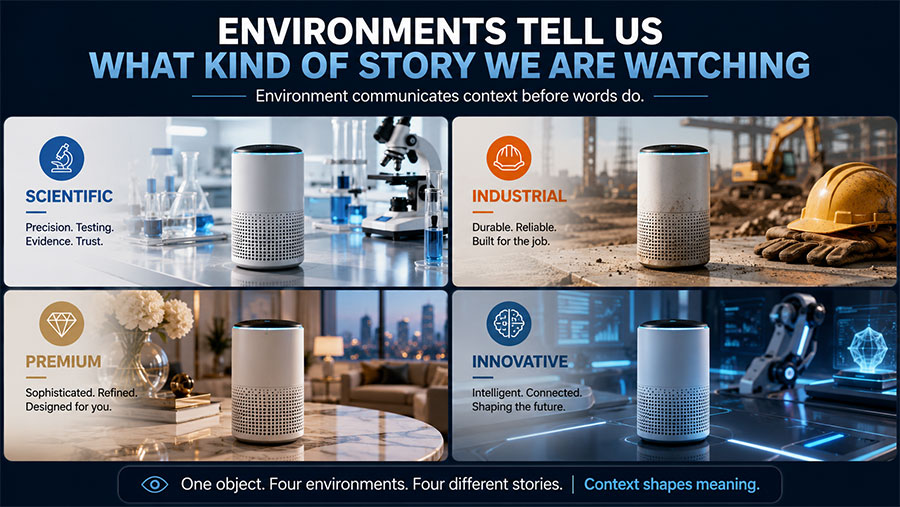
Environment communicates:
- Context
- Audience
- Scale
- Use case
- Brand positioning
before anyone explains the product.
Background Details Can Support or Sabotage the Story
More detail is not automatically better.
If a technical product demo contains:
- Moving workers
- Vehicles
- Blinking monitors
- Machinery
- Particles
- Signs
- Equipment
the environment may compete with the actual product.
A good background supports the story.
It should not become a second story fighting for attention.
Visual Metaphor Makes Abstract Ideas Visible
Many business concepts do not have a literal appearance.
What does:
- Trust
- Cybersecurity
- Efficiency
- Growth
- Collaboration
- Artificial intelligence
look like?
Animation can create visual metaphors.
Cybersecurity
Layers forming around data.
Growth
A system expanding.
Collaboration
Separate paths converging.
Efficiency
A complicated workflow becoming shorter.
Integration
Disconnected systems connecting.
Risk
A chain reaction moving outward.
The metaphor turns abstraction into something visible.
Good Metaphors Clarify; Bad Metaphors Add Another Problem
Not every metaphor helps.
If an abstract concept requires a long explanation before the viewer understands the metaphor, the animation has added complexity.
Useful metaphors should usually be:
- Intuitive
- Consistent
- Relevant
- Visually simple
For example:
Disconnected nodes → connected network
is easy to understand as integration.
A highly elaborate fantasy sequence may be beautiful but unnecessary if the objective is to explain a software API.
Motion Graphics Turn Information Into Events
Motion graphics are especially powerful for visual storytelling in animation because they make information behave.
A statistic does not simply appear.
It:
increases
A timeline:
progresses
A process:
connects
A headline:
transforms
A chart:
builds
This helps audiences see relationships over time.
Professional motion graphics combine typography, shapes, illustrations, charts, icons, visual effects, and animation to make information easier to sequence and emphasize.
Typography Can Become Part of the Story
Animated text can do more than display words.
Consider:
FAST
appearing quickly.
The motion reinforces the meaning.
Or:
HEAVY
dropping forcefully into place.
Again, movement and language work together.
Typography can:
- Expand
- Contract
- Scatter
- Assemble
- Follow objects
- Become objects
But the audience still needs to read it.
Movement should support the word rather than make it difficult to understand.
Transitions Can Connect Ideas
A transition is not merely the gap between scenes.
It can show that two ideas are related.
Imagine:
Gear rotates
↓
Gear becomes circular chart
The transition says:
The mechanical performance we just saw is connected to this data.
Or:
City map
↓
Lines transform into data network
The audience moves from geography to infrastructure without a hard conceptual break.
Transitions can create continuity.
A Cut Can Be More Powerful Than an Elaborate Transition
Not every scene needs to morph into the next.
Sometimes a direct cut is the clearest choice.
For example:
Problem
CUT
Solution
The contrast becomes immediate.
Transitions should be chosen because they help:
- Continuity
- Comparison
- Rhythm
- Meaning
not because every scene needs a visual trick.
Repetition Creates Visual Grammar
Animation can teach the audience its own rules.
Imagine that throughout a product video:
Blue glow = active component
Every time a new component activates, the same blue glow appears.
After the first few scenes, no explanation is necessary.
The audience understands:
Blue means active.
This is visual grammar.
Other repeated rules might include:
- Dashed line = data transfer
- Orange = risk
- Zoom-in = technical detail
- White background = overview
- Dark background = cinematic feature reveal
Consistency reduces the amount of explanation required.
Animation Can Tell the Audience Where They Are in a Process
Processes are difficult to understand when viewers lose track of sequence.
Visual storytelling can preserve orientation.
Imagine a five-step workflow.
At the top of the screen:
1 → 2 → 3 → 4 → 5
As each scene plays, one number becomes active.
Now the viewer always knows:
- Where they are
- What came before
- What remains
This is particularly valuable for:
- Training
- Government communication
- Technical procedures
- Software
- Healthcare
Scale Can Communicate Importance
Make one object dramatically larger than another and the audience interprets a relationship.
A massive threat approaching a small character feels dangerous.
A huge product dominating the screen feels important.
A small icon beside an enormous data network communicates complexity.
Animation can also change scale over time.
A tiny object grows.
The audience understands increasing importance.
A massive problem shrinks.
The audience understands resolution.
Perspective Can Make Complicated Systems Understandable
Some systems operate across several levels.
Consider an enterprise technology platform.
Scene 1
Individual employee.
Scene 2
Camera pulls back.
Department appears.
Scene 3
Camera pulls back again.
Enterprise appears.
Scene 4
Multiple locations connect.
The audience learns:
This began as one action and now operates across the organization.
Camera scale itself becomes the explanation.
The Order of Information Changes the Story
Storytelling is not only about what is shown.
It is about when it is shown.
Consider a product failure.
Version A
Show broken component first.
Then show machine stopping.
Version B
Show machine stopping.
Operator reacts.
Then reveal broken component.
Version B creates a question:
Why did it stop?
Then provides an answer.
The same information is present.
The sequence changes the experience.
Reveal Is One of Animation’s Most Useful Storytelling Tools
Animation can deliberately withhold information.
A product enters frame in silhouette.
Light moves across it.
A detail becomes visible.
Then the full product appears.
Or:
A machine is shown from outside.
Housing becomes transparent.
Internal mechanism appears.
The viewer experiences discovery.
This can create:
- Curiosity
- Suspense
- Understanding
- Visual reward
Storytelling Can Exist in a 10-Second Product Clip
A story does not require:
- Characters
- Dialogue
- Conflict
- Three acts
A product animation can contain a miniature story.
Beginning
Product is closed.
Change
Components separate.
Discovery
Internal technology appears.
Resolution
Product reassembles.
The object itself experiences a visual journey.
That is storytelling.
Business Animation Still Needs a Story
Business communication sometimes assumes storytelling is only appropriate for entertainment.
But even highly technical subjects benefit from structure.
Consider:
Without Story
- Feature
- Feature
- Feature
- Feature
With Story
Problem
↓
Product introduced
↓
Product operates
↓
Critical feature revealed
↓
Result improves
The information becomes easier to follow because there is progression.
Visual Storytelling for Product Demonstrations
Product animation should answer questions visually.
Instead of writing:
“Easy maintenance.”
show:
Panel unlocks → filter slides out → replacement slides in → panel closes
The benefit becomes an event.
Instead of saying:
“Compact.”
show the product entering a space where a larger alternative does not fit.
Instead of:
“Improved airflow.”
show airflow following the redesigned path.
The principles developed in Animation for Product Demos: 2D vs 3D Animation for Products are useful because visual storytelling should always be connected to the information the product needs to communicate.
Visual Storytelling in Advertising
Advertising often compresses storytelling into seconds.
A commercial may need to establish:
Problem → product → benefit → brand
in 15 or 30 seconds.
Animation can compress time.
A complicated transformation that would take months in real life can happen instantly.
A product can move from:
Design → manufacturing → customer
within seconds.
A visual metaphor can represent an entire concept.
The audience does not need every intermediate step if the visual sequence remains understandable.
Visual Storytelling in Film and Documentary Animation
Film and documentary production can use animation to represent:
- Memory
- History
- Scientific processes
- Missing footage
- Imagined worlds
- Internal emotions
A documentary might transition from:
Interview
to:
Animated map
to:
Historical reconstruction
to:
Archival photograph
Each medium contributes something different.
Our guide to Film Animation for Documentaries, TV Commercials & Movies looks more closely at how animation can support cinematic, advertising, historical, and documentary storytelling.
Visual Storytelling for Technology
Technology companies frequently need to communicate invisible systems.
Examples include:
- APIs
- Artificial intelligence
- Cybersecurity
- Cloud infrastructure
- Data pipelines
- Automation
Visual storytelling may turn them into sequences.
For example:
User request
↓
Data enters platform
↓
AI analyzes
↓
Risk identified
↓
Human reviews
↓
Action continues
The system becomes something the audience can watch.
Visual Storytelling for Manufacturing
Manufacturing animation can make hidden processes visible.
A scene might begin outside a machine.
Then:
Housing disappears
↓
Camera moves inward
↓
Material enters
↓
Mechanical process occurs
↓
Finished output exits
The audience follows the process spatially and chronologically.
This is more than product visualization.
It is a story about transformation.
Visual Storytelling for Healthcare
Healthcare animation can show:
- Anatomy
- Disease progression
- Treatment
- Device operation
The story may be:
Current condition
↓
Treatment introduced
↓
Biological change
↓
Improved state
Good healthcare storytelling should prioritize:
- Accuracy
- Clarity
- Appropriate pacing
- Appropriate emotional tone
Visual drama should not distort medical information.
Visual Storytelling for Government Communication
Government and public-sector animation may need to explain:
- Programs
- Services
- Policy
- Infrastructure
- Emergency preparedness
- Public health
- Transportation
The narrative might follow a citizen.
For example:
Resident needs service
↓
Visits portal
↓
Completes application
↓
Agency processes request
↓
Resident receives result
The citizen gives the process a human perspective.
That can be easier to understand than simply listing administrative steps.
Visual Storytelling Without Characters
Characters are useful.
They are not required.
A story can be told entirely through:
- Products
- Shapes
- Data
- Architecture
- Maps
- Machines
- Typography
Consider a manufacturing animation:
Raw material enters
↓
Material transforms
↓
Quality check occurs
↓
Finished product exits
There may not be a single human character.
Yet there is still:
- Beginning
- Change
- Sequence
- Result
That is enough to create narrative structure.
Sound Can Change the Meaning of the Same Visual
Show a machine operating.
Add:
Heavy mechanical sound
and it feels powerful.
Add:
Soft electronic sound
and it feels precise.
Add:
Aggressive cinematic music
and it feels dramatic.
Show the same scene silently.
Now the audience may focus more on visual mechanics.
Sound is therefore part of visual storytelling even though it is not visual.
It changes how imagery is interpreted.
Music Can Establish Emotional Expectation
Music can tell viewers how to interpret what is happening.
A slow visual sequence combined with optimistic music may feel inspiring.
The same sequence with ominous music may feel threatening.
The picture does not exist in isolation.
Animation storytelling should consider:
- Image
- Motion
- Voice
- Music
- Effects
as one communication system.
Storyboarding Is Where Visual Storytelling Becomes Concrete
Visual storytelling should not be invented only after animation begins.
The storyboard determines:
- Shot order
- Composition
- Camera
- Reveals
- Character reactions
- Transitions
- Timing
A storyboard can answer:
What does the audience know in this shot?
Then:
What new information do they learn in the next one?
That question is fundamental.
Our Animation Storyboarding: How to Design Storyboards for Video guide explains how scripts can be translated into shots, camera directions, visual beats, timing notes, and animatics before final production.
Build a Visual Grammar Before You Animate
For complex projects, define consistent visual rules.
For example:
Color
- Blue = normal
- Orange = active
- Red = warning
Camera
- Wide = overall system
- Close-up = technical detail
Lines
- Solid = physical connection
- Dashed = data
Motion
- Clockwise = normal operation
- Pulsing = attention required
Now the animation has its own language.
Once viewers learn it, communication becomes more efficient.
The Ten-Second Test
Take any ten-second section of an animation.
Ask:
1. What should the viewer notice first?
There should be a clear answer.
2. What changes?
Movement should contribute information.
3. What does that change mean?
If it means nothing, reconsider it.
4. Does the viewer know where to look next?
Visual hierarchy should guide them.
5. Could anything be removed?
Clarity often improves through subtraction.
This simple test can expose scenes that contain movement but little communication.
When Visual Storytelling Starts Working Against the Message
Visual storytelling can fail in predictable ways.
Everything Moves
The audience has no focal point.
Camera Never Stops
Spatial orientation becomes difficult.
Every Scene Uses a Different Visual Rule
The audience has to relearn the language repeatedly.
Metaphors Are Too Complicated
The explanation requires another explanation.
Text Repeats Exactly What the Visual Shows
The animation adds little value.
Visuals Contradict Narration
Audience understanding becomes unstable.
Style Dominates Meaning
The project looks impressive but communicates poorly.
No Time Exists to Process Information
The audience is always catching up.
Sound Carries Everything
The visuals become decorative.
No Story Progression Exists
The video becomes a collection of scenes rather than a coherent experience.
Do Not Animate Something Simply Because You Can
Animation offers almost unlimited movement.
That is exactly why restraint matters.
A camera can:
- Fly
- Spin
- Orbit
- Accelerate
- Travel through objects
A product can:
- Explode
- Transform
- Float
- Dissolve
Text can:
- Bounce
- Rotate
- Scatter
- Morph
The question should always remain:
Does this help communicate something?
If the answer is no, the effect may be unnecessary.
A Useful Visual Storytelling Planning Exercise
Before storyboarding, write three columns.
| What the Audience Must Understand | What They Should See | What Changes |
|---|---|---|
| Product has simple maintenance | Filter slides out | Housing opens |
| Data moves automatically | Nodes connect | Lines travel |
| System reduces steps | Workflow becomes shorter | Extra steps disappear |
| Product is compact | Product compared with available space | Scale becomes visible |
| Problem is resolved | Warning disappears | Screen returns to normal |
This forces the team to connect:
message
with:
visual evidence.
Visual Storytelling Can Reduce Dependence on Narration
Many videos use voiceover as the primary communication system.
Then animation simply illustrates it.
A stronger production can divide responsibility.
Narration
Provides context.
Animation
Demonstrates.
Typography
Emphasizes.
Sound
Reinforces.
For example:
Narration:
“Maintenance takes seconds.”
Visual:
Housing opens and filter slides out immediately.
The visual proves the statement.
What Should the Audience Remember?
This question should influence the entire production.
If the audience should remember:
The product is easy to maintain
then the animation should create a memorable maintenance moment.
If they should remember:
The platform connects systems
then connection should become a recurring visual idea.
If they should remember:
The organization protects people
then the animation should visually reinforce protection.
Do not rely on the final sentence to establish the main message.
Build it into the visual language.
The Best Visual Storytelling Is Often Simple
Complexity is easy to create.
Clarity is harder.
A sophisticated animation may contain:
- Beautiful modeling
- Detailed environments
- Advanced simulation
- Cinematic lighting
but still communicate poorly.
Another animation may use:
Three shapes and one line
and make the process immediately understandable.
Production value matters.
But visual storytelling is ultimately about meaning.
Older Visual Storytelling Craft and Modern Motion Design
Just Animations has previously explored the broader creative craft in The Art of Visual Storytelling: Exploring the Depths of Animation Craftsmanship, including character, environment, design, and cinematic storytelling.
Modern animation expands that conversation into:
- Product visualization
- Enterprise communication
- Interfaces
- Data
- Motion graphics
- Technical processes
- Interactive media
The medium changes.
The fundamental question remains:
How do images communicate meaning over time?
Visual Storytelling Gives Motion a Purpose
An animation is not a story simply because something moves.
Movement becomes storytelling when it creates:
- Information
- Emotion
- Relationships
- Cause and effect
- Change
- Anticipation
- Resolution
The strongest visual storytelling in animation connects every important motion decision to an audience outcome.
The camera moves because viewers need to see something.
The character reacts because viewers need to understand how an event feels.
The product opens because viewers need to understand what is inside.
The color changes because the system has entered a different state.
The scene becomes still because the moment needs emphasis.
The transition transforms one image into another because the concepts are connected.
That is how motion shapes meaning.
Not through movement alone.
Through intentional movement.
For businesses, companies, enterprises, advertisers, filmmakers, manufacturers, technology companies, government agencies, NGOs, and public-sector organizations, this distinction can determine whether animation is merely attractive or genuinely useful.
A strong animated story does not simply show the audience more.
It controls:
what they see,
when they see it,
how they interpret it,
and:
why it matters.
That is the real power of animation storytelling.
Frequently Asked Questions
What is visual storytelling in animation?
Visual storytelling in animation is the use of movement, composition, camera framing, characters, timing, color, lighting, transitions, environments, visual metaphor, and other animated elements to communicate information, emotion, relationships, and narrative meaning through images over time.
How does motion help tell a story in animation?
Motion communicates action, intention, timing, weight, change, direction, and cause and effect. The way an object or character moves can influence how viewers interpret it. Fast, slow, hesitant, heavy, smooth, or abrupt movement can each communicate different meanings even when the visual object itself remains the same.
Can animation tell a story without dialogue?
Yes. Animation can communicate through facial expression, character posture, movement, composition, camera direction, visual metaphor, color, environment, transitions, music, and sound effects. Silent films and animated productions demonstrate that complex emotions and narrative information can be communicated without spoken dialogue.
Why is storyboarding important for visual storytelling?
Storyboarding allows creators to plan what the audience sees, the order in which information is revealed, camera positions, compositions, character reactions, movement, timing, and transitions before full animation begins. It helps determine whether the visual story works before expensive production stages are completed.
How can businesses use visual storytelling in animation?
Businesses can use visual storytelling to demonstrate products, explain software, visualize technical systems, communicate data, illustrate customer journeys, simplify complex services, support advertising, improve training, and make otherwise invisible processes easier for audiences to understand. The most effective business animation connects visual movement directly to the message the audience needs to remember.