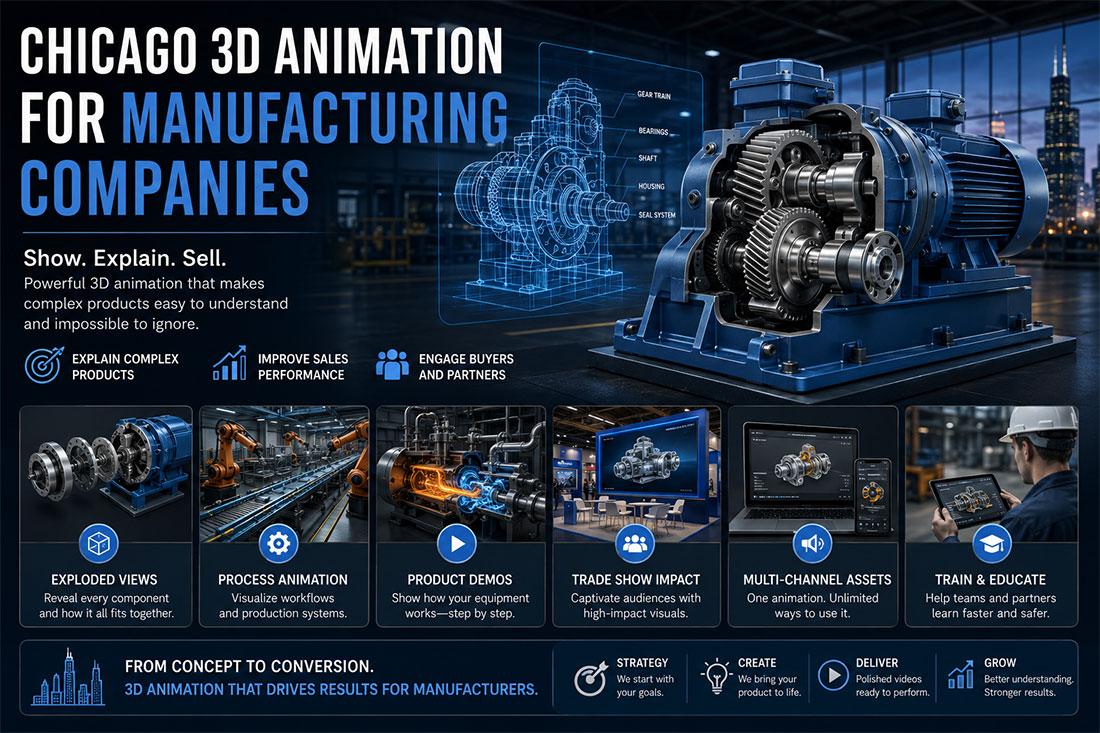
Chicago 3D animation for manufacturing companies helps industrial brands explain products, machinery, systems, and technical advantages with more clarity and visual impact.
That matters because manufacturing marketing is not always easy.
Many manufacturers sell products that are complex, large, engineered, internal, mechanical, or difficult to explain quickly. A buyer may need to understand how a machine works, how a component moves, how a system improves production, or why one technical feature is better than another.
A brochure can describe the product.
A photo can show what it looks like.
A live-action video can show the equipment in a real environment.
But 3D animation can show what happens inside the machine, inside the process, and inside the value proposition.
That is why manufacturing companies in Chicago and across the Midwest use 3D animation for marketing, sales, trade shows, product launches, distributor education, and buyer presentations.
A strong 3D animation does not just make manufacturing look more modern.
It makes the product easier to understand.
Chicago 3D Animation For Manufacturing Companies: The Short Answer
Chicago 3D animation for manufacturing companies is used to create animated visual content that explains industrial products, equipment, components, machinery, production lines, and technical processes.
It can be used for:
✓ Manufacturing marketing videos
✓ Industrial product videos
✓ Machinery animation
✓ 3D product demonstrations
✓ Exploded view animations
✓ Trade show booth videos
✓ Sales presentation assets
✓ Distributor training videos
✓ Product launch videos
✓ Website product explainers
✓ Technical process animations
✓ Safety and training videos
✓ Social media cutdowns
✓ Investor or executive presentations
The goal is not just to show machinery.
The goal is to help buyers understand why the machinery matters.
Manufacturing Animation Snapshot
| Manufacturing Need | How 3D Animation Helps | Common Output | Value Bar |
|---|---|---|---|
| Explain Machine Function | Shows how the equipment works step by step | 3D product demo | ██████████ |
| Show Internal Components | Reveals parts that are hidden in real life | Exploded view animation | ██████████ |
| Support Sales Teams | Gives reps a repeatable visual asset | Sales presentation video | █████████ |
| Improve Trade Show Impact | Makes booths more visually engaging | Looping booth animation | █████████ |
| Educate Distributors | Helps partners understand features and value | Distributor training video | ████████ |
| Launch New Equipment | Creates interest before or during release | Product launch animation | ████████ |
| Build Website Engagement | Makes product pages more useful | Web explainer video | ███████ |
Manufacturing buyers often need proof, clarity, and confidence.
3D animation helps by showing the product story visually.
Why Manufacturing Companies Need Better Visuals
Manufacturing companies often have strong products but weak marketing assets.
The product may be excellent.
The engineering may be impressive.
The performance may be better than competitors.
The sales team may understand the value clearly.
But if the buyer cannot see or understand the difference quickly, the marketing loses power.
That is common in manufacturing because many product advantages are hidden.
A machine may be more efficient because of an internal mechanism.
A component may reduce wear because of a specific design.
A production system may save time because of workflow automation.
A part may improve performance because of material engineering.
A safety feature may be valuable because of what it prevents.
These are hard ideas to communicate with static photos alone.
3D animation can turn those details into clear visual moments.
Why Chicago Is A Strong Market For Manufacturing Animation
Chicago has long been connected to manufacturing, logistics, engineering, food processing, packaging, industrial supply, fabrication, transportation, and business services.
Manufacturing companies in and around Chicago often serve buyers across the Midwest, North America, and global markets.
That means their marketing assets need to work beyond one local sales conversation.
They need to support:
- Website visitors
- Sales teams
- Distributors
- Trade shows
- Engineers
- Procurement teams
- Executives
- Training teams
- International buyers
- Channel partners
3D animation helps because one visual asset can be reused across several business functions.
A manufacturing animation can appear on a website, in a sales deck, at a trade show, in an email campaign, on LinkedIn, and in distributor training.
That makes it more than a video.
It becomes a marketing and sales tool.
Best Uses For 3D Animation In Manufacturing
3D animation works especially well when the product has internal details, mechanical movement, technical differentiation, or a process that is hard to film.
| Best Use | Best Animation Direction | Why It Works | Usefulness Bar |
|---|---|---|---|
| Machinery Product Videos | 3D product demo | Shows how equipment works visually | ██████████ |
| Exploded Views | Component breakdown animation | Reveals hidden parts and internal systems | ██████████ |
| Process Animation | Workflow or production line animation | Explains complex industrial processes clearly | █████████ |
| Trade Show Marketing | Looping booth animation | Attracts attention on busy show floors | █████████ |
| Sales Enablement | Short product explainer | Gives reps a clear visual support tool | ████████ |
| Distributor Education | Training-style product animation | Helps partners explain the product correctly | ████████ |
| Product Launches | Cinematic machinery reveal | Builds awareness and buyer interest | ███████ |
The best manufacturing animation should be practical.
It should look good, but it should also help a buyer understand the product faster.
Budget Ladder For Manufacturing 3D Animation
Manufacturing animation budgets vary based on product complexity, modeling requirements, animation length, technical accuracy, visual realism, and final deliverables.
| Budget Range | Best Fit | Typical Use | Relative Scope |
|---|---|---|---|
| $10K to $25K | Focused Industrial Animation | Simple product overview, short feature demo, basic motion graphics | ██ |
| $25K to $75K | Professional Manufacturing Video | Custom 3D product animation, exploded views, sales-ready content | █████ |
| $75K to $150K+ | Premium Industrial Animation | Complex machinery animation, trade show assets, product launch visuals | ████████ |
| $150K+ | Manufacturing Content System | Multiple product videos, training modules, distributor assets, campaign versions | ██████████ |
A larger budget should not simply mean a longer video.
It should mean better product clarity, stronger visual accuracy, more polished rendering, and more deliverables that can be used across marketing and sales.
Typical Pricing Breakdown For Manufacturing 3D Animation
Manufacturing animation usually requires more technical preparation than a simple corporate video.
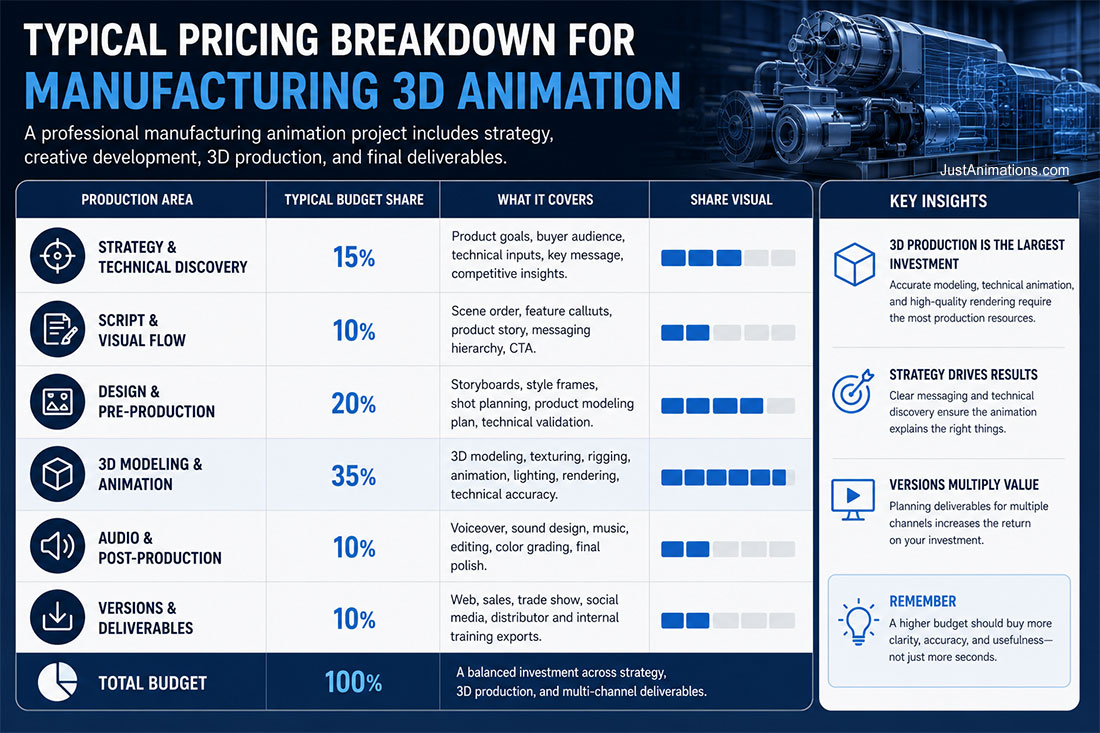
| Production Area | Typical Budget Share | What It Covers | Share Bar |
|---|---|---|---|
| Strategy & Technical Discovery | 15% | Product goals, buyer audience, technical inputs, key message | ███ |
| Script & Visual Flow | 10% | Scene order, feature callouts, product story, CTA | ██ |
| Design & Pre-Production | 20% | Storyboards, style frames, model planning, shot layout | ████ |
| 3D Modeling & Animation | 35% | Product modeling, movement, rigging, lighting, rendering | ███████ |
| Audio & Post-Production | 10% | Voiceover, sound design, music, editing, polish | ██ |
| Versions & Deliverables | 10% | Web, sales, trade show, social, distributor exports | ██ |
For manufacturing projects, 3D production often takes the largest share because the visuals need to be accurate enough for technical buyers.
If the machine is shown incorrectly, the animation loses credibility.
Cost Drivers For Manufacturing Animation
Some manufacturing animations are simple.
Others require detailed engineering-level visualization.
| Cost Driver | Impact Level | Why It Matters | Impact Bar |
|---|---|---|---|
| Custom 3D Modeling | Very High | Accurate machinery models take time to build and refine | ██████████ |
| Technical Accuracy | Very High | Product teams may need specific details shown correctly | ██████████ |
| Mechanical Movement | High | Moving parts, timing, and sequences require careful animation | ████████ |
| Exploded Views | High | Internal components and assembly views add complexity | ████████ |
| Rendering Realism | Medium to High | Materials, lighting, and textures affect perceived quality | ███████ |
| Multiple Product Versions | Medium to High | Different models or configurations increase scope | ███████ |
| Trade Show Versions | Medium | Large-screen formats and loops require extra planning | ██████ |
| Rush Timeline | High | Compressed schedules can require more resources | ████████ |
The biggest mistake is treating manufacturing animation like generic video production.
The technical details matter.
3D Animation Vs Live-Action Manufacturing Video
Live-action video can be useful for showing real facilities, people, production environments, and customer proof.
But manufacturing companies often need visuals that live-action cannot capture well.
| Format | Best For | Limitations | Best Use Case |
|---|---|---|---|
| Live-Action Video | Facilities, interviews, real equipment, company culture | Hard to show hidden components or internal movement | Factory tours, testimonials, brand videos |
| 3D Animation | Internal parts, process flow, technical explanation, future products | Requires modeling and technical planning | Product demos, exploded views, technical marketing |
| Hybrid Video | Combining real footage with animation overlays | Needs careful integration | Sales videos, trade show content, product campaigns |
Many manufacturing brands benefit from a hybrid approach.
Live-action can show the company and real environment.
3D animation can explain the product and technical value.
What A Strong Manufacturing Animation Should Include
A strong manufacturing animation studio should usually include:
✓ Clear product positioning
✓ Simple explanation of the problem
✓ Accurate 3D product visuals
✓ Key feature callouts
✓ Internal or exploded views where useful
✓ Benefits tied to buyer needs
✓ Clean pacing
✓ Technical accuracy
✓ Professional voiceover or on-screen text
✓ Sound design and polish
✓ Versions for sales, web, and events
The animation should not try to show every detail.
It should show the details that help the buyer understand why the product is valuable.
Manufacturing Sales And Marketing Deliverables
| Deliverable | Best Use | Business Value |
|---|---|---|
| Main Product Animation | Website, sales calls, product pages | ██████████ |
| Exploded View Animation | Technical buyer education | ██████████ |
| Trade Show Loop | Booth screens and large displays | █████████ |
| Sales Deck Version | Rep presentations and follow-up | █████████ |
| Distributor Training Video | Channel partner education | ████████ |
| Product Launch Cutdown | Email and social launch campaigns | ███████ |
| No-Voiceover Version | Events, international use, display screens | ███████ |
| Still Frames | Brochures, thumbnails, ads, product pages | ██████ |
The best manufacturing animation projects create assets that can be reused across multiple sales and marketing channels.
That is where the value increases.
Buyer Readiness Checklist
Before creating a 3D manufacturing animation, prepare:
✓ Product photos
✓ CAD files or 3D models, if available
✓ Engineering drawings
✓ Technical specifications
✓ Feature list
✓ Buyer pain points
✓ Sales materials
✓ Product brochures
✓ Existing videos or images
✓ Brand guidelines
✓ Target audience
✓ Primary use channels
✓ Required deliverables
✓ Stakeholder list
✓ Review process
✓ Budget range
✓ Timeline
The more accurate the technical source material, the easier it is to create useful 3D animation Chicago.
If CAD files are available, they may help, but they often need cleanup or conversion for animation use.
Buyer Readiness Chart
| Buyer Input | Readiness Impact | Why It Matters | Readiness Bar |
|---|---|---|---|
| CAD Files Or 3D Models | Very High | Helps create accurate product visuals | ██████████ |
| Product Specifications | Very High | Prevents incorrect technical details | ██████████ |
| Feature List | High | Guides the story and callouts | ████████ |
| Buyer Pain Points | High | Connects features to business value | ████████ |
| Sales Materials | Medium to High | Helps align video with existing messaging | ███████ |
| Brand Guidelines | Medium to High | Keeps visuals consistent with the company | ███████ |
| Distribution Plan | Medium | Helps plan formats and versions | ██████ |
| Timeline | Medium | Affects scope and review planning | ██████ |
Manufacturing animation works best when creative teams and technical teams collaborate early.
The studio needs enough information to simplify without misrepresenting.
Cheap Manufacturing Animation Vs Professional 3D Marketing Asset
Manufacturing companies should be careful with cheap 3D animation.
If the video makes the equipment look inaccurate, unrealistic, or generic, it can weaken the brand instead of helping it.
Cheap Manufacturing Animation
Lower upfront cost.
May use generic models.
May look unrealistic.
May miss important technical details.
May not support serious sales conversations.
May need to be replaced later.
Professional 3D Marketing Asset
Higher upfront investment.
More accurate product visuals.
Stronger technical storytelling.
Better rendering and polish.
More useful for sales, trade shows, and marketing.
Stronger buyer confidence.
For manufacturing, credibility matters.
A strong product should not be represented by weak animation.
Red Flags To Avoid
Be cautious if a studio:
✕ Does not ask for technical references
✕ Skips product discovery
✕ Cannot explain the 3D modeling process
✕ Has weak industrial examples
✕ Uses generic machinery visuals
✕ Ignores engineering accuracy
✕ Does not plan for sales or trade show use
✕ Provides vague pricing
✕ Offers only one final file
✕ Promises complex 3D at a suspiciously low price
Manufacturing animation needs both creative quality and technical discipline.
Without both, the video may look interesting but fail to help the sales process.
How Just Animations Supports Chicago Manufacturing Companies
Just Animations creates animated videos for businesses that need polished, professional visual communication.
That includes 3D animation, product animation, industrial animation, explainer videos, motion graphics, animated commercials, corporate videos, training videos, safety training animation, AI-assisted animation, social media videos, and video production.
For Chicago manufacturing companies, the focus is on clarity, accuracy, and practical business use.
The animation should help manufacturers explain products, show technical value, support sales teams, improve trade show visibility, educate distributors, and create reusable marketing assets.
A strong 3D animation should make the product easier to understand and easier to sell.
Final Thoughts
Chicago 3D animation for manufacturing companies is valuable because it helps industrial brands explain products and processes that are difficult to show with traditional video.
It can reveal internal components, demonstrate machine operation, support sales conversations, improve trade show impact, and help buyers understand technical value faster.
For manufacturers, the goal is not simply to look modern.
The goal is to communicate clearly.
A good 3D animation turns complex machinery into a visual story that sales teams, buyers, distributors, and executives can understand.
That is what makes it useful.
Not just impressive visuals.
Manufacturing communication that actually explains what matters.
FAQ
What is Chicago 3D animation for manufacturing companies?
Chicago 3D animation for manufacturing companies is animated visual content used to explain machinery, industrial products, components, production systems, technical processes, and product benefits for sales, marketing, trade shows, websites, and distributor education.
How much does 3D animation for manufacturing companies cost?
3D animation for manufacturing companies can cost from $10,000 to $75,000+ for many professional projects. Complex machinery animations, exploded views, product launch videos, trade show assets, and multi-deliverable campaigns can cost $100,000 to $150,000+.
Why do manufacturing companies use 3D animation?
Manufacturing companies use 3D animation to show internal components, machine movement, production processes, technical features, product advantages, safety details, and equipment value in ways that are difficult to capture with photos or live-action video.
Is 3D animation better than live-action for manufacturing videos?
3D animation is better when the company needs to show hidden components, exploded views, mechanical movement, future products, or technical processes. Live-action is better for facility tours, interviews, culture videos, and real-world equipment footage.
What should I provide before creating manufacturing animation?
Useful materials include CAD files, product photos, engineering drawings, technical specifications, feature lists, buyer pain points, sales materials, product brochures, brand guidelines, distribution plans, budget range, and timeline.