If you’re wondering how to hire a professional animator for a project it can be daunting. Hiring the right animator can determine whether an animation becomes a valuable business asset or an expensive project that never quite communicates what you intended.
A professional animator does more than make objects move. Depending on the project, the animator may need to understand storytelling, visual design, character performance, product engineering, branding, typography, camera movement, user interfaces, sound, rendering, or technical subject matter.
So, how do you hire a professional animator for a project?
Start by defining what the animation needs to accomplish, determine the animation style required, establish a realistic budget and timeline, review portfolios for relevant work, discuss the animator’s production process, and confirm deliverables, revisions, ownership, and deadlines in writing before production begins.
Businesses can hire an individual freelance animator, a specialized animation team, or a full-service animation studio. The right choice depends on the project’s complexity, creative requirements, internal resources, budget, and level of production management required.
This guide explains how to hire a professional animator, what to look for, what animation can cost, which questions to ask, and when hiring a studio may make more sense than hiring one individual.
What Does a Professional Animator Actually Do?
A professional animator turns an idea, message, product, character, process, or story into moving visual content.
That sounds simple, but animation projects often involve several disciplines.
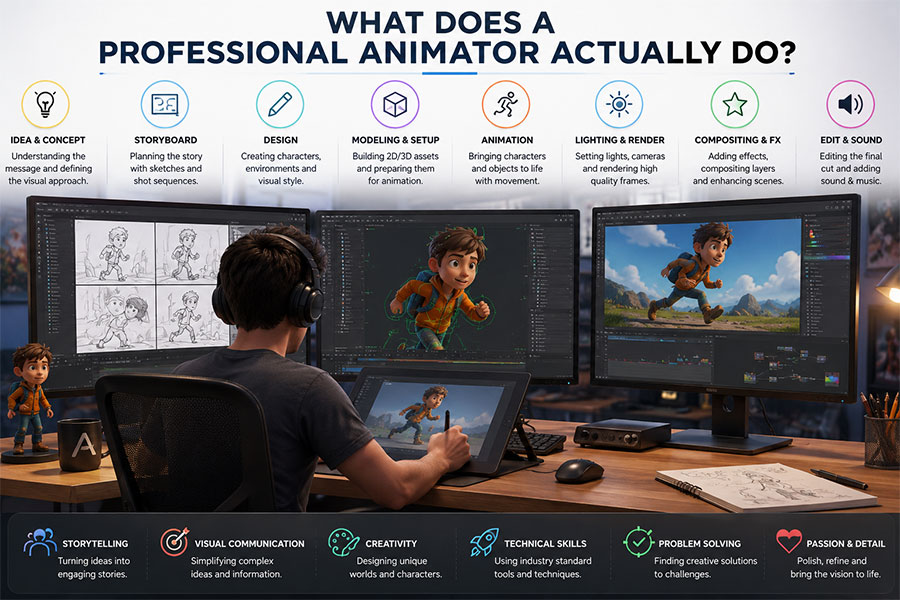
Depending on the assignment, an animator may participate in:
- Creative direction
- Concept development
- Script planning
- Storyboarding
- Illustration
- Character design
- 3D modeling
- Rigging
- Texturing
- Motion design
- Character animation
- Camera animation
- Lighting
- Rendering
- Compositing
- Visual effects
- Editing
- Sound synchronization
- Final file preparation
Some professional animators specialize in one part of this process.
Others provide several services.
Animation studios typically assemble several specialists under one production workflow.
That distinction matters when hiring.
A business needing a simple animated logo may be able to work effectively with one specialist. A company commissioning a three-minute product launch animation involving scripting, custom illustration, voiceover, 3D modeling, sound, and multiple stakeholder reviews may need an entire production team.
Start With the Purpose of the Animation
Before looking for an animator, determine what the animation is supposed to achieve.
A weak brief might say:
“We need an animated video.”
A useful brief says:
“We need a 90-second animation that explains our software platform to procurement managers and encourages them to schedule a demonstration.”
The second description immediately gives the animator more useful information.
Define:
✓ The business objective
✓ The target audience
✓ The primary message
✓ The desired viewer action
✓ Where the animation will appear
✓ Approximate duration
✓ Brand requirements
✓ Preferred visual style
✓ Required deadline
✓ Budget range
An animation being created for an investor presentation may require a different visual approach than an animation used for employee training.
A product launch may require more cinematic production.
A technical training video may prioritize accuracy and clarity.
A social advertisement may need to communicate within seconds.
Defining the purpose first makes every later hiring decision easier.
Decide What Type of Animator You Need
“Animator” is a broad job description.
The person who creates expressive cartoon characters may not be the right person to create a realistic industrial machine.
Likewise, an excellent 3D product artist may not specialize in hand-drawn character animation.
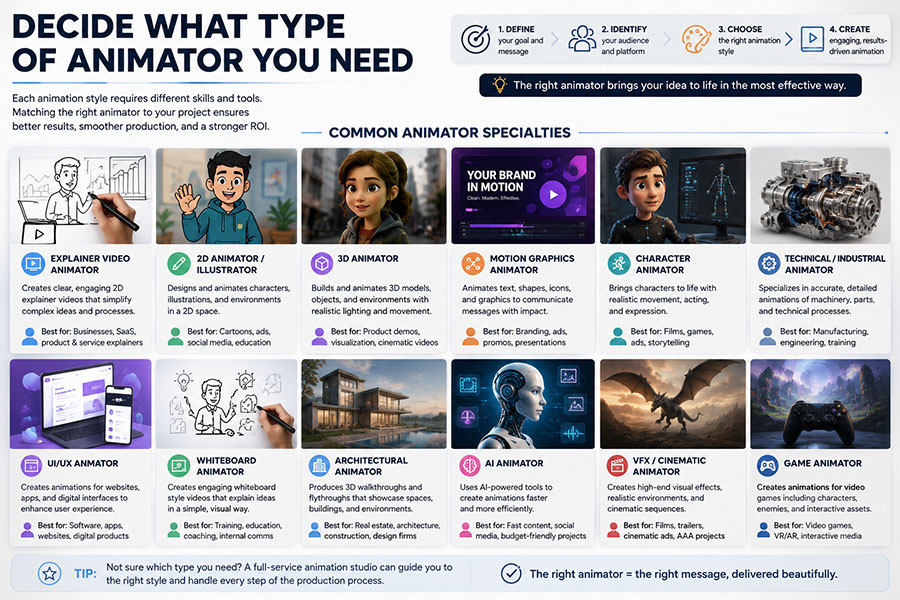
Common Animator Specialties
| Project Need | Animator or Service to Consider |
|---|---|
| Business explainer | 2D animator or motion designer |
| Product visualization | 3D animator |
| Animated brand characters | Character animator |
| Logo movement | Motion designer or logo animator |
| Software demonstration | UI and motion graphics animator |
| Industrial equipment | Technical 3D animator |
| Film or cinematic sequence | Character/VFX/3D animation team |
| Training content | Explainer or instructional animator |
| Social media advertising | Motion graphics animator |
| Whiteboard presentation | Whiteboard animator |
| Interactive website asset | Web/motion animator |
| AI-assisted content | AI animator with production experience |
Businesses that need illustrated storytelling may benefit from professional 2D animation services.
Projects involving products, machinery, architecture, realistic objects, or three-dimensional environments may require a specialist in 3D animation.
When the goal is primarily explaining a service, platform, product, or process, an explainer video animator may be the better fit.
Should You Hire a Freelancer or an Animation Studio?
One of the biggest decisions is whether to hire an individual animator or a professional animation studio.
Neither is automatically better.
The project should determine the production structure.
| Freelancer | Animation Studio |
|---|---|
| Usually one primary animator | Multiple specialists may collaborate |
| Can be efficient for smaller projects | Better suited to complex productions |
| Lower overhead | More project-management infrastructure |
| Direct communication | Dedicated project coordination may be available |
| May specialize in one discipline | Can provide several animation disciplines |
| Capacity depends on one person’s availability | Greater capacity for larger projects |
| Client may need to coordinate other vendors | Studio may manage production end to end |
| Useful for individual assets | Useful for campaigns and multi-stage production |
Hire a Freelancer When:
✓ The project is relatively small
✓ You already have the script and creative direction
✓ You need one specialized animation skill
✓ Your internal team can manage production
✓ There are few stakeholders
✓ The deliverables are straightforward
Consider an Animation Studio When:
✓ Several creative disciplines are required
✓ The animation represents an important brand or product
✓ Multiple videos are required
✓ Technical review is necessary
✓ The project has a fixed launch date
✓ Several executives or departments must approve the work
✓ Scriptwriting and storyboarding are required
✓ 2D and 3D techniques need to be combined
✓ You need project management throughout production
Businesses deciding between these options can also review our guide, Can You Hire an Animation Studio?, which looks specifically at working with a professional studio.
Where Can You Hire a Professional Animator?
Professional animators can be found through several channels.
Freelance marketplaces can be useful for smaller projects and individual production tasks.
Professional networks can help businesses find independent artists with specialized experience.
Animation studios are usually found through search engines, referrals, industry directories, professional portfolios, agency relationships, or recommendations.
The source matters less than the evaluation process.
A polished profile does not necessarily mean the animator is right for your project.
Instead, evaluate:
Relevant portfolio work
Has the animator produced something comparable to what you need?
Production quality
Does movement feel deliberate and polished?
Communication
Can the animator explain the process clearly?
Reliability
Are timelines, milestones, and deliverables defined?
Commercial understanding
Does the animator understand that a business animation must achieve a communication objective?
Technical capability
Can the person or team produce the exact files and formats your project requires?
How to Evaluate an Animator’s Portfolio
Do not simply ask whether you like the portfolio.
Ask whether the portfolio proves the animator can successfully execute your type of project.
Look at Movement Quality
Good animation should feel controlled.
Watch for:
✓ Natural timing
✓ Smooth movement
✓ Appropriate pacing
✓ Intentional camera motion
✓ Consistent visual quality
✓ Clear transitions
Look at Visual Storytelling
Can you understand what is happening without constantly relying on narration?
Professional animation should use movement to communicate.
Look at Design Consistency
Characters, icons, interfaces, environments, typography, and brand elements should feel like they belong in the same production.
Look for Relevant Complexity
If you need a detailed 3D character, do not hire someone based entirely on logo animations.
If your project involves three-dimensional characters, review work that demonstrates modeling, rigging, facial expression, movement, lighting, and rendering. Our guide to 3D character animation explains these production elements in greater detail.
Look Beyond the Animator’s Best Five Seconds
Showreels are intentionally edited to display the strongest moments.
Ask to see complete projects.
A 90-second finished animation reveals far more about pacing, consistency, storytelling, transitions, and quality control than a five-second portfolio clip.
Give the Animator a Useful Project Brief
Good animators can help develop ideas, but they still need useful information.
A professional animation brief should explain:
Project: What are you creating?
Objective: What should the animation accomplish?
Audience: Who will watch it?
Message: What should they understand?
Length: Approximately how long should it be?
Style: 2D, 3D, motion graphics, character animation, or another format?
References: Are there visual examples that communicate the desired direction?
Brand: Are there colors, fonts, logos, or design guidelines?
Distribution: Website, social media, advertising, presentation, trade show, television, application, or training system?
Deadline: When must the final files be ready?
Budget: What investment range is realistic?
Approvals: Who has final decision-making authority?
The animator should not have to guess which executive ultimately approves the project.
Identifying the decision-maker early can prevent significant rework later.
How Much Does It Cost to Hire a Professional Animator?
Animation pricing can vary considerably.
The final price depends on more than the number of seconds in the finished video.
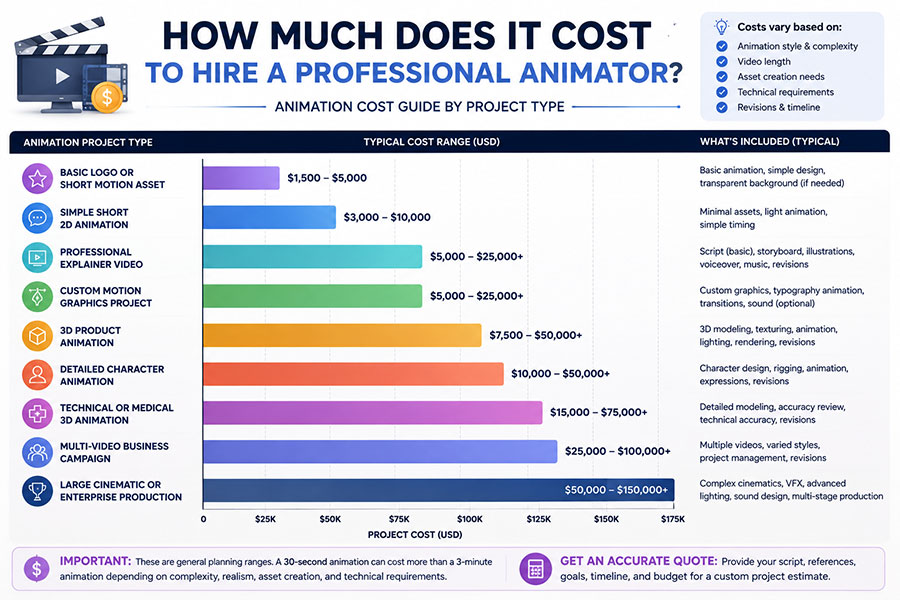
General planning ranges for professionally produced animation may look like this:
| Type of Animation Project | Approximate Planning Range |
|---|---|
| Basic logo or short motion asset | $1,500–$5,000 |
| Simple short 2D animation | $3,000–$10,000 |
| Professional explainer video | $5,000–$25,000+ |
| Custom motion graphics project | $5,000–$25,000+ |
| 3D product animation | $7,500–$50,000+ |
| Detailed character animation | $10,000–$50,000+ |
| Technical or medical 3D animation | $15,000–$75,000+ |
| Multi-video business campaign | $25,000–$100,000+ |
| Large cinematic or enterprise production | $50,000–$150,000+ |
These figures are general planning ranges rather than fixed prices.
A 30-second animation can cost more than a three-minute animation if it requires photorealistic modeling, custom characters, simulations, visual effects, or complex rendering.
What Makes an Animation More Expensive?
Several factors affect animation pricing.
Animation Style
Simple motion graphics generally require less production than a realistic three-dimensional environment.
Asset Creation
Existing assets may reduce production requirements.
Starting from nothing may require:
- Character design
- Illustration
- 3D modeling
- Product recreation
- Environment design
- Texture creation
- Interface design
Length
Longer animations generally require more production, but complexity per second is equally important.
Character Complexity
A basic illustrated figure is very different from a realistic 3D human requiring facial rigging and detailed performance.
Technical Accuracy
Manufacturing animation may require engineering files, CAD preparation, component review, technical labels, and subject-matter-expert approval.
Healthcare and medical animation can similarly require additional review for visual and informational accuracy.
Voiceover and Sound
Voice talent, music licensing, sound design, mixing, and language versions may add to production costs.
Revisions
A well-defined revision process protects both the client and animator.
Unlimited changes can quickly make a project inefficient.
Deadline
Urgent projects may require additional animators, parallel production, overtime, or priority scheduling.
If timing is especially important, the guide Which Animation Company Offers the Fastest Turnaround Times? explains what businesses should evaluate when comparing production speed.
How Long Should a Professional Animation Project Take?
Production time depends on complexity.
A simple animated asset may require several days or a few weeks.
A professional business explainer may require approximately four to eight weeks.
Complex 3D, character, technical, or multi-video projects can require several months.
The production process commonly includes:
- Discovery
- Script development
- Storyboarding
- Visual design
- Asset creation
- Animation
- Voiceover and sound
- Revisions
- Rendering
- Final delivery
Trying to eliminate planning stages does not always make production faster.
Approving the wrong creative direction quickly can create much more work later.
Ask Who Is Actually Doing the Work
This question is especially important when hiring an agency or studio.
Ask:
Who will animate the project?
A salesperson may conduct the first meeting, but you should understand the production structure behind the work.
For a larger project, that may include:
- Creative director
- Producer
- Scriptwriter
- Storyboard artist
- Illustrator
- 2D animator
- 3D artist
- Character animator
- Motion designer
- Editor
- Sound designer
- Project manager
You do not necessarily need to meet every production artist.
You should, however, understand who is responsible for creative quality, communication, deadlines, and final approval.
Questions to Ask Before Hiring a Professional Animator
Before signing an agreement, ask questions that reveal how the project will actually be managed.
- Have you completed similar animation projects?
- Which animation style would you recommend for this project?
- Is the work completely custom?
- Who will be working on the project?
- Who will manage communication?
- Is scriptwriting included?
- Is storyboarding included?
- How many creative concepts are provided?
- How many revision rounds are included?
- What happens if the scope changes?
- What does the quoted price include?
- Are voiceover and music included?
- Which final formats will be delivered?
- Are source files included?
- Who owns the final animation?
- Are third-party assets being used?
- What is the production timeline?
- What do you need from us to begin?
- Which milestones require approval?
- What could cause the deadline or budget to change?
A professional animator should be able to answer these questions clearly.
Agree on Revisions Before Animation Begins
Revisions are normal.
Unstructured revisions are expensive.
A professional animation workflow usually contains approval stages.
For example:
Script approval → storyboard approval → design approval → animation approval → final delivery
Once a stage is approved, changing it later may affect subsequent work.
Suppose a company approves the script and storyboard, then changes the primary product message after animation begins.
The animator may need to modify:
- Voiceover
- Timing
- Illustrations
- Characters
- Camera shots
- Graphics
- Animation
- Sound
That is not a normal minor revision.
It is a scope change.
A good agreement explains how revisions are handled before this happens.
Understand Copyright and Ownership Before You Hire
Do not assume paying for an animation automatically answers every ownership question.
The agreement should address:
✓ Ownership of the final animation
✓ Rights to illustrations and characters
✓ Rights to 3D models
✓ Source-file ownership
✓ Music licensing
✓ Stock assets
✓ Voiceover usage
✓ Modification rights
✓ Geographic or platform restrictions, if any
✓ Portfolio rights for the animator or studio
For U.S. projects, “work made for hire” has specific legal requirements and does not apply automatically to every commissioned creative project. The U.S. Copyright Office’s Works Made for Hire guidance explains the applicable framework.
For significant commercial projects, businesses should have appropriate legal counsel review ownership and licensing terms rather than relying on assumptions.
Freelancer Red Flags to Watch For
A low price is not automatically a warning sign.
Neither is a high price proof of quality.
More useful warning signs include:
✗ No relevant portfolio examples
✗ Refusal to define milestones
✗ No written scope
✗ Vague deliverables
✗ Unclear revision terms
✗ Unrealistic delivery promises
✗ Poor communication before payment
✗ No explanation of the creative process
✗ Inability to explain file formats
✗ Portfolio work that cannot be verified
✗ No discussion of ownership or licensing
✗ Immediate agreement to every request without understanding the project
A professional animator should sometimes challenge the brief.
If an idea will not work visually, technically, or within the available budget, experienced professionals should explain why and offer an alternative.
Match the Animator to Your Industry
Industry knowledge is particularly useful when the animation involves specialized terminology, compliance, technical equipment, or complex audiences.
Technology
A technology animation may involve software interfaces, artificial intelligence, SaaS platforms, hardware, cybersecurity, cloud systems, or technical workflows.
Look for animators who can make complicated products understandable without oversimplifying important details.
Manufacturing
Manufacturers may need machinery demonstrations, assembly sequences, internal cutaways, robotics, factory processes, installation videos, or safety training.
A 3D technical animator may be substantially more useful than a general character artist.
Healthcare and Medical
Healthcare projects may need patient-friendly visual communication, while medical animation may require detailed anatomy, devices, procedures, or scientific processes.
Accuracy and review procedures become especially important.
Enterprise
Large companies may require animation for training, sales, internal communication, investor presentations, product launches, conferences, or multiple regional markets.
The animator or studio should be comfortable managing stakeholder review.
Government and Public Sector
Government animation may be used for public information, infrastructure, programs, training, safety, education, or community communication.
Accessibility, accuracy, stakeholder approvals, and procurement requirements may influence production.
A Simple Animator Evaluation Scorecard
When several candidates look capable, compare them systematically.
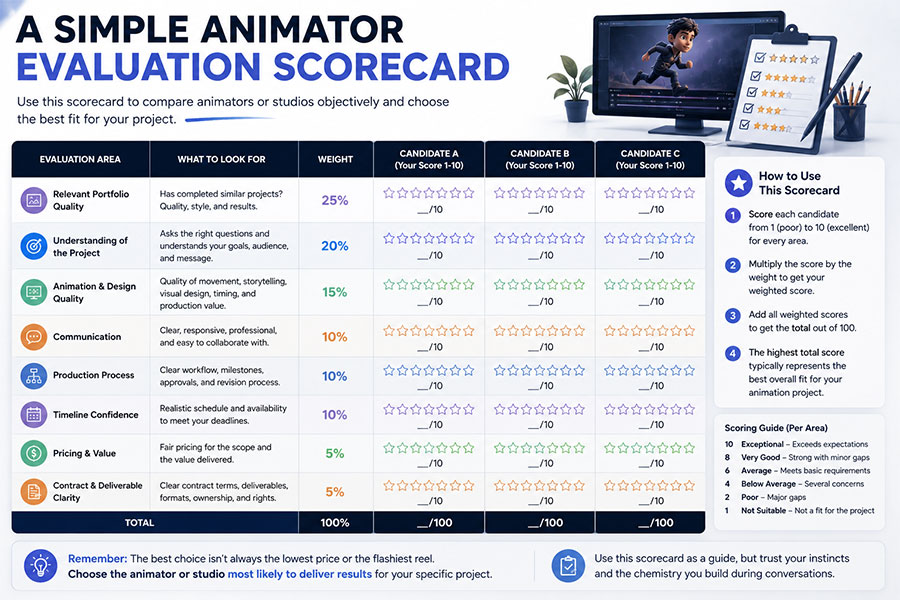
| Evaluation Area | Suggested Weight |
|---|---|
| Relevant portfolio quality | 25% |
| Understanding of the project | 20% |
| Animation and design quality | 15% |
| Communication | 10% |
| Production process | 10% |
| Timeline confidence | 10% |
| Pricing and value | 5% |
| Contract and deliverable clarity | 5% |
The cheapest candidate should not automatically win.
Neither should the candidate with the flashiest showreel.
The best choice is the animator or studio most likely to achieve the project’s actual objective.
What Should You Send an Animator Before Requesting a Quote?
You do not need a completed production package.
But the more relevant information you provide, the more useful the quote can be.
Send:
✓ A short project description
✓ Animation objective
✓ Approximate video length
✓ Target audience
✓ Intended platforms
✓ Preferred style
✓ Example animations you like
✓ Brand guidelines
✓ Existing logo and design files
✓ Product photos or CAD files if relevant
✓ Draft or approved script if available
✓ Required deadline
✓ Budget range
✓ Number of final versions required
Avoid sending fifty reference videos without explaining what you like about them.
Instead, say:
“We like the character style in this example.”
“We like the camera movement in this 3D sequence.”
“We want the pacing of this explainer, but not its illustration style.”
Specific feedback gives the animator something actionable.
How to Hire a Professional Animator for a Project Step by Step
A practical hiring process looks like this:
1. Define the Outcome
Determine why the animation is being created and what success looks like.
2. Choose the Animation Type
Decide whether the project likely requires 2D, 3D, motion graphics, character animation, AI-assisted animation, or another technique.
3. Establish the Budget
Create a realistic investment range before contacting candidates.
4. Create a Brief
Provide enough information for an animator to understand the audience, message, style, deadline, and deliverables.
5. Build a Shortlist
Compare several qualified animators or studios instead of evaluating dozens of unrelated portfolios.
6. Review Complete Work
Look beyond showreels.
Evaluate projects similar to yours.
7. Discuss the Production Process
Understand milestones, communication, responsibilities, and approvals.
8. Compare Proposals
Compare scope as well as price.
One proposal may include scriptwriting, storyboarding, voiceover, sound, revisions, and source files while another includes animation only.
9. Confirm Rights and Deliverables
Put ownership, licensing, source files, formats, and usage rights in writing.
10. Approve the Production Schedule
Know when your team needs to provide feedback.
11. Start With a Clear Kickoff
Confirm expectations before creative production begins.
What Makes a Professional Animator Worth Hiring?
Professional animation is not valuable simply because an experienced person used professional software.
The value comes from judgment.
A skilled animator knows:
- What should move
- What should remain still
- How quickly something should happen
- What the viewer needs to notice
- How movement communicates emotion
- How to make complicated information clearer
- When a scene is becoming too busy
- When realism matters
- When simplicity is stronger
- How to maintain visual consistency
- How to prepare files for the final platform
That judgment becomes increasingly important as the project becomes more visible, technical, expensive, or strategically important.
When Should You Hire an Animation Studio Instead?
An individual animator can be an excellent choice for the right project.
But there is a point where the job becomes a production rather than an animation task.
Consider a studio when the project requires several of the following simultaneously:
✓ Strategy
✓ Scriptwriting
✓ Storyboarding
✓ Custom illustration
✓ 2D animation
✓ 3D modeling
✓ Character development
✓ Motion graphics
✓ Professional voiceover
✓ Sound design
✓ Technical review
✓ Multiple stakeholder approvals
✓ Several deliverables
✓ Multiple videos
✓ Strict deadlines
A studio can coordinate specialists while giving the client one production workflow.
Hiring Just Animations for a Professional Animation Project
Just Animations works with businesses, companies, enterprises, government agencies, NGOs, and public-sector organizations requiring custom animation for marketing, products, training, websites, presentations, advertising, technical communication, and visual storytelling.
Our professional animation services include 2D animation, 3D animation, AI animation, cartoon animation, explainer videos, logo animation, motion graphics, whiteboard animation, video game animation, motion picture animation, video production, and social media video content.
Projects can include:
✓ Discovery and creative planning
✓ Script development
✓ Storyboarding
✓ Illustration and design
✓ 2D and 3D production
✓ Character animation
✓ Motion graphics
✓ Voiceover and sound
✓ Revisions
✓ Final delivery
Businesses can also work with Just Animations alongside their internal marketing teams, agencies, engineers, product specialists, developers, subject-matter experts, or other production partners.
If you already know what you need—or simply know what the animation needs to accomplish—you can request an animation quote and provide the project requirements, budget, deadline, references, and available source materials.
Hire for the Project, Not Just the Portfolio
Knowing how to hire a professional animator for a project comes down to matching the right creative capability with the right business need.
Do not select an animator because one impressive video caught your attention.
Determine whether the animator understands:
✓ Your objective
✓ Your audience
✓ Your animation style
✓ Your technical requirements
✓ Your deadline
✓ Your approval process
✓ Your budget
✓ Your final deliverables
A successful animation project begins before anything moves on screen.
It begins with selecting a professional who understands what needs to be communicated and has a reliable process for turning that objective into finished animation.
Frequently Asked Questions
How do I hire a professional animator for a project?
Define the animation’s objective, audience, style, approximate length, budget, and deadline. Then compare professional animators or studios based on relevant portfolio work, production quality, communication, process, pricing, revisions, deliverables, and ownership terms. Review complete projects rather than relying only on showreels.
How much does it cost to hire a professional animator?
A professional animation project can range from a few thousand dollars for simple motion assets to $25,000–$50,000 or more for detailed 3D, character, technical, or multi-stage productions. Large campaigns and cinematic projects can exceed $100,000. Cost depends on style, length, complexity, assets, sound, revisions, and timeline.
Is it better to hire a freelance animator or animation studio?
A freelance animator can be a good choice for a smaller project requiring one specialized skill. An animation studio may be better when the project requires scripting, storyboarding, illustration, 2D or 3D production, sound, project management, multiple specialists, several deliverables, or complex stakeholder reviews.
What should I ask an animator before hiring them?
Ask about relevant portfolio examples, production process, project team, timeline, milestones, revisions, pricing, included services, final formats, source files, third-party assets, copyright ownership, communication, and what information they need from you before beginning production.
What should I provide when hiring an animator?
Provide a project brief containing the objective, audience, message, approximate length, animation style, reference examples, brand guidelines, intended platforms, deadline, budget, approval team, and any existing scripts, illustrations, product files, CAD data, logos, or other assets that may support production.