Film animation allows filmmakers, advertisers, documentary producers, businesses, and entertainment companies to create scenes that cameras alone cannot capture.
A documentary can reconstruct an event for which no footage exists.
A television commercial can transform an ordinary product into a cinematic visual experience.
A movie can create an entire world, character, creature, environment, or visual effect that has never physically existed.
Animation can also be much more subtle.
It can appear as:
- Animated maps
- Historical timelines
- Motion graphics
- Titles
- Data visualization
- Product demonstrations
- Character sequences
- 3D environments
- Digital set extensions
- Scientific visualization
- Visual effects
- Animated diagrams
- Interface graphics
The best animation for film is not necessarily the animation that looks the most elaborate.
It is the animation that supports the story.
That distinction becomes especially important because documentary animation, TV commercial animation, and movie animation have different objectives.
Documentaries frequently prioritize clarity, accuracy, context, and responsible reconstruction.
TV commercials prioritize attention, brand recognition, product communication, persuasion, and strict running times.
Movies prioritize narrative, emotion, continuity, cinematic quality, world-building, and believable integration with the rest of the production.
Understanding those differences is the foundation of successful film animation.
What Is Film Animation?
Film animation is the creation or integration of animated visuals for motion-picture, television, advertising, documentary, broadcast, and cinematic productions.
It can involve a completely animated production or animation incorporated into live-action footage.
Common approaches include:
- 2D animation
- 3D animation
- CGI
- Character animation
- Motion graphics
- Stop motion
- Rotoscoping
- Compositing
- Visual effects
- Matte painting
- Digital environments
- Animated typography
- Simulation
- Mixed-media animation
The term can therefore describe everything from a five-second animated title in a documentary to a feature film constructed almost entirely through computer animation.
Professional motion picture animation combines animation with cinematic production principles such as storyboarding, shot composition, camera movement, lighting, character performance, editing, sound, and visual continuity.
Film Animation at a Glance
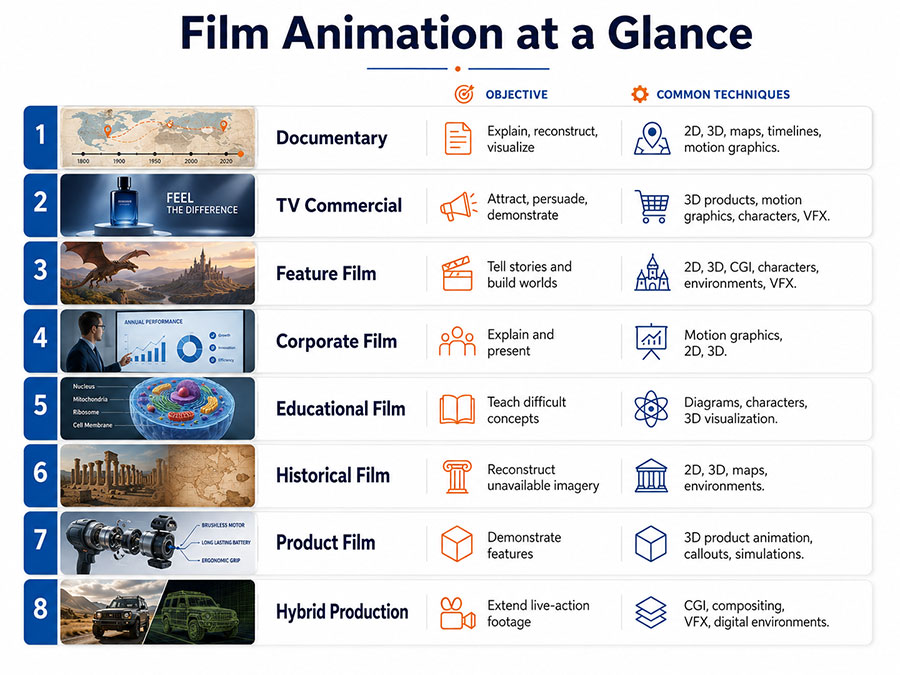
| Production | Main Animation Objective | Common Techniques |
|---|---|---|
| Documentary | Explain, reconstruct, visualize | 2D, 3D, maps, timelines, motion graphics |
| TV Commercial | Attract, persuade, demonstrate | 3D products, motion graphics, characters, VFX |
| Feature Film | Tell stories and build worlds | 2D, 3D, CGI, characters, environments, VFX |
| Corporate Film | Explain and present | Motion graphics, 2D, 3D |
| Educational Film | Teach difficult concepts | Diagrams, characters, 3D visualization |
| Historical Film | Reconstruct unavailable imagery | 2D, 3D, maps, environments |
| Product Film | Demonstrate features | 3D product animation, callouts, simulations |
| Hybrid Production | Extend live-action footage | CGI, compositing, VFX, digital environments |
The technique should follow the communication objective.
Film Animation Is More Than Animated Movies
When people hear film animation, they may immediately think of fully animated feature films.
That is only one application.
Animation is increasingly useful whenever filmmakers need to visualize information or events that cannot be photographed effectively.
Consider a documentary about an ancient city.
No camera can travel back in time.
But animation can reconstruct:
- Streets
- Buildings
- Landscapes
- People
- Trade routes
- Political boundaries
Now consider a TV commercial for a mechanical product.
A normal camera can show the exterior.
Animation can show:
- What happens inside
- How components connect
- Where energy travels
- How the product performs
- Why one design differs from another
Film animation expands what the camera can communicate.
Animation for Documentaries
Documentary animation uses animated visuals to explain, reconstruct, visualize, or interpret real events, information, places, people, and concepts within a documentary production.
It can be especially valuable when original visual material is unavailable.
For example:
- No historical footage exists
- An event happened privately
- A process cannot be filmed
- The subject is microscopic
- The subject is astronomical
- Locations no longer exist
- Records exist only as documents
- Data needs visualization
- Interview testimony needs visual support
Animation gives the filmmaker another visual language.
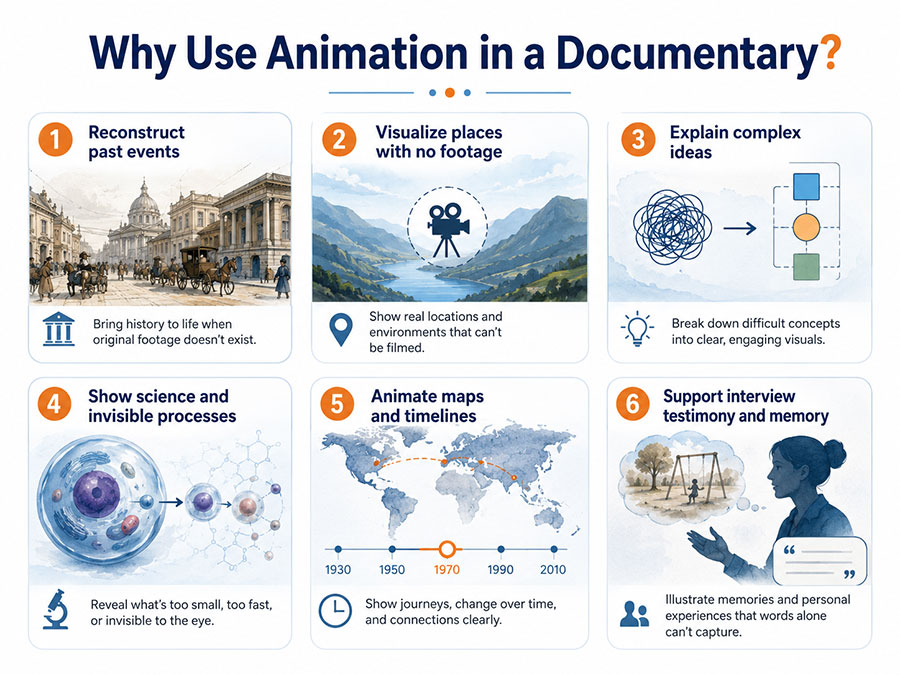
Why Use Animation in a Documentary?
Documentaries often face a fundamental problem:
The story exists, but the pictures do not.
A person may describe an event that occurred decades ago.
A historian may explain how a civilization developed.
A scientist may discuss something happening inside a cell.
An economist may describe decades of financial change.
A military historian may explain troop movement across a battlefield.
The information can be important, but simply showing someone talking may not communicate it effectively.
Animation can turn the information into something visible.
Documentary Animation for Historical Reconstruction
Historical reconstruction is one of the strongest uses of animation for documentary productions.
Imagine a documentary about a city in 1850.
Available source material might include:
- Maps
- Paintings
- Newspaper illustrations
- Photographs
- Architectural plans
- Written descriptions
Animation can use those references to reconstruct the environment.
A camera may move through a 3D interpretation of a historical street.
Buildings can appear over time.
Maps can transform as boundaries change.
Timelines can show political or economic developments.
The animation should clearly communicate where visualization or interpretation is being used rather than presenting uncertain reconstruction as indisputable historical footage.
Animated Maps in Documentary Film
Maps become much easier to understand when movement is introduced.
Instead of displaying a static map, animation can show:
- Migration
- Military movement
- Trade routes
- Transportation
- Population change
- Political borders
- Exploration
- Geographic expansion
A viewer can watch change happen over time.
For example:
Year 1 → territory highlighted
Year 5 → boundary expands
Year 15 → new region appears
This is often easier to understand than displaying several separate maps.
Animated Timelines
Timelines are another useful documentary tool.
They can communicate:
- Historical events
- Corporate history
- Scientific development
- Political change
- Technology evolution
- Biographical milestones
Motion establishes sequence.
Events appear in chronological order instead of forcing viewers to interpret a large static diagram.
Documentary Animation for Science
Many scientific subjects are impossible or impractical to film directly.
Animation can visualize:
- Molecules
- Cells
- Viruses
- Human anatomy
- Chemical reactions
- Astronomy
- Physics
- Geological processes
- Climate systems
3D animation can add spatial understanding where relationships between structures matter.
2D animation can simplify scientific concepts where realism would create unnecessary complexity.
Documentary Animation for Interview Testimony
Some documentaries use animation to visualize first-person accounts.
This can be useful when:
- No footage exists
- The subject should not be visually identified
- Events happened in inaccessible locations
- The material is emotionally sensitive
- Literal reenactment would be inappropriate
The style becomes part of the storytelling.
A restrained illustrated sequence may communicate memory differently from a realistic 3D reconstruction.
The goal is not necessarily to simulate a camera recording.
It can be to create a visual interpretation of what the speaker is describing.
Documentary Animation Should Preserve Context
Documentary animation carries a responsibility that purely fictional animation does not.
Animation can look convincing.
That means viewers should not be unintentionally led to believe that a reconstructed scene is authentic archival footage.
Depending on context, filmmakers may distinguish reconstructed visuals through:
- Style
- Labels
- Narration
- Captions
- Editorial framing
The production team should also keep good records of source material used to guide historically or scientifically sensitive visuals.
Animation for TV Commercials
Animation for TV commercial production uses animated imagery to capture attention, explain products, communicate brand messages, and create visual experiences within the limited duration of an advertisement.
Animation is particularly effective in commercials because advertising frequently asks the viewer to understand something quickly.
A commercial may need to communicate:
Product → benefit → brand → action
within seconds.
Animation can compress that communication.
Why Animation Works for TV Commercials
Live-action filming is constrained by the physical world.
Animation is not.
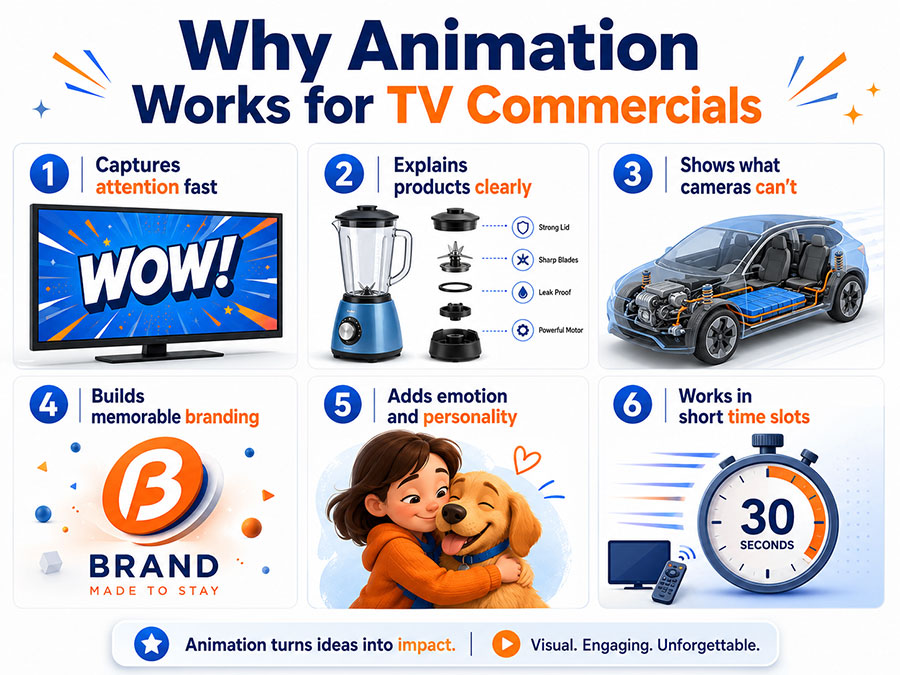
A commercial can:
- Shrink a product
- Enlarge a product
- Travel inside it
- Transform it
- Explode it apart
- Freeze time
- Remove gravity
- Create impossible environments
- Visualize invisible processes
- Animate typography around it
That creative flexibility is especially useful when a product’s strongest benefit cannot easily be photographed.
3D Product Animation for TV Commercials
3D is frequently valuable for products.
A virtual product can be:
✓ Rotated
✓ Opened
✓ Disassembled
✓ Reassembled
✓ Lit cinematically
✓ Shown underwater
✓ Suspended in space
✓ Surrounded by particles
✓ Viewed internally
Imagine a watch commercial.
The product floats against a dark background.
The case separates.
Gears emerge.
The camera travels between mechanical components.
Everything reconnects.
The final watch rotates into a hero position.
That sequence may communicate:
precision
without using a paragraph of explanation.
Animation for Food and Beverage Commercials
Animation can also exaggerate qualities that conventional footage struggles to communicate.
A beverage commercial might use:
- Simulated liquid
- Ice
- Condensation
- Particles
- Ingredient visualization
- Slow-motion CGI
Food products can use stylized motion to emphasize:
- Texture
- Freshness
- Ingredients
- Energy
- Flavor
The animation does not always need to be photorealistic.
A stylized approach may better match the brand.
Character Animation for Commercials
Animated characters can become brand assets.
They may appear as:
- Mascots
- Product characters
- Human representatives
- Creatures
- Abstract personalities
Character animation can add:
- Humor
- Emotion
- Memorability
- Personality
Characters can also return across multiple campaigns.
That turns an individual advertisement into a broader branded animation system.
Businesses considering this approach can review our 3D Character Animation: Design, Costs, and Studio Guide for a deeper look at character design and production considerations.
Motion Graphics for TV Commercials
Not every commercial requires characters or photorealistic CGI.
Motion graphics can communicate:
- Promotions
- Statistics
- Pricing
- Features
- Brand messages
- Calls to action
They are especially useful when the advertisement needs to communicate information rapidly.
For example:
NEW
becomes:
2X PERFORMANCE
then:
AVAILABLE NOW
Motion directs the viewer’s attention toward one message at a time.
Animated Typography in Commercials
Typography itself can become part of the action.
Words can:
- Scale
- Rotate
- Transform
- Break apart
- Follow objects
- Interact with products
Kinetic typography can be particularly effective in short advertising where every second matters.
Instead of placing text over the image as an afterthought, the text becomes part of the composition.
Animation for Movies
Movie animation covers a much broader production spectrum.
A movie might be:
- Fully animated
- Primarily live action with CGI
- Live action with animated sequences
- 2D
- 3D
- Stop motion
- Mixed media
Animation can create:
- Characters
- Creatures
- Vehicles
- Buildings
- Landscapes
- Entire worlds
- Weather
- Destruction
- Crowds
- Fire
- Water
- Space
- Fantasy environments
Modern film production often combines multiple techniques rather than relying on one animation style from beginning to end.
The British Film Institute’s animation archive and editorial resources provide a useful look at animation across film history, from early experimental techniques through stop motion, hand-drawn animation, television production, and modern animated filmmaking.
2D Animation for Film
2D animation remains a powerful cinematic medium.
It can produce:
- Hand-drawn characters
- Digital characters
- Stylized environments
- Graphic sequences
- Dream sequences
- Historical reconstructions
- Experimental film
- Titles
Its strength is not realism.
Its strength is artistic control.
Every visual can be deliberately stylized.
An environment can look like:
- Ink
- Watercolor
- Pencil
- Painting
- Graphic design
- Comic art
A filmmaker can create a visual identity that live action or photorealistic CGI would not reproduce.
3D Animation for Film
3D animation provides dimensional control over characters, environments, objects, lighting, and cameras.
A 3D scene may contain:
- Character models
- Props
- Buildings
- Vehicles
- Terrain
- Lights
- Virtual cameras
Because the environment exists digitally, filmmakers can create complex camera movement that would be difficult or impossible to capture physically.
3D is commonly useful for:
- Fantasy
- Science fiction
- Action
- Product visualization
- Architecture
- Creatures
- Vehicles
- Technical subjects
However, 3D does not need to look realistic.
It can be deliberately stylized.
CGI vs Animation
CGI and animation overlap, but the terms are not identical.
CGI refers broadly to computer-generated imagery.
That imagery may be:
- Animated
- Static
- Photorealistic
- Stylized
A digital building added to a live-action scene is CGI.
A completely computer-generated character performing throughout the scene is both CGI and animation.
In practical production discussions, the terminology often overlaps because modern film pipelines combine:
- Modeling
- Animation
- Simulation
- Rendering
- Compositing
Animation and Visual Effects
Animation and visual effects frequently work together.
Imagine a live-action actor standing on a physical set.
The finished shot may add:
Animated creature + digital sky + particle effects + extended environment
The creature needs animation.
The digital environment requires CGI.
The particles may use simulation.
Compositing integrates everything into the photographed plate.
The audience sees one finished shot.
Film Animation and Live-Action Compositing
One of the most important skills in hybrid film production is making animated elements feel like they belong inside the photographed scene.
That requires consistency in:
- Perspective
- Camera movement
- Lighting
- Shadows
- Color
- Depth
- Motion blur
- Focus
- Grain
- Reflections
If the animated object appears perfectly sharp while the camera footage contains motion blur, it may look artificial.
If virtual lighting comes from the left while the live actor is lit from the right, the elements may not feel connected.
Successful compositing considers the entire shot.
What Is Rotoscoping?
Rotoscoping involves tracing or isolating movement from filmed footage.
Historically, animators could trace live-action movement to create animated performances.
In modern visual effects, rotoscoping is also used to isolate:
- Actors
- Objects
- Foreground elements
from backgrounds.
This makes it possible to insert visual effects or animated elements behind or around them.
Rotoscoping can also be used deliberately as a visual style.
Film Animation for Scenes That Cannot Be Filmed
Some animation exists because filming would be impossible.
Other animation exists because filming would be impractical.
Consider:
Space
Filming an actor standing on another planet is impossible.
Ancient History
There is no camera footage.
Microscopic Processes
The subject may be smaller than conventional imaging can communicate clearly.
Dangerous Events
Explosions, disasters, and extreme conditions can create production risks.
Future Buildings
The location has not been constructed yet.
Internal Machinery
The camera cannot see through metal.
Fantasy
The subject does not exist.
Animation gives filmmakers control over all of these situations.
Animation for Historical Film
Historical productions can use animation for:
- Maps
- Architecture
- Battle sequences
- Transportation
- Cities
- Artifacts
- Historical figures
- Timelines
The degree of realism should depend on the available source material.
A production should avoid inventing precise visual details and then unintentionally presenting them as established historical fact.
A stylized reconstruction can sometimes communicate uncertainty more appropriately than a photorealistic one.
Animation for Educational Films
Educational film animation should prioritize comprehension.
Animation can:
- Isolate a concept.
- Remove irrelevant visual information.
- Demonstrate change.
- Repeat important movement.
- Compare two states.
- Show invisible information.
That makes it useful for:
- Schools
- Universities
- Healthcare
- Corporate training
- Government education
- Technical instruction
A good educational animation is not merely decorative.
It teaches visually.
Animation for Corporate Films
Corporate film animation may include:
- Company stories
- Product videos
- Investor presentations
- Employee communication
- Technology explanations
- Training
- Recruitment
- Corporate documentaries
A production might begin with live-action executive interviews, transition into animated data visualization, show a 3D product demonstration, and return to live footage.
Film animation can therefore become one component of a larger communication system.
Animation for Government and Public-Sector Film
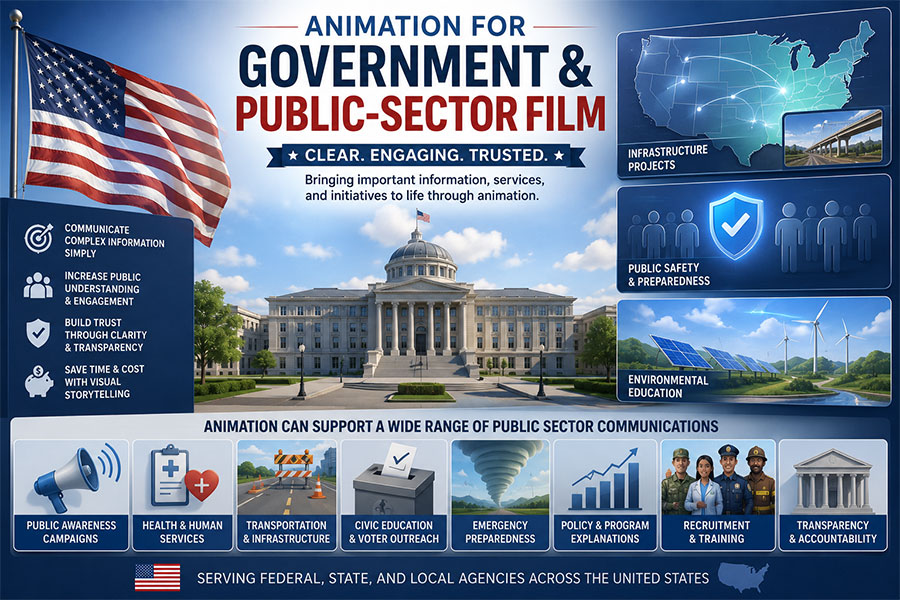
Government agencies and public-sector organizations can use film animation for:
- Public education
- Historical content
- Infrastructure
- Emergency preparedness
- Policy explanation
- Transportation
- Training
- Recruitment
The visual approach should generally prioritize:
- Accuracy
- Accessibility
- Clarity
- Appropriate tone
Animation should simplify the communication without oversimplifying the subject.
Choosing Between 2D and 3D Film Animation
The choice is not simply about which style looks better.
Choose 2D When:
✓ Illustration supports the story
✓ Stylization is important
✓ Characters do not require realistic depth
✓ The subject is conceptual
✓ Graphic storytelling fits the production
Choose 3D When:
✓ Physical depth matters
✓ Objects need multiple camera angles
✓ Products or machinery must be accurate
✓ Environments need dimensional exploration
✓ Realistic lighting is important
Combine Them When:
✓ A dimensional subject requires graphic explanation
✓ Live action needs animated overlays
✓ A film uses several visual languages
✓ Information and cinematic imagery need to coexist
Our guide to 15 Animation Styles: Choosing the Best Style of Animation compares a broader range of approaches, including 2D, 3D, motion graphics, stop motion, rotoscoping, kinetic typography, mixed media, and AI-assisted animation.
Film Animation Storyboarding
Animation should be planned before expensive production begins.
The storyboard establishes:
- Shot composition
- Camera angle
- Character position
- Product position
- Sequence
- Transitions
- Visual effects
- Timing
For film animation, the storyboard also helps determine how animated shots connect with:
- Live-action shots
- Interviews
- Existing footage
- Product footage
- Titles
This can prevent expensive changes later.
Animatics Before Full Animation
An animatic turns storyboard frames into a rough timed sequence.
It may contain:
- Storyboard panels
- Temporary voiceover
- Placeholder music
- Rough transitions
The animatic answers an important question:
Does the sequence work before we spend time finishing it?
This is particularly valuable in movie and commercial production where changing completed animation can be expensive.
Previsualization for Film
Previsualization—or previs—creates rough versions of complex shots before final production.
It can help filmmakers plan:
- Camera movement
- Character blocking
- Action
- Visual effects
- Set design
- Timing
A rough 3D scene does not need final textures or lighting.
Its purpose is to solve filmmaking problems early.
The Film Animation Production Process
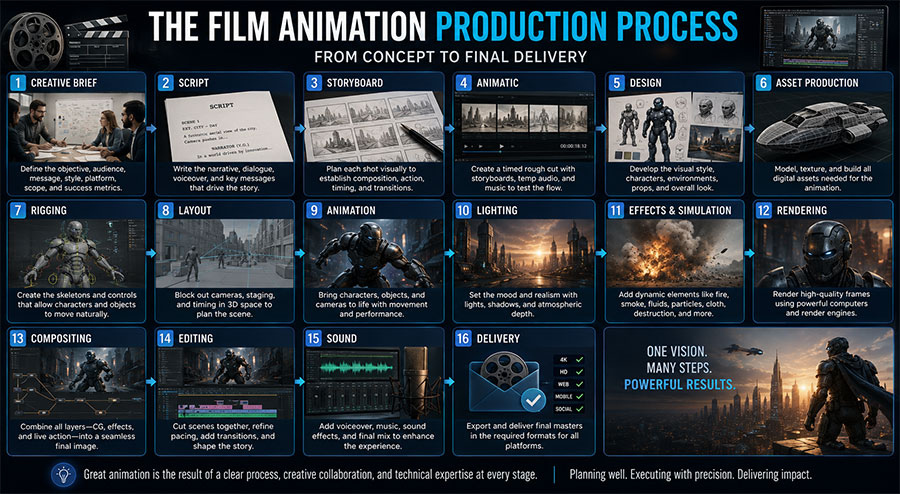
A typical professional pipeline may include:
1. Creative Brief
Define:
- Objective
- Audience
- Story
- Platform
- Duration
- Style
2. Script
Establish dialogue, narration, action, and structure.
3. Storyboard
Translate the script into visual shots.
4. Animatic
Test pacing and sequence.
5. Design
Create:
- Characters
- Environments
- Props
- Products
- Graphic systems
6. Asset Production
Build the actual 2D or 3D assets.
7. Rigging
Prepare characters or mechanical objects for movement where necessary.
8. Layout
Position:
- Cameras
- Characters
- Objects
- Environments
9. Animation
Create the performances and movement.
10. Lighting
Establish mood, depth, and visual continuity.
11. Effects and Simulation
Add:
- Smoke
- Fire
- Water
- Particles
- Destruction
- Cloth
- Hair
where required.
12. Rendering
Generate the finished frames.
13. Compositing
Combine all visual layers.
14. Editing
Assemble the final sequence.
15. Sound
Integrate:
- Dialogue
- Voiceover
- Music
- Foley
- Effects
16. Delivery
Export the correct masters and versions.
Not every project uses every stage.
A 15-second motion-graphics commercial requires a very different pipeline from a feature-film character sequence.
Film Animation Camera Language
Animated filmmaking still uses the visual language of cinema.
That includes:
- Wide shots
- Medium shots
- Close-ups
- Establishing shots
- Tracking
- Panning
- Tilting
- Zooming
- Dolly movement
- Depth of field
Virtual cameras are not physical cameras, but they should still be directed intentionally.
A camera should move because the movement adds information or emotion.
Not simply because animation makes movement possible.
Lighting in 3D Film Animation
Lighting affects:
- Mood
- Depth
- Focus
- Realism
- Product appearance
Consider the difference between a product lit with:
Bright even lighting
and:
Dark cinematic lighting with a narrow rim light
The object is identical.
The emotional effect is not.
Film animation should align lighting with the story and brand.
Color in Film Animation
Color can establish:
- Time
- Place
- Emotion
- Brand
- Hierarchy
- Visual continuity
A documentary reconstruction may use muted tones to distinguish it from modern footage.
A children’s animated film may use a saturated palette.
A technology commercial may use high-contrast digital colors.
Color should be part of the visual system rather than applied randomly scene by scene.
Sound Still Matters in Animation
Animation is visual, but film is audiovisual.
Sound can dramatically change how animation feels.
Consider the same mechanical animation with:
Version A
Soft music.
Version B
Heavy mechanical impacts.
Version C
Futuristic electronic sound.
The images remain the same.
The perceived product changes.
Sound design should therefore be considered early rather than added as an afterthought.
Film Animation for Different Screen Formats
A production may eventually appear on:
- Television
- Cinema
- Streaming
- Website
- Social media
- Trade show display
- Presentation
- Mobile device
The main film may be 16:9.
But marketing could require:
- 9:16
- 1:1
- 4:5
Important visual elements should be composed with potential reframing in mind.
Television Commercial Animation Length
Commercials may be created in several lengths.
Typical campaign deliverables can include:
- 6-second cutdowns
- 10-second versions
- 15-second spots
- 30-second spots
- 60-second versions
A production may create one master concept and edit it into multiple durations.
That should be considered during storyboarding.
If the central product reveal happens at second 25, a 15-second version may be difficult to create effectively.
Modular planning helps.
Documentary Animation Length
Documentary animation usually follows editorial need rather than a fixed advertising duration.
An animated segment may last:
- Several seconds
- One minute
- Several minutes
The deciding question should be:
How long does the audience need to understand the information?
Not:
How long can we keep animation on screen?
Movie Animation Length
Movie animation may involve:
- One shot
- One sequence
- Repeated visual effects
- Entire scenes
- The entire film
A feature production should therefore think in terms of pipeline and consistency, not simply individual animation clips.
Characters, lighting, environments, and rendering systems must remain consistent across large numbers of shots.
Film Animation Production Timelines
Production times vary significantly.
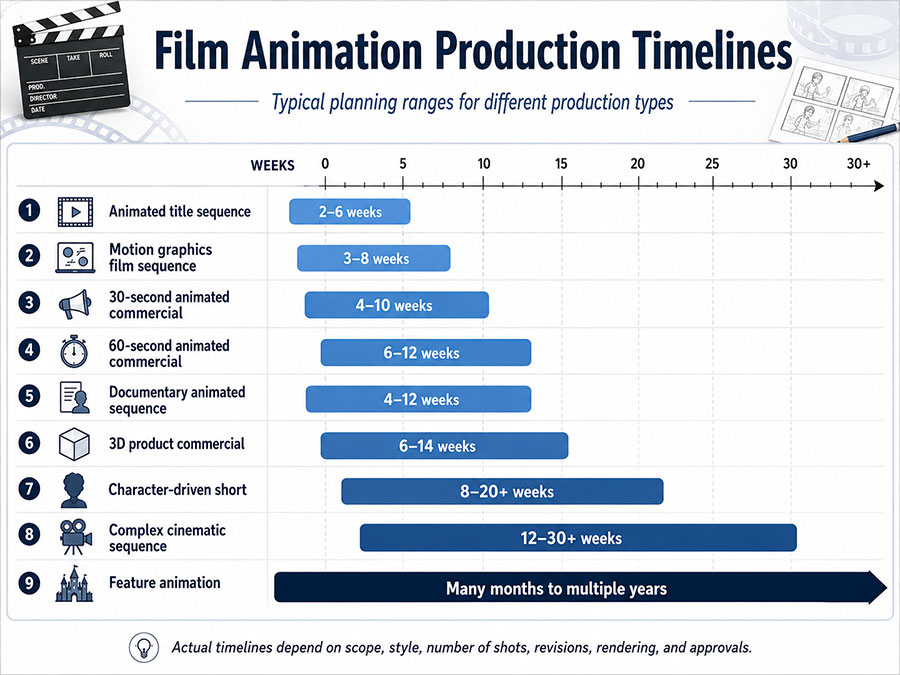
General planning ranges may include:
| Production | Typical Planning Window |
|---|---|
| Animated title sequence | 2–6 weeks |
| Motion graphics film sequence | 3–8 weeks |
| 30-second animated commercial | 4–10 weeks |
| 60-second animated commercial | 6–12 weeks |
| Documentary animated sequence | 4–12 weeks |
| 3D product commercial | 6–14 weeks |
| Character-driven short | 8–20+ weeks |
| Complex cinematic sequence | 12–30+ weeks |
| Feature animation | Many months to multiple years |
These are planning ranges rather than guarantees.
Timeline depends on:
- Duration
- Style
- Asset complexity
- Number of shots
- Character requirements
- Rendering
- Revisions
- Approvals
- Technical requirements
How Much Does Film Animation Cost?
There is no universal price per minute.
A minute of simple animated graphics and a minute of cinematic character animation are completely different productions.
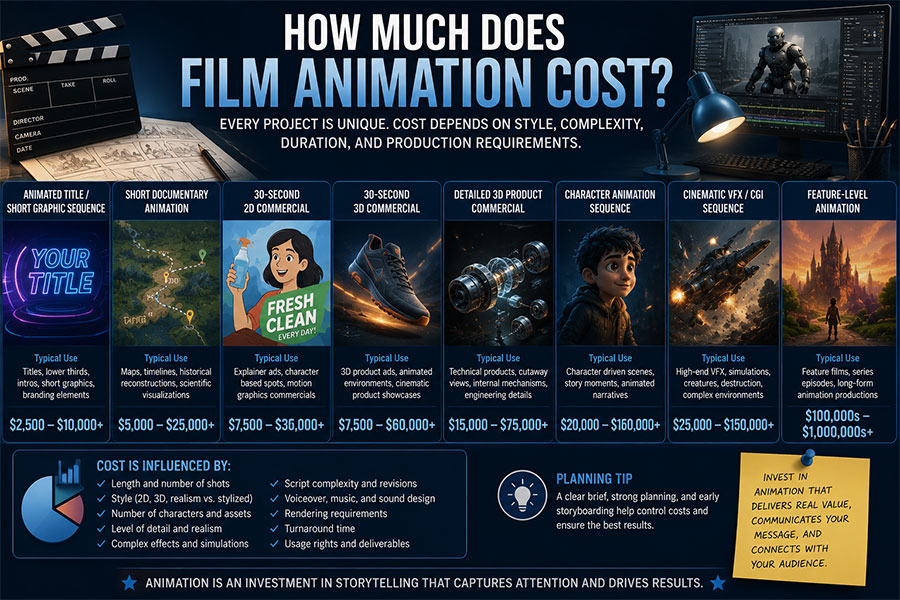
General planning ranges may look like:
| Project | Approximate Professional Range |
|---|---|
| Animated title / short graphic sequence | $2,500–$10,000+ |
| Short documentary animation | $5,000–$25,000+ |
| 30-second 2D commercial | $7,500–$30,000+ |
| 30-second 3D commercial | $15,000–$60,000+ |
| Detailed 3D product commercial | $20,000–$75,000+ |
| Character animation sequence | $20,000–$100,000+ |
| Cinematic VFX / CGI sequence | $25,000–$150,000+ |
| Complex short animated film | $50,000–$250,000+ |
| Feature-level animation | Potentially hundreds of thousands to millions+ |
These are broad planning ranges, not fixed Just Animations pricing.
Final cost depends on production requirements.
What Makes Film Animation Expensive?
Cost generally increases when a project requires:
More Assets
More:
- Characters
- Products
- Props
- Environments
means more production.
Greater Realism
Photorealism requires more attention to:
- Modeling
- Materials
- Lighting
- Rendering
- Simulation
Character Performance
Characters may require:
- Modeling
- Rigging
- Facial animation
- Body animation
- Hair
- Clothing
Complex Effects
Fire, water, crowds, destruction, hair, and cloth can increase production requirements.
Numerous Shots
Each new shot may require:
- Camera setup
- Lighting
- Animation
- Rendering
- Compositing
High Resolution
Cinema and large-format outputs can increase rendering requirements.
Can Existing 3D Assets Reduce Film Animation Cost?
Potentially.
A company may already have:
- CAD models
- Product models
- Architectural models
- Character models
These assets can provide a useful starting point.
However, engineering CAD is not automatically production-ready animation geometry.
Models may need:
- Cleanup
- Retopology
- Materials
- UV preparation
- Rigging
The animation team should evaluate the files before estimating how much production they eliminate.
Film Animation Rights and Source Materials
Productions should determine whether they have permission to use:
- Photographs
- Archival footage
- Artwork
- Music
- Logos
- Character designs
- Third-party models
- Fonts
Animation does not automatically eliminate copyright concerns.
If a documentary animation is based directly on a copyrighted photograph or artwork, the production may still need to consider licensing.
Legal questions should be reviewed with appropriate rights-clearance or legal professionals.
AI in Film Animation
AI-assisted tools are increasingly entering parts of the animation workflow.
They may support:
- Concept development
- Storyboarding
- Reference generation
- Background development
- Cleanup
- Rotoscoping
- Voice prototypes
- Editing assistance
However, professional film production still needs careful consideration of:
- Consistency
- Rights
- Brand requirements
- Actor or likeness permissions
- Quality control
- Editorial integrity
AI should be treated as a production tool rather than an automatic substitute for direction.
Film Animation vs Live Action
Use live action when reality itself is valuable.
Examples include:
- Interviews
- Human testimony
- Real locations
- Customer stories
- Performance
Use animation when visualization adds something the camera cannot easily provide.
Examples include:
- Invisible systems
- History
- Internal products
- Fantasy
- Data
- Scientific concepts
Use both when each medium contributes something different.
When Is Hybrid Film Production Better?
Hybrid production can be extremely effective.
Imagine a documentary:
Interview → animated historical map → archival photograph → 3D reconstruction → interview
Or a commercial:
Actor uses product → 3D cutaway reveals mechanism → actor reacts → motion graphics show benefit
Each visual method performs the task it handles best.
The audience does not need the whole production to use one technique.
Film Animation in Los Angeles
Los Angeles remains deeply associated with:
- Film
- Television
- Advertising
- Entertainment
- Production
- Post-production
Businesses, agencies, producers, and entertainment companies looking for animation support in the region can review our Los Angeles animation studio page for additional information about animation production for businesses and creative projects.
Just Animations also explores the changing medium itself in From Hand-Drawn to CGI: Tracing the Evolution of Motion Picture Animation, which looks at the transition from traditional techniques toward modern computer-generated filmmaking.
Questions to Ask Before Starting Film Animation
Before production, establish:
- What is the animation supposed to communicate?
- Who is watching?
- Is the project documentary, commercial, educational, or narrative?
- Does it need to integrate with live action?
- Should the style be realistic or stylized?
- Is 2D or 3D more appropriate?
- What references are available?
- Are accurate product or historical details required?
- What is the final duration?
- What screen formats are needed?
- What resolution is required?
- Does the production require characters?
- Are there multiple stakeholder approvals?
- Will assets need to be reused?
- What is the final deadline?
Good answers to these questions can eliminate expensive uncertainty later.
Common Film Animation Mistakes
1. Choosing Style Before Understanding the Story
A technique should solve a communication problem.
2. Skipping Storyboarding
Animation changes become increasingly expensive later in production.
3. Making Every Shot Move
Movement needs purpose.
4. Overusing Visual Effects
More effects do not automatically improve storytelling.
5. Ignoring Live-Action Lighting
CGI should integrate with photographed footage.
6. Forgetting Sound
Sound contributes significantly to perceived quality.
7. Designing Only One Aspect Ratio
Modern campaigns often require several formats.
8. Leaving Rights Questions Until the End
Clear source-material permissions early.
9. Pursuing Realism Without a Reason
Stylization may communicate better.
10. Treating Documentary Reconstruction as Fiction
Accuracy and editorial context matter.
A Simple Film Animation Decision Framework
Use four questions.
WHAT MUST THE VIEWER SEE?
Is the subject:
- Physical?
- Historical?
- Invisible?
- Fictional?
- Abstract?
WHY CAN’T A CAMERA SHOW IT?
Is it:
- Impossible?
- Dangerous?
- Expensive?
- Unavailable?
- Too small?
- Too large?
HOW REAL SHOULD IT FEEL?
Should it be:
- Photorealistic?
- Illustrated?
- Cinematic?
- Graphic?
- Stylized?
HOW DOES IT SUPPORT THE STORY?
The final question is the most important.
If removing the animation would make the story harder to understand, less emotional, less persuasive, or visually impossible to communicate, animation is solving a real problem.
What Is the Best Animation for Documentary Film?
The best documentary animation is generally the approach that communicates real information clearly while respecting the factual and editorial context of the production.
That might be:
- 2D historical illustrations
- Animated maps
- Timelines
- 3D reconstructions
- Scientific animation
- Motion graphics
The objective is not necessarily cinematic spectacle.
It is understanding.
What Is the Best Animation for a TV Commercial?
The best animation for TV commercial production should communicate the campaign idea quickly and memorably.
For a physical product, that may mean cinematic 3D.
For a service, it may mean characters or motion graphics.
For a brand campaign, it may mean a distinctive visual world.
The best approach depends on:
- Product
- Audience
- Message
- Brand
- Running time
What Is the Best Animation for Movies?
There is no single best movie-animation technique.
The right approach may be:
- Traditional 2D
- Digital 2D
- 3D CGI
- Stop motion
- Rotoscoping
- Mixed media
- Live action with VFX
What matters is whether the visual language supports the story consistently.
Film Animation Should Serve the Story
Technology has dramatically expanded what filmmakers can put on screen.
But unlimited visual possibility creates another challenge:
Knowing what not to animate.
Good film animation is intentional.
For documentaries, it can reveal information that otherwise has no imagery.
For television commercials, it can communicate products and ideas in seconds.
For movies, it can create characters, places, events, and worlds that could never exist in front of a physical camera.
The most successful film animation does not draw attention to technology simply because the technology is impressive.
It makes the story:
✓ Clearer
✓ Stronger
✓ More memorable
✓ More believable
✓ More emotionally effective
Whether the finished production uses a simple animated map or an entire digital world, animation works best when every movement, shot, and visual decision has a reason to be there.
Frequently Asked Questions
What is film animation?
Film animation is the creation or integration of animated visuals within movies, documentaries, television commercials, corporate films, educational productions, and other cinematic content. It can include 2D animation, 3D CGI, motion graphics, characters, maps, visual effects, digital environments, titles, and mixed-media techniques.
How is animation used in documentaries?
Documentaries use animation to reconstruct historical events, visualize interview testimony, explain scientific concepts, animate maps and timelines, show data, and represent events or environments for which no usable footage exists. The animation should support factual understanding and be presented with appropriate editorial context.
Why use animation in a TV commercial?
Animation allows advertisers to show products, ideas, transformations, internal mechanisms, characters, graphics, and environments that may be difficult or impossible to capture with conventional photography. It can also communicate complex benefits quickly within short commercial running times.
What is the difference between film animation and CGI?
Film animation refers to the creation of movement and animated storytelling for cinematic productions. CGI means computer-generated imagery and can include both animated and static digital visuals. A computer-generated character performing in a movie is both CGI and animation, while a static digital background may be CGI without being character animation.
Can animation be combined with live-action film?
Yes. Live-action and animation are frequently combined. A filmmaker can add animated characters, products, environments, diagrams, typography, visual effects, or 3D objects to photographed footage through tracking, lighting, rendering, rotoscoping, and compositing. Hybrid production allows filmmakers to preserve real human performances while adding visuals that cannot be filmed practically.