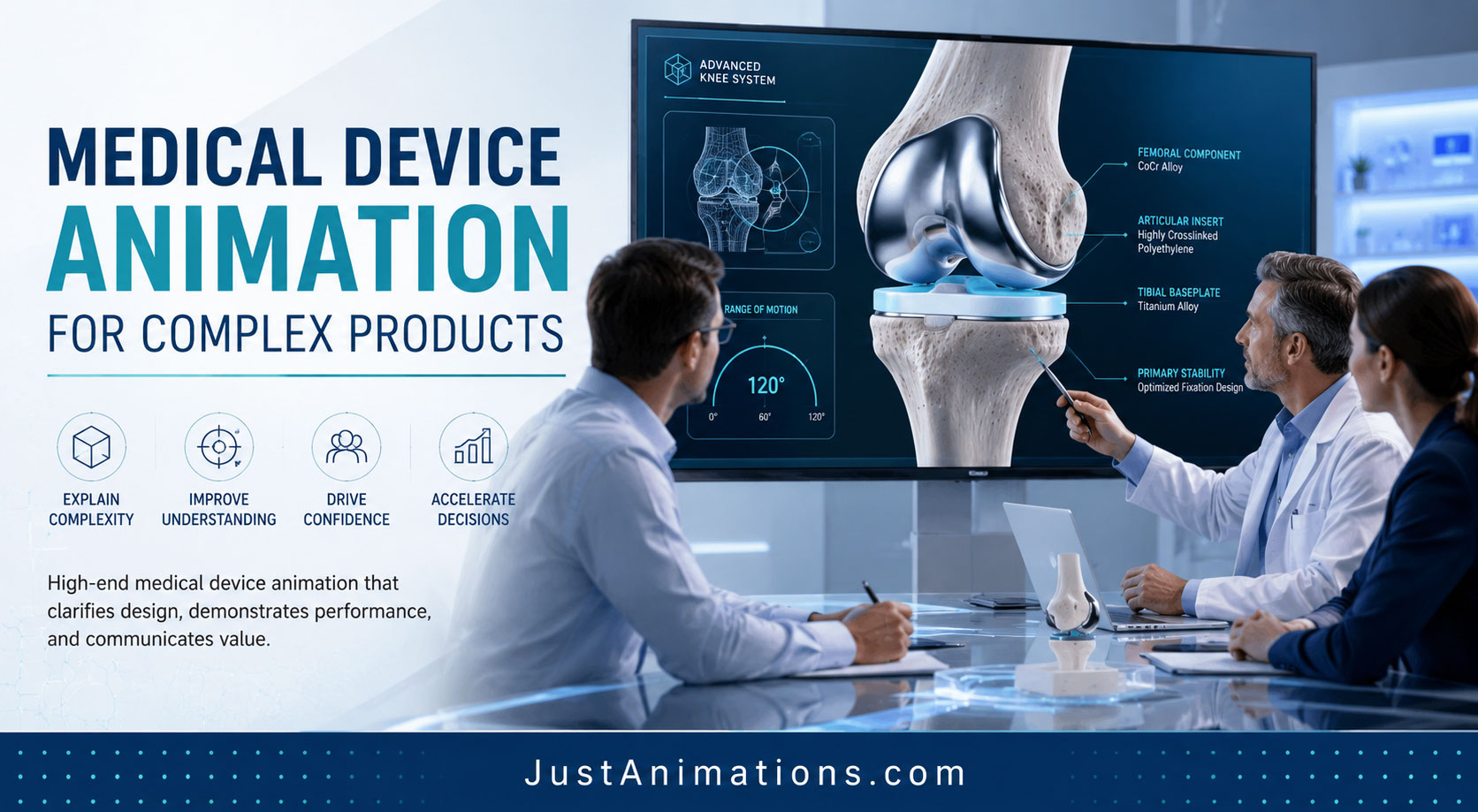
Medical device animation helps companies explain complex products, procedures, mechanisms, and clinical value in a way that is easier to understand.
That matters because medical devices are rarely simple.
They may involve internal components, patient anatomy, procedural steps, clinical workflows, software interfaces, engineering details, safety considerations, and regulatory-sensitive messaging.
A brochure can describe the device.
A photo can show what it looks like.
A live-action video can show parts of the procedure.
But animation can show what is happening inside the body, inside the device, and inside the clinical workflow.
That is why medical device animation is so useful.
It makes complex products easier to explain to surgeons, physicians, patients, investors, sales teams, distributors, hospital buyers, and internal training teams.
Medical Device Animation: The Short Answer
Medical device animation is animated visual content used to explain how a medical device works, what problem it solves, how it is used, and why it matters.
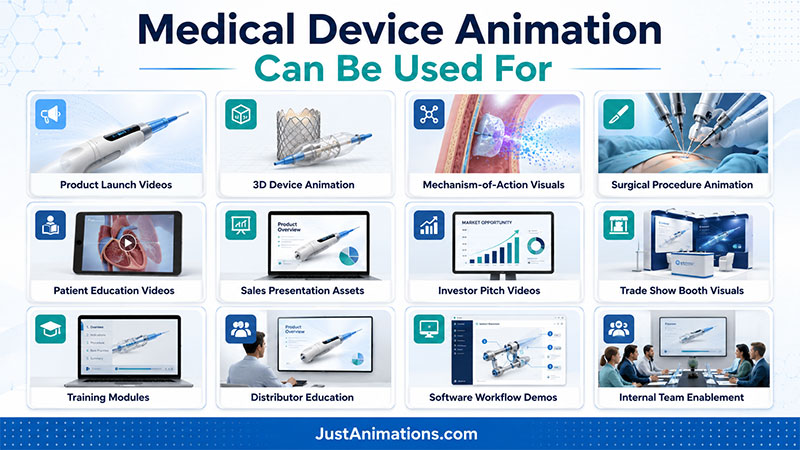
It can be used for:
✓ Product launch videos
✓ 3D device animation
✓ Mechanism-of-action visuals
✓ Surgical procedure animation
✓ Patient education videos
✓ Sales presentation assets
✓ Investor pitch videos
✓ Trade show booth visuals
✓ Training modules
✓ Distributor education
✓ Software workflow demos
✓ Internal team enablement
The goal is not just to make the device look advanced.
The goal is to explain the product clearly, accurately, and professionally.
Medical Device Animation Snapshot
| Medical Device Need | How Animation Helps | Common Output |
|---|---|---|
| Explain Device Function | Shows how the product works internally | 3D device animation |
| Show Procedure Steps | Demonstrates use in a controlled sequence | Procedure animation |
| Educate Patients | Simplifies medical concepts visually | Patient education video |
| Support Sales Teams | Gives reps a repeatable explanation tool | Sales presentation video |
| Train Clinical Teams | Shows correct use and workflow | Training animation |
| Launch A Device | Creates a premium product reveal | Product launch video |
| Explain Software Integration | Shows interface and workflow | Motion graphics demo |
A strong medical device animation should be clear, accurate, and easy to follow.
It should not overwhelm the viewer with unnecessary complexity.
Why Medical Devices Are Difficult To Explain
Medical devices are often difficult to explain because they sit at the intersection of science, engineering, patient care, and business.
The audience may need to understand:
- What the device does
- How it works
- How it is used
- Where it fits in the clinical workflow
- What problem it solves
- What makes it different
- What the physician or operator needs to know
- What the patient should understand
- How the device interacts with anatomy
- How the technology supports better outcomes
- How the device compares to existing approaches
That is a lot of information.
Medical device animation studios help by organizing the explanation visually.
Instead of forcing the audience to imagine the process, animation shows it step by step.
Medical Device Animation Value Scorecard
| Business Value | Importance | Visual Score |
|---|---|---|
| Product Understanding | 10/10 | ██████████ |
| Technical Accuracy | 10/10 | ██████████ |
| Clinical Workflow Clarity | 9/10 | █████████ |
| Sales Enablement | 9/10 | █████████ |
| Training Usefulness | 8/10 | ████████ |
| Patient Education | 8/10 | ████████ |
| Investor Communication | 8/10 | ████████ |
| Lowest Cost | 3/10 | ███ |
For medical device companies, clarity and accuracy matter more than flashy visuals.
A beautiful animation that explains the product incorrectly is not a good animation.
Best Uses For Medical Device Animation
Medical device animation is especially useful for products that are difficult to film, difficult to demonstrate, or difficult to explain with static visuals.
It works well for:
- Surgical devices
- Diagnostic devices
- Implantable devices
- Robotic surgery systems
- Monitoring devices
- Imaging technology
- Catheters and delivery systems
- Orthopedic devices
- Dental devices
- Cardiovascular devices
- Neurological devices
- Laboratory equipment
- Patient monitoring platforms
- Medtech software
- Hospital workflow technology
- Rehabilitation devices
- Wearable medical technology
The more technical the device, the more useful animation becomes.
Budget Ladder: Medical Device Animation
$15K to $30K: Focused Medical Device Animation
This can support a short device overview, simple product explanation, motion graphics piece, or focused feature animation.
$30K to $75K: Professional Medical Animation
This range can support custom 3D device visuals, procedural explanation, sales videos, training assets, and more polished product animation.
$75K to $150K+: Premium Medical Device Animation
This can support advanced 3D animation, anatomy visualization, complex procedure sequences, investor videos, product launch assets, and multi-channel deliverables.
$150K+: Medical Device Content System
At this level, the project may include multiple videos, procedure modules, sales versions, patient education assets, trade show loops, distributor training, and campaign content.
The right budget depends on the audience, complexity, accuracy needs, and where the animation will be used.
Typical Pricing Breakdown For Medical Device Animation
Medical device animation often requires careful planning and technical review.
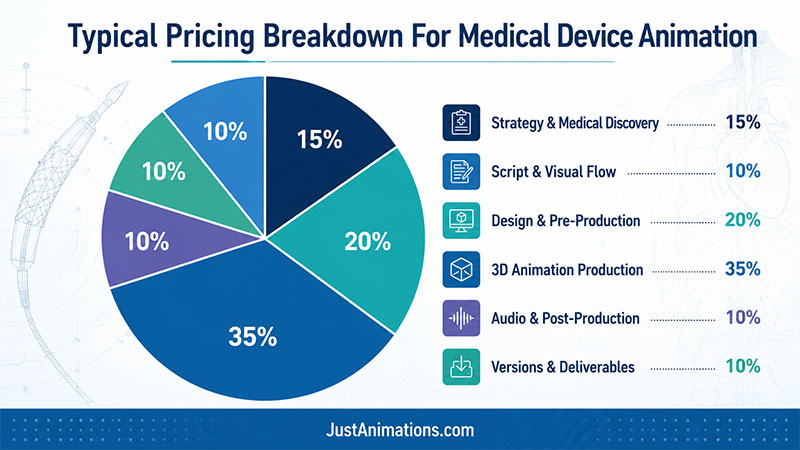
| Production Area | Typical Budget Share | What It Covers |
|---|---|---|
| Strategy & Medical Discovery | 15% | Audience, use case, device details, message goals |
| Script & Visual Flow | 10% | Product story, procedure sequence, claims-sensitive wording |
| Design & Pre-Production | 20% | Storyboards, style frames, anatomy/device planning |
| 3D Animation Production | 35% | Modeling, animation, rendering, device movement, anatomy visuals |
| Audio & Post-Production | 10% | Voiceover, music, sound design, editing, polish |
| Versions & Deliverables | 10% | Sales, training, trade show, investor, and web versions |
Medical device animation often requires more review than general product animation because accuracy matters.
The more clinical or technical the content is, the more important the planning phase becomes.
Cost Driver Meter
Here is what usually increases the cost of medical device animation.
Custom Device Modeling
Cost Impact: Very High
██████████
Anatomy Visualization
Cost Impact: Very High
██████████
Procedure Sequence Animation
Cost Impact: High
█████████
Technical And Clinical Accuracy
Cost Impact: High
█████████
Regulatory-Sensitive Messaging
Cost Impact: Medium to High
███████
Multiple Audience Versions
Cost Impact: Medium to High
███████
Sales, Training, And Trade Show Deliverables
Cost Impact: Medium
██████
Rush Timeline
Cost Impact: High
████████
A simple product overview and a detailed surgical procedure animation may both be “medical device videos,” but they are very different projects.
Scope matters more than length alone.
Medical Device Animation Decision Guide
| Business Goal | Best Animation Direction | Why It Works |
|---|---|---|
| Explain how the device works | 3D device animation | Shows internal function and product value |
| Show a procedure | Surgical or clinical workflow animation | Demonstrates steps clearly |
| Educate patients | Simplified 2D or 3D explanation | Makes medical information easier to understand |
| Support sales teams | Product explainer or demo animation | Gives reps a repeatable asset |
| Train users | Instructional animation | Shows correct use consistently |
| Support investors | Premium product visualization | Builds confidence and clarity |
| Use at trade shows | Looping device animation | Creates booth attention and product interest |
A medical device animation should be designed around the audience.
A surgeon, patient, investor, hospital buyer, and distributor may all need different levels of detail.
Technical Accuracy Matters
Medical device animation needs creative skill, but it also needs technical discipline.
The animation may need to align with:
✓ Product specifications
✓ Device dimensions
✓ Clinical workflow
✓ Anatomical accuracy
✓ Procedural sequence
✓ Intended use
✓ Safety considerations
✓ Approved messaging
✓ Brand and compliance guidance
This does not mean the animation has to show every technical detail.
It means the details it does show should be correct.
A strong animation simplifies the message without misrepresenting the device.
Patient Education Vs Professional Education
Medical device companies often need different versions for different audiences.
Patient Education Animation
Uses simpler language.
Focuses on comfort, understanding, and reassurance.
Avoids unnecessary technical depth.
Explains what the patient needs to know.
Professional Education Animation
Uses more technical language.
Shows clinical workflow, procedure steps, and device function.
Supports physicians, clinicians, sales teams, or hospital buyers.
May include more detailed visuals.
The same product may need both.
That is why planning deliverables early matters.
Common Medical Device Animation Deliverables
| Deliverable | Best Use |
|---|---|
| Main Device Animation | Website, sales, product pages, launch campaigns |
| Procedure Animation | Physician education, training, clinical explanation |
| Patient Education Video | Waiting rooms, websites, patient onboarding |
| Sales Presentation Version | Sales reps, distributors, hospital buyers |
| Trade Show Loop | Booth screens and event displays |
| Investor Version | Fundraising, board presentations, partner meetings |
| No-Voiceover Version | Events, international use, screen displays |
| Short Social Cutdown | LinkedIn, YouTube, launch teasers |
A good medical device animation can support multiple teams.
Marketing, sales, training, investor relations, and customer education may all benefit from the same core visual asset.
Buyer Readiness Checklist
Before starting a medical device animation project, prepare:
✓ Device photos
✓ CAD files or 3D models
✓ Product specifications
✓ Clinical workflow information
✓ Procedure steps
✓ Intended audience
✓ Approved claims or messaging guidance
✓ Brand guidelines
✓ Sales materials
✓ Training documents
✓ Existing diagrams or illustrations
✓ Regulatory or legal review process
✓ Target video length
✓ Use channels
✓ Required deliverables
✓ Budget range
✓ Timeline
The clearer the source material, the stronger the animation can be.
A medical animation studio should not be guessing how the device works.
Buyer Readiness Meter
| Buyer Input | Readiness Impact | Visual Score |
|---|---|---|
| Device Specifications | Very High | ██████████ |
| CAD Files Or 3D Assets | Very High | ██████████ |
| Clinical Workflow | High | ████████ |
| Approved Messaging | High | ████████ |
| Intended Audience | High | ████████ |
| Review Process | High | ████████ |
| Brand Guidelines | Medium to High | ███████ |
| Use Channels | Medium | ██████ |
Medical animation projects become smoother when the technical and review inputs are ready early.
Cheap Medical Device Animation Vs Professional Medical Animation
Medical device companies should be careful with low-cost animation.
A cheap animation may look acceptable at first glance, but if the device is shown incorrectly, the anatomy is inaccurate, or the message is unclear, the video can create more problems than it solves.
Cheap Medical Animation
Lower upfront cost.
May use generic visuals.
May lack technical accuracy.
May not reflect real workflow.
May be difficult to approve internally.
May need to be remade.
Professional Medical Device Animation
Higher upfront investment.
More accurate visuals.
Clearer explanation.
Better product credibility.
More useful for sales, training, and education.
Stronger approval confidence.
For medical devices, trust matters.
The animation should support that trust, not weaken it.
Red Flags To Avoid
Be cautious if a studio:
✕ Does not ask for device specifications
✕ Ignores clinical workflow
✕ Has weak 3D product examples
✕ Does not plan for review rounds
✕ Uses generic medical visuals
✕ Cannot explain how accuracy will be handled
✕ Skips storyboarding
✕ Does not ask about audience type
✕ Treats patient and professional education the same way
✕ Promises complex medical animation at a suspiciously low price
Medical device animation needs accuracy, clarity, and restraint.
Not just flashy visuals.
How Just Animations Approaches Medical Device Animation
Just Animations creates 3D animation, product animation, medical device animation, explainer videos, motion graphics, animated commercials, corporate videos, training videos, AI-assisted animation, social media videos, and video production.
For complex medical products, the focus is on visual clarity, technical accuracy, and business usefulness.
The animation should make the device easier to understand, easier to present, and easier to use across sales, training, trade shows, investor communication, and education.
The best medical device animation does not just show the product.
It explains the value of the product clearly.
Final Thoughts
Medical device animation is valuable because it helps companies explain complex products with clarity and control.
It can show how a device works, how it is used, what happens inside the body, how a procedure flows, and why the product matters.
For medical device companies, the value is not just visual polish.
The value is trust.
A strong animation can support sales teams, educate physicians, train users, inform patients, support investors, and strengthen product launches.
That is what complex medical products need.
Clear visuals.
Accurate explanation.
Professional presentation.
FAQ
What is medical device animation?
Medical device animation is animated visual content used to explain how a medical device works, how it is used, how it interacts with anatomy, or how it supports clinical workflows, patient education, sales, training, and product launches.
How much does medical device animation cost?
Medical device animation can cost from $15,000 to $75,000+ for many professional projects. More advanced 3D device animation, anatomy visuals, surgical procedure animation, product launch videos, and multi-deliverable campaigns can cost $100,000 to $150,000+.
Why use animation for medical devices?
Animation is useful for medical devices because it can show internal components, anatomy, procedure steps, device movement, clinical workflow, and technical details that are difficult to explain with photos, brochures, or live-action video.
Who uses medical device animation?
Medical device companies, medtech startups, healthcare technology firms, surgical device manufacturers, diagnostic companies, hospital technology providers, sales teams, training teams, and investor relations teams use medical device animation.
What should I provide before creating a medical device animation?
Useful materials include device photos, CAD files, product specifications, clinical workflow details, procedure steps, approved messaging, brand guidelines, training documents, sales materials, review requirements, intended audience details, and distribution plans.