Effective Public sector animation solves challenges which Government agencies, public-sector organizations, and NGOs often face; a communication problem, which private-sector brands often do not encounter in quite the same way:
The information is important, but it is not always easy to explain.
A new policy may contain dozens of pages of technical language.
A public health initiative may need to reach people across different age groups, languages, abilities, and education levels.
An infrastructure project may involve engineering concepts that are difficult to understand from plans alone.
A public service may require citizens to complete several unfamiliar steps.
This is where public sector animation can become valuable.
Animation gives public organizations a way to transform complicated information into structured visual communication that is easier to follow, distribute, reuse, and understand.
The goal is not to make government communication look more entertaining.
The goal is to make important information clearer.
Public-Sector Communication Has a Clarity Problem
Government communication often begins with information created for internal or technical audiences.
That information may include:
- Policy documents
- Reports
- Data
- Regulations
- Procedures
- Engineering plans
- Program requirements
But the final audience may be the general public.
A resident trying to understand a new benefit program should not need to interpret the same document used by policy specialists.
A commuter trying to understand a transportation project should not need engineering expertise.
A business owner applying for a permit should not need to decode an administrative workflow.
The communication challenge is therefore not merely:
How do we publish the information?
It is:
How do we translate the information without losing accuracy?
That is one of the strongest use cases for government animation.
What Is Public Sector Animation?
Public sector animation is animated visual communication created for government agencies, public institutions, NGOs, and organizations delivering information or services to the public.
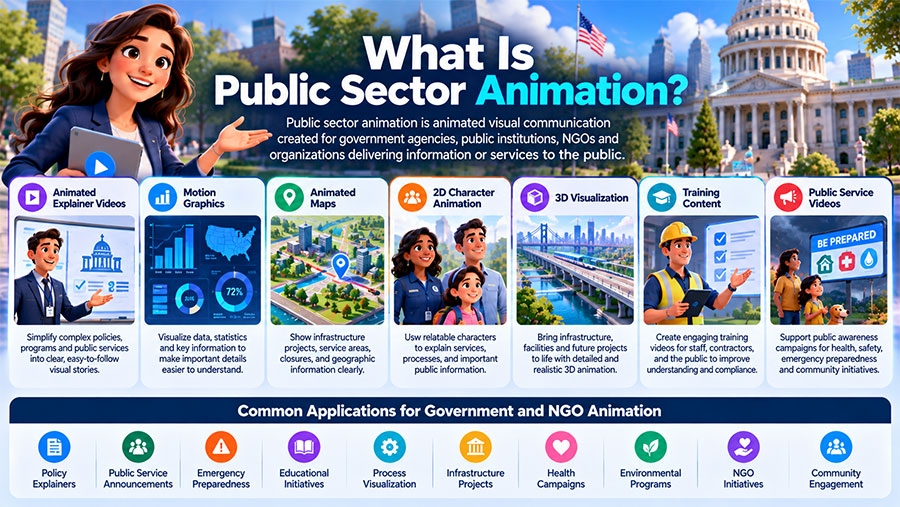
It can include:
- Animated explainer videos
- Motion graphics
- Animated maps
- Data visualization
- 2D character animation
- 3D infrastructure visualization
- Training content
- Public service videos
- Emergency preparedness content
- Digital-service tutorials
The correct format depends on what the audience needs to understand.
A policy process may work well as 2D animation.
Public statistics may be clearer through motion graphics.
A proposed transit station, roadway, facility, or infrastructure project may require 3D visualization.
The medium should follow the communication problem.
A Public Sector Awareness Campaign Needs More Than Attention
A successful public sector awareness campaign is not simply an advertisement with a government logo attached.
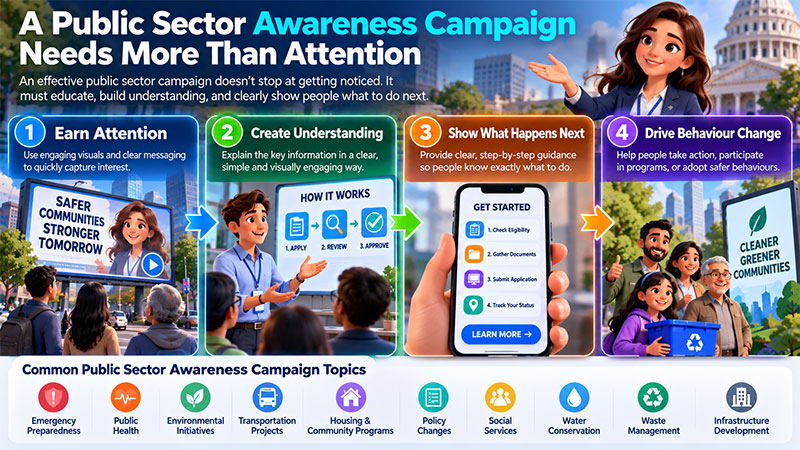
Public campaigns often need people to:
- Understand a risk
- Recognize a public service
- Change behavior
- Complete an action
- Participate in a program
- Prepare for an emergency
- Understand a policy change
That means the communication must usually do several things in sequence.
First:
Earn attention.
Then:
Create understanding.
Then:
Explain what happens next.
Consider an emergency-preparedness campaign.
A static message might say:
“Prepare an emergency kit.”
An animated sequence can show:
- What belongs in the kit.
- Why those items matter.
- Where the kit should be stored.
- What residents should do when an alert occurs.
The audience receives a process rather than a slogan.
That distinction matters.
Government Animation Can Make Invisible Processes Visible
Many government services are difficult to visualize because the important activity happens behind the scenes.
Consider:
- Permit processing
- Tax administration
- Emergency response
- Public-health monitoring
- Infrastructure planning
- Environmental assessment
- Benefit applications
A resident may only see:
Application submitted
and later:
Application approved.
Animation can visualize what happens between those two points.
For example:
Citizen submits application
↓
Agency validates information
↓
Department reviews eligibility
↓
Additional information requested
↓
Decision issued
Now the process feels understandable.
The same principle can be used for NGO animation.
A nonprofit or NGO may use visual storytelling to show how:
- Donations are allocated
- Aid reaches communities
- Programs operate
- Environmental initiatives work
- Health interventions create impact
Accessibility Should Be Planned Before Production
Accessibility should not be treated as a final production add-on.
For U.S. federal agencies, Section 508 guidance addresses accessible synchronized media, including captions, audio descriptions, transcripts, and accessible media controls.
The federal guidance specifically recommends planning accessibility requirements during the media-development process rather than attempting to retrofit them afterward.
The current Section 508 guidance for video and synchronized media provides detailed requirements and planning guidance for government content.
For public-sector animation, accessibility planning can influence:
- Script pacing
- On-screen text placement
- Narration
- Caption timing
- Visual descriptions
- Color contrast
- Delivery formats
That means accessibility can affect creative decisions before animation even begins.
What Makes Government Video Communication Effective?
Strong government video communication usually begins with a specific audience outcome.
Not:
“We need an animation.”
Instead:
“Residents need to understand how to apply for this program.”
Or:
“Businesses need to know what changes under this regulation.”
Or:
“The public needs to understand how this infrastructure project will affect the community.”
That small change in thinking makes the production much easier to plan.
The communication team can then determine:
- What the audience already knows
- What they need to learn
- What information can be simplified
- What cannot be simplified
- Which stakeholders must review the content
- Which accessibility requirements apply
- Which platforms will distribute the video
The animation becomes the delivery system for a communication strategy.
Public-Sector Video Should Be Designed for Reuse
One well-planned animation can often support several communication channels.
A master video might become:
- Website content
- Social media clips
- Presentation material
- Public meeting visuals
- Training content
- Internal communications
- Short awareness ads
A 90-second public-information animation, for example, could also produce:
30-second awareness video
15-second social clip
silent event loop
presentation excerpt
This can make public-sector video production more useful across departments and campaigns.
Why NGOs Can Use the Same Communication Principles
Government agencies are not the only organizations dealing with complicated public information.
NGOs frequently communicate subjects involving:
- Public health
- Humanitarian programs
- Environment
- Education
- Community development
- International aid
- Social services
NGO animation can help explain the relationship between:
problem → intervention → outcome
without requiring the audience to interpret lengthy reports.
It can also help organizations communicate with donors, beneficiaries, partners, and policymakers using a consistent visual narrative.
The Hard Part Is Deciding What to Leave Out
Public-sector organizations often possess too much information rather than too little.
Every department may want something included.
Every stakeholder may have an important point.
Every subject-matter expert may want another qualification added.
The result can become a video that is technically accurate but impossible to follow.
High-impact communication requires prioritization.
The production team must determine:
What does the audience absolutely need to understand?
Then everything else should support that objective.
This is where strategy, scripting, storyboarding, animation, accessibility planning, and stakeholder review need to work together.
Download The Public Sector Guide to High-Impact Video Communication
For communications teams, agencies, NGOs, and public-sector decision makers planning upcoming initiatives, we created a deeper resource:
The Public Sector Guide to High-Impact Video Communication
The guide goes beyond the concepts in this article and provides a more structured framework for planning effective visual communication.
It is designed for:
- Communications directors
- Public affairs teams
- Program managers
- Government marketing teams
- Public information officers
- NGO communications teams
- Procurement stakeholders
- Agency leadership
The guide includes strategic frameworks, illustrated charts, planning considerations, and practical guidance for translating complicated public information into visual narratives while considering accessibility from the beginning.

Click Here to download the Free Public Sector Animation guide.
Planning a Government or Public-Sector Video Initiative?
If your organization is preparing a:
- Public awareness campaign
- Policy explainer
- Infrastructure presentation
- Public health initiative
- Emergency communication program
- Employee training initiative
- Community outreach campaign
You can also schedule a discussion with our team about the communication requirements, animation approach, and production considerations for your project.
The objective should always be the same:
Make important information easier for people to understand and act on.
That is where public sector animation can create its greatest value.
Frequently Asked Questions
What is public sector animation?
Public sector animation is animated visual communication created for government agencies, public institutions, NGOs, and organizations delivering services or information to the public. It can include explainers, animated maps, motion graphics, training videos, public awareness content, and 3D visualization.
How can government agencies use animation?
Government agencies can use animation to explain policies, programs, public services, emergency procedures, infrastructure projects, digital services, public health initiatives, and employee training.
What is a public sector awareness campaign?
A public sector awareness campaign is a communication initiative designed to educate or influence a defined public audience around a service, policy, risk, program, or desired action. Animation can help turn complicated campaign information into a clearer visual sequence.
Can government animation be accessible?
Yes. Accessibility can be incorporated through captions, transcripts, readable text, appropriate contrast, narration, audio-description planning, accessible media controls, and other requirements relevant to the project and agency.
Can NGOs use animation for public communication?
Yes. NGO animation can explain programs, social issues, public-health initiatives, environmental projects, humanitarian work, and organizational impact to donors, communities, partners, and policymakers.