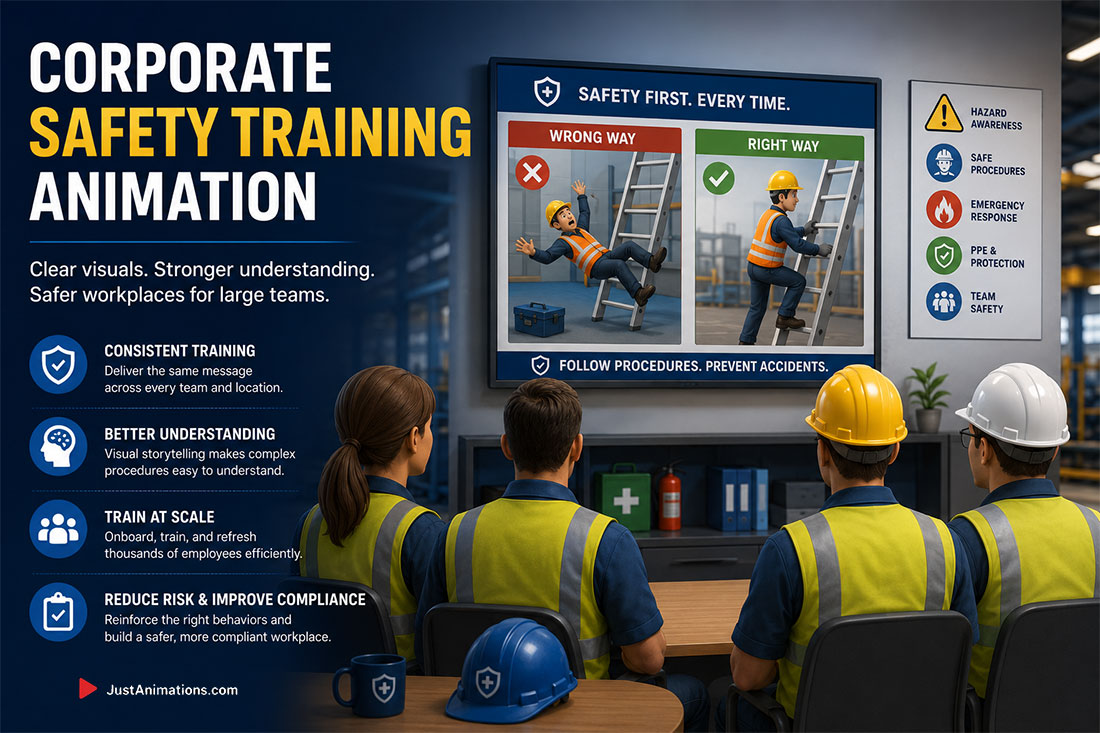
Corporate safety training animation helps large organizations teach safety procedures clearly, consistently, and at scale.
That sounds straightforward.
But safety training is one of those areas where “good enough” can become expensive fast.
If employees misunderstand a procedure, mistakes happen.
If training is inconsistent between locations, risk increases.
If safety rules are explained in dense policy language, people tune out.
If training is too boring, retention drops.
If managers explain the same process differently, teams operate differently.
For large teams, safety training is not just an HR checkbox.
It is a risk-management tool.
And animation can make safety information easier to understand, easier to remember, and easier to repeat across departments, locations, shifts, contractors, and onboarding programs.
Corporate Safety Training Animation: The Short Answer
Corporate safety training animation studio is animated video content used to explain workplace safety procedures, hazards, emergency protocols, equipment use, compliance requirements, and correct employee behavior.
It can be used for:
✓ Employee safety onboarding
✓ Workplace hazard awareness
✓ Emergency response training
✓ Equipment safety procedures
✓ Manufacturing safety training
✓ Construction safety training
✓ Warehouse and logistics safety
✓ Healthcare safety protocols
✓ Fire safety training
✓ Chemical handling training
✓ Cybersecurity awareness training
✓ Compliance and policy training
✓ Contractor safety orientation
✓ Refresher training modules
The goal is not to make safety training more entertaining for no reason.
The goal is to make important safety information clearer and more memorable.
Safety Training Animation Snapshot
| Safety Training Need | How Animation Helps | Common Output |
|---|---|---|
| Explain Hazards | Shows risks visually before incidents happen | Hazard awareness video |
| Train Large Teams | Delivers the same message consistently | Standardized training module |
| Show Correct Procedures | Demonstrates the right steps clearly | Procedure animation |
| Support Compliance | Simplifies required policy information | Compliance training video |
| Train Contractors | Provides repeatable orientation content | Contractor safety module |
| Reduce Manager Repetition | Gives leaders a reusable training tool | Internal safety video |
| Refresh Knowledge | Reinforces key rules over time | Short refresher clips |
Safety animation is most useful when the organization needs the same message delivered clearly to many people.
Why Safety Training Often Fails
Safety training often fails because it is treated like information transfer.
The company gives people a document, slide deck, manual, checklist, or long recorded session and assumes the training has worked.
But safety training is not just about exposure.
It is about understanding.
Employees need to know:
- What the hazard is
- Why it matters
- What the correct procedure is
- What not to do
- What can go wrong
- Who is responsible
- What to do in an emergency
- How to apply the rule in real work conditions
Animation helps because it can show cause and effect.
It can show the wrong action, the consequence, and the correct behavior in a controlled way.
That is much stronger than simply saying, “Follow the procedure.”
Safety Training Value Scorecard
| Safety Training Value | Importance | Visual Score |
|---|---|---|
| Consistent Delivery | 10/10 | ██████████ |
| Hazard Understanding | 10/10 | ██████████ |
| Procedure Clarity | 9/10 | █████████ |
| Knowledge Retention | 9/10 | █████████ |
| Compliance Support | 8/10 | ████████ |
| Onboarding Efficiency | 8/10 | ████████ |
| Refresher Training Value | 7/10 | ███████ |
| Lowest Cost | 3/10 | ███ |
For large teams, consistency matters.
One weak explanation can create confusion.
One strong animated module can be used repeatedly.
Best Uses For Corporate Safety Training Animation
Safety training animation works especially well for topics that are repetitive, procedural, visual, or difficult to demonstrate safely in real life.
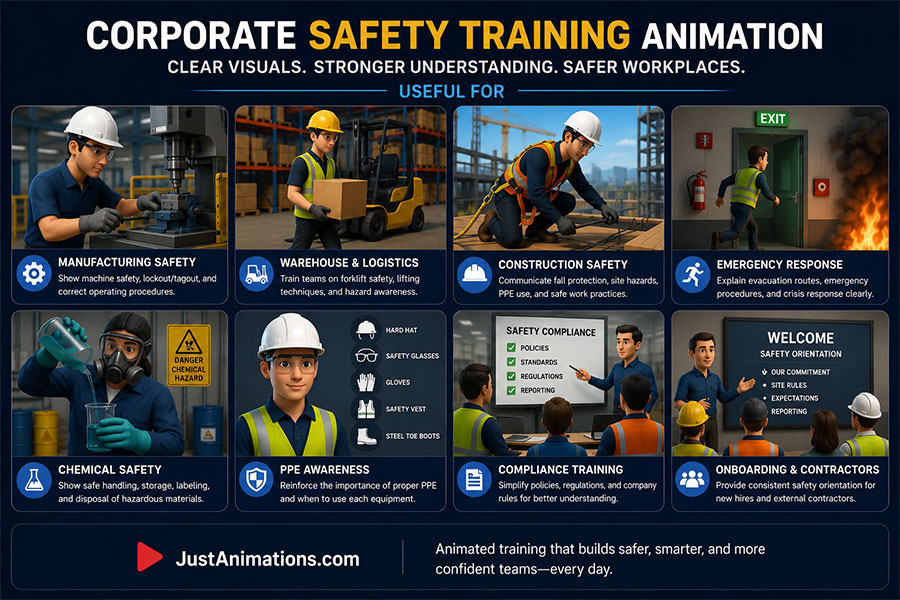
It is useful for:
- Manufacturing safety
- Construction site safety
- Warehouse safety
- Forklift and equipment awareness
- Machine guarding
- Lockout/tagout procedures
- Fire safety
- Emergency evacuation
- Chemical handling
- PPE requirements
- Slip, trip, and fall prevention
- Healthcare safety protocols
- Workplace violence prevention
- Cybersecurity awareness
- Driver safety
- Office safety
- Contractor safety onboarding
- Environmental health and safety programs
The more important the procedure, the more valuable clear training becomes.
Budget Ladder: Corporate Safety Training Animation
$5K to $15K: Focused Safety Training Video
This can support a short safety refresher, hazard awareness clip, simple animated policy explanation, or onboarding segment.
$15K to $40K: Professional Safety Training Module
This range can support custom scripting, scenario-based animation, branded visuals, voiceover, and a polished training video for internal use.
$40K to $100K+: Enterprise Safety Training Series
This can support multiple modules, department-specific versions, LMS-ready exports, quizzes, subtitles, and role-specific training content.
$100K+: Full Safety Training Content System
At this level, the project may include a complete safety animation library across locations, departments, contractors, onboarding, compliance, and refresher training.
The budget depends on how many modules are needed, how customized the training is, and how many employees or locations will use the content.
Typical Pricing Breakdown For Safety Training Animation
Corporate safety training animation budgets are usually spread across training strategy, scripting, design, animation, review, and delivery.
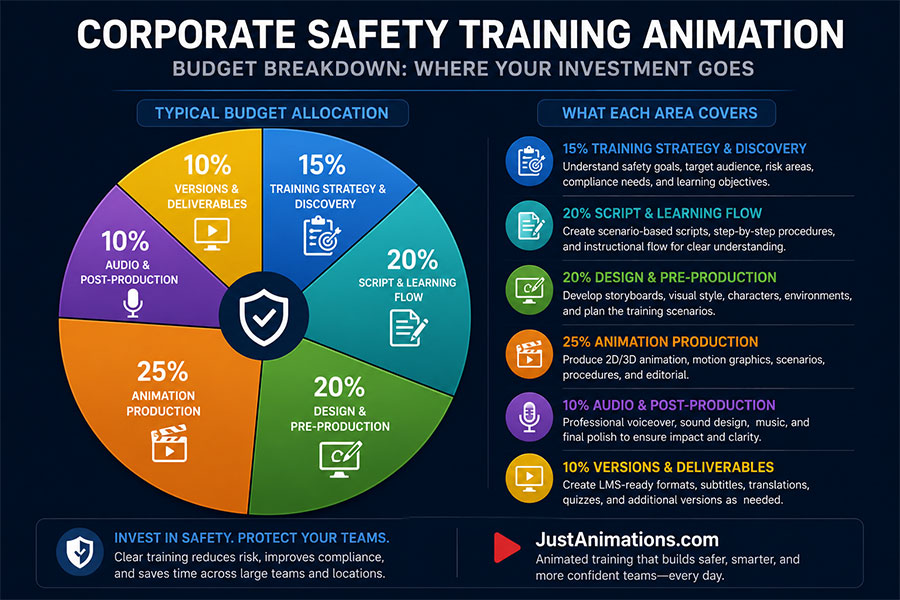
| Production Area | Typical Budget Share | What It Covers |
|---|---|---|
| Training Strategy & Discovery | 15% | Safety goals, audience, risk areas, learning outcomes |
| Script & Learning Flow | 20% | Scenario writing, procedure steps, instructional structure |
| Design & Pre-Production | 20% | Storyboards, characters, environments, visual planning |
| Animation Production | 25% | 2D animation, motion graphics, scenarios, editing |
| Audio & Post-Production | 10% | Voiceover, music, sound design, polish |
| Versions & Deliverables | 10% | LMS files, subtitles, language versions, refresher clips |
For safety training, script quality matters heavily.
The animation must be clear, accurate, and aligned with the actual workplace procedure.
Cost Driver Meter
Here is what usually increases the cost of corporate safety training animation.
Scenario-Based Training
Cost Impact: High
████████
Custom Characters And Environments
Cost Impact: Medium to High
███████
Technical Procedure Accuracy
Cost Impact: High
████████
Multiple Modules
Cost Impact: Very High
██████████
Compliance Or Legal Review
Cost Impact: Medium to High
███████
Multilingual Versions
Cost Impact: Medium to High
███████
LMS Formatting And Accessibility
Cost Impact: Medium
██████
Rush Timeline
Cost Impact: Medium to High
███████
A single safety video and a full enterprise safety training system are very different projects.
The cost should match the complexity and scale.
Safety Training Animation Decision Guide
| Training Goal | Best Animation Direction | Why It Works |
|---|---|---|
| Teach a safety procedure | Step-by-step animation | Shows the correct process clearly |
| Explain hazards | Scenario-based animation | Shows risk before it becomes real |
| Train new employees | Onboarding module | Creates consistency from day one |
| Train contractors | Orientation animation | Gives external teams repeatable guidance |
| Support compliance | Policy animation | Makes dense rules easier to understand |
| Refresh existing teams | Short animated clips | Reinforces key safety reminders |
| Train across locations | Modular animation series | Standardizes learning at scale |
The best safety training animation is not overloaded.
It teaches one clear lesson at a time.
Why Animation Works Better Than Slides For Safety
Slides can be useful.
But slides often tell people what to do.
Animation can show people what to do.
That difference matters.
Slide-Based Training
Lower cost.
Easy to update.
Often text-heavy.
Depends heavily on the presenter.
May feel repetitive or passive.
Safety Training Animation
More visual.
Shows procedures and consequences.
Delivers the same message every time.
Works for remote, hybrid, and distributed teams.
Can be reused in onboarding and refresher programs.
The best training program may use both.
Slides can support discussion.
Animation can deliver the core safety message clearly.
What A Strong Safety Animation Should Include
A strong corporate safety training animation should usually include:
✓ Clear learning objective
✓ Specific workplace context
✓ Visual hazard explanation
✓ Correct procedure demonstration
✓ Common mistake warning
✓ Consequence or risk explanation
✓ Clear employee action steps
✓ Simple language
✓ Accessibility considerations
✓ Subtitles where needed
✓ LMS-ready format
✓ Short modular structure
The best safety training is easy to understand and hard to misinterpret.
Common Deliverables For Large Teams
| Deliverable | Best Use |
|---|---|
| Main Safety Training Module | LMS, onboarding, compliance sessions |
| Short Refresher Clip | Monthly safety reminders and team meetings |
| Contractor Orientation Video | External worker onboarding |
| No-Voiceover Version | Multilingual or noisy work environments |
| Subtitled Version | Accessibility and international teams |
| Manager Discussion Guide | Follow-up team conversations |
| Quiz Questions | LMS assessment and completion tracking |
| Poster Or Still Frames | Break rooms, safety boards, internal portals |
Safety animation becomes more valuable when it supports a broader training system.
One video can become several training assets.
Buyer Readiness Checklist
Before creating safety training animation, prepare:
✓ Safety training objective
✓ Target employee group
✓ Existing policy or SOP
✓ Required procedure steps
✓ Common mistakes or incidents
✓ Workplace photos or references
✓ PPE requirements
✓ Legal or compliance requirements
✓ Brand guidelines
✓ LMS requirements
✓ Accessibility requirements
✓ Language or subtitle needs
✓ Review stakeholders
✓ Desired module length
✓ Budget range
✓ Timeline
Safety animation should be based on real procedures, not generic assumptions.
Buyer Readiness Meter
| Buyer Input | Readiness Impact | Visual Score |
|---|---|---|
| Safety Objective | Very High | ██████████ |
| SOP Or Procedure | Very High | ██████████ |
| Target Employee Group | High | ████████ |
| Common Risk Scenarios | High | ████████ |
| Compliance Requirements | High | ████████ |
| LMS Requirements | Medium to High | ███████ |
| Review Stakeholders | Medium to High | ███████ |
| Language Needs | Medium | ██████ |
The clearer the training objective, the better the animation can teach the right behavior.
Cheap Safety Animation Vs Professional Training Content
Cheap safety animation may seem efficient.
But weak training can create real risk.
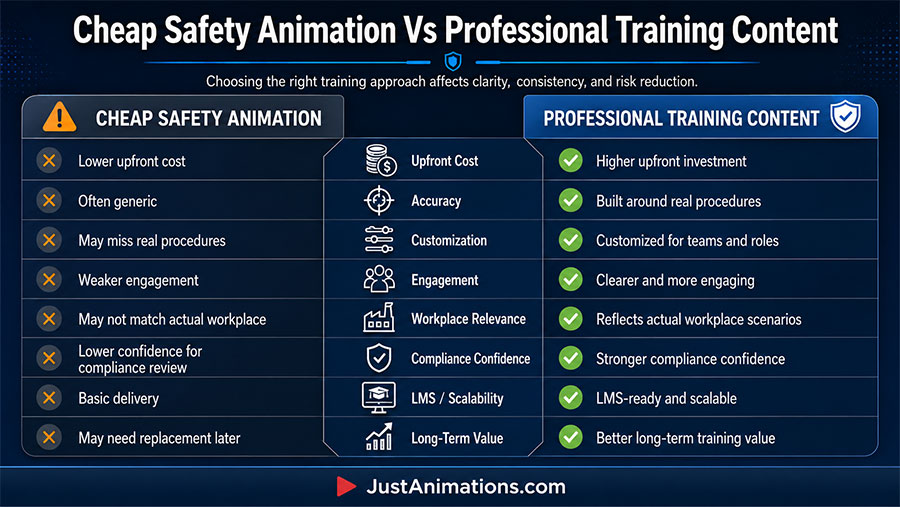
Cheap Safety Animation
Lower upfront cost.
May be generic.
May not reflect the real workplace.
May skip important procedure details.
May be less engaging.
May fail internal review.
Professional Safety Training Animation
Higher upfront investment.
Built around real procedures.
Clearer scenarios and visuals.
Better retention and usability.
More useful for LMS, onboarding, and refreshers.
Stronger confidence for large teams.
Safety content should be practical.
If the team cannot apply it, the training has not done its job.
Red Flags To Avoid
Be careful if a vendor:
✕ Does not ask for the actual procedure
✕ Uses generic safety messaging only
✕ Skips learning objectives
✕ Ignores compliance review
✕ Does not plan for subtitles or accessibility
✕ Makes the video too long
✕ Uses unrealistic workplace scenarios
✕ Cannot provide LMS-ready files
✕ Treats safety training like a generic explainer
✕ Promises a full training system at a suspiciously low price
Safety animation needs clarity, accuracy, and training structure.
Not just motion.
How Just Animations Approaches Corporate Safety Training Animation
Just Animations creates corporate safety training animation, 2D animation, 3D animation, motion graphics, product animation, explainer videos, animated commercials, corporate videos, AI-assisted animation, social media videos, and video production.
For large teams, the focus is on creating safety content that is clear, repeatable, and practical.
That may include onboarding modules, hazard awareness videos, procedure animations, contractor orientation, compliance training, refresher clips, LMS-ready videos, and multilingual versions.
The goal is to help organizations explain safety clearly and consistently across teams.
Final Thoughts
Corporate safety training animation helps large organizations reduce confusion, standardize training, and make important safety procedures easier to understand.
It is useful for onboarding, compliance, hazard awareness, emergency response, equipment procedures, contractor training, and refresher education.
The value is not just that animated training looks better than a slide deck.
The value is that it can show the right behavior clearly and consistently.
For large teams, that matters.
Because safety training is not just about checking a box.
It is about helping people understand what to do before mistakes happen.
FAQ
What is corporate safety training animation?
Corporate safety training animation is animated video content used to explain workplace safety procedures, hazards, emergency protocols, compliance requirements, equipment use, and correct employee behavior.
How much does safety training animation cost?
Safety training animation can cost from $5,000 to $40,000+ for individual videos or modules. Larger enterprise safety training series, LMS-ready content, multilingual versions, and full safety training systems can cost $50,000 to $100,000+.
Why use animation for safety training?
Animation helps safety training by showing hazards, procedures, consequences, and correct behavior visually. It also delivers the same message consistently across employees, locations, contractors, and onboarding programs.
What types of safety training work best as animation?
Animation works well for hazard awareness, emergency response, equipment safety, manufacturing safety, construction safety, warehouse safety, chemical handling, fire safety, PPE training, contractor orientation, and compliance training.
Should safety training animation be used in an LMS?
Yes, safety training animation is often useful in a learning management system. LMS-ready videos can support onboarding, tracking, quizzes, compliance completion, refresher training, and standardized training across large teams.