Architectural 3D animation helps real estate developers show projects before they are fully built.
That is the simple answer.
The better answer is this: architectural 3D animation helps people believe in a project before they can physically walk through it.
That matters because real estate development is often sold, funded, approved, marketed, and pre-leased long before construction is complete.
A buyer may need to imagine the lobby.
An investor may need to understand the scale.
A planning committee may need to see the streetscape.
A tenant may need to picture the experience.
A sales team may need to explain the lifestyle, location, amenities, and value.
A developer may need to create momentum before the building exists.
Static renderings can help.
But architectural 3D animation can do something more powerful.
It can move through the space, show the surrounding area, reveal the design intent, highlight amenities, and turn an unbuilt property into a visual story.
For real estate developers, that can become a serious sales and presentation asset.
Architectural 3D Animation: The Short Answer
Architectural 3D animation is a visual production method used to create animated walkthroughs, flythroughs, exterior reveals, interior tours, amenity previews, master plan videos, and real estate marketing content for projects that are built, under construction, or still in planning.
It can be used for:
✓ Pre-construction marketing
✓ Investor presentations
✓ Condo sales campaigns
✓ Commercial leasing
✓ Master-planned communities
✓ Mixed-use developments
✓ Hotel and hospitality projects
✓ Luxury real estate marketing
✓ Planning and approval presentations
✓ Sales center displays
✓ Website videos
✓ Social media campaigns
✓ Trade show or investor event visuals
The goal is not just to make a building look attractive.
The goal is to help buyers, tenants, investors, and stakeholders understand the project faster.
Architectural 3D Animation Snapshot
| Real Estate Need | How 3D Animation Helps | Common Output |
|---|---|---|
| Pre-Sell Units | Shows the future property experience | Condo or residential walkthrough |
| Attract Investors | Communicates scale, design, and vision | Investor presentation video |
| Support Leasing | Highlights interiors, amenities, and access | Commercial leasing animation |
| Explain Master Plans | Shows development layout and flow | Master plan flythrough |
| Promote Amenities | Visualizes lifestyle and experience | Amenity animation |
| Support Approvals | Shows streetscape and project context | Planning presentation video |
| Improve Marketing | Creates premium campaign visuals | Website and social cutdowns |
A strong architectural animation helps people understand what the project will feel like, not just what it will look like.
Why Real Estate Developers Use 3D Animation
Real estate buyers and stakeholders make decisions based on confidence.
They need to believe the project is real, desirable, well-planned, and worth the investment.
Architectural 3D animation helps create that confidence because it can show:
- Exterior building design
- Interior layouts
- Lobby experience
- Amenity spaces
- Views and surroundings
- Streetscape integration
- Parking and access
- Retail frontage
- Master plan layout
- Landscape design
- Unit flow
- Lighting and atmosphere
- Lifestyle experience
- Construction vision before completion
This is especially useful when the project is expensive, premium, or complex.
The more people need to imagine, the more valuable visualization becomes.
Architectural Animation Value Scorecard
| Development Value | Importance | Visual Score |
|---|---|---|
| Buyer Confidence | 10/10 | ██████████ |
| Investor Understanding | 10/10 | ██████████ |
| Pre-Construction Marketing | 9/10 | █████████ |
| Sales Center Impact | 9/10 | █████████ |
| Leasing Support | 8/10 | ████████ |
| Planning Presentation Clarity | 8/10 | ████████ |
| Social Campaign Value | 7/10 | ███████ |
| Lowest Cost | 3/10 | ███ |
For real estate development, visualization is not just decoration.
It can influence perception, trust, and momentum.
Best Uses For Architectural 3D Animation
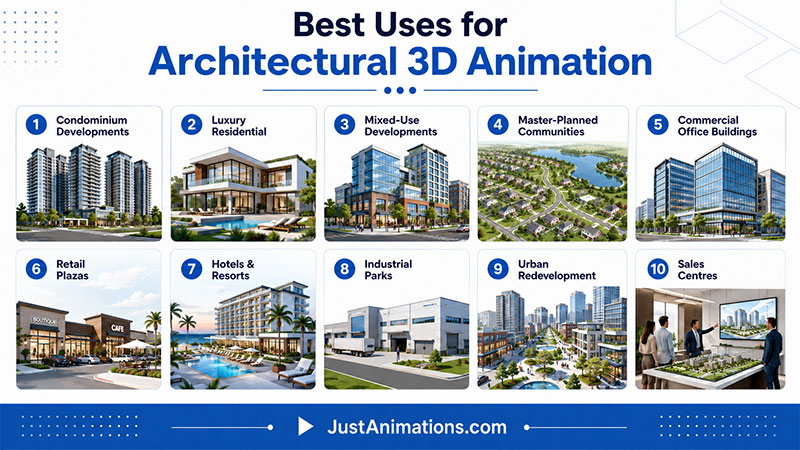
Architectural 3D animation works especially well for:
- Condominium developments
- Luxury residential projects
- Mixed-use developments
- Master-planned communities
- Commercial office buildings
- Retail plazas
- Hotels and resorts
- Hospitality properties
- Industrial parks
- Senior living communities
- Student housing
- Healthcare buildings
- Institutional projects
- Real estate investment presentations
- Urban redevelopment projects
- High-rise towers
- Real estate sales centers
The more important the project’s first impression, the more valuable high-quality architectural animation becomes.
Budget Ladder: Architectural 3D Animation
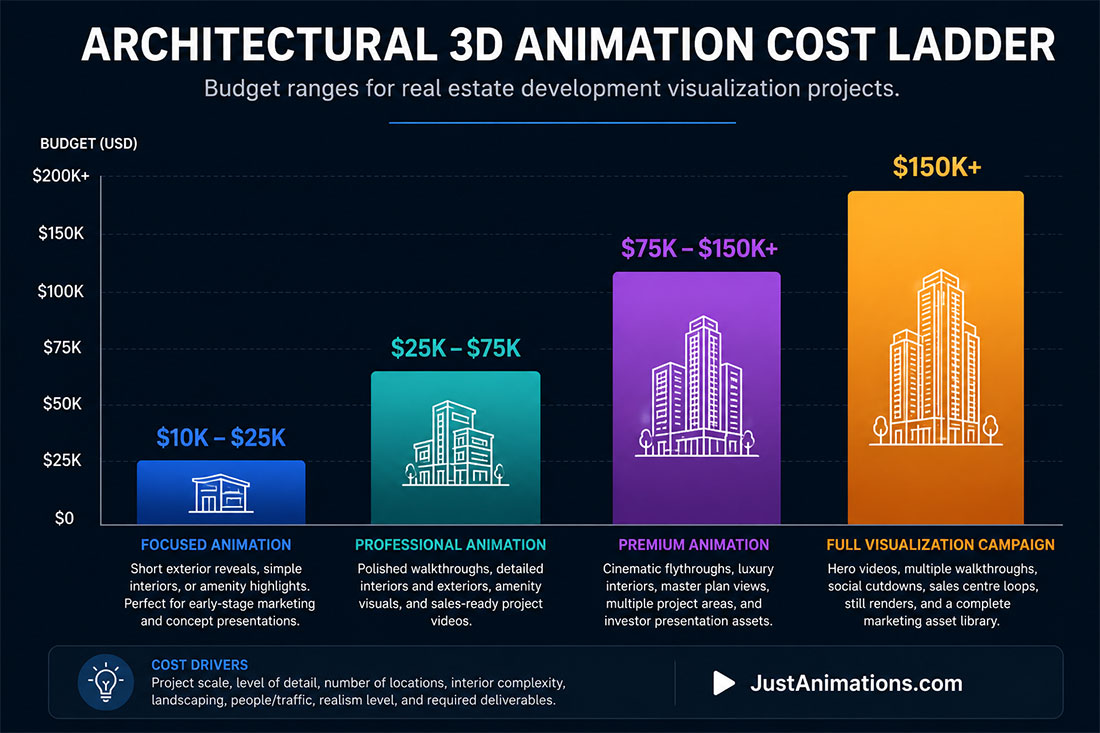
$10K to $25K: Focused Architectural Animation
This can support a short exterior reveal, simple interior walkthrough, amenity highlight, or focused marketing clip.
$25K to $75K: Professional Real Estate Animation
This range can support polished walkthroughs, stronger lighting, interior/exterior scenes, amenity visuals, and sales-ready project videos.
$75K to $150K+: Premium Development Animation
This can support cinematic flythroughs, luxury interiors, master plan views, lifestyle scenes, multiple project areas, sales center versions, and investor presentation assets.
$150K+: Full Real Estate Visualization Campaign
At this level, the project may include hero videos, multiple walkthroughs, social cutdowns, investor versions, sales center loops, still render packages, and campaign-ready visual content.
The budget should match the importance of the development.
A small internal concept may not need a cinematic production.
A luxury condo launch, major mixed-use project, or investment campaign might.
Typical Pricing Breakdown For Architectural 3D Animation
Architectural animation budgets are usually spread across planning, modeling, animation, rendering, and deliverables.
| Production Area | Typical Budget Share | What It Covers |
|---|---|---|
| Strategy & Project Discovery | 10% | Project goals, audience, sales use, creative direction |
| Script & Visual Flow | 10% | Shot planning, sequence structure, key message |
| Modeling & Scene Preparation | 25% | Building models, interiors, materials, environment setup |
| Animation & Camera Movement | 25% | Flythroughs, walkthroughs, transitions, motion |
| Lighting, Rendering & Post | 20% | Realism, atmosphere, editing, polish |
| Versions & Deliverables | 10% | Website, sales center, social, investor, event exports |
Architectural 3D animation can become expensive when the project requires high realism, multiple spaces, large environments, detailed interiors, people, landscaping, traffic, or cinematic lighting.
Cost Driver Meter
Here is what usually increases the cost of architectural 3D animation.
Detailed Building Modeling
Cost Impact: Very High
██████████
Interior Design Detail
Cost Impact: High
█████████
Cinematic Lighting And Rendering
Cost Impact: High
█████████
Large Site Or Master Plan Scale
Cost Impact: High
████████
Landscape And Streetscape Detail
Cost Impact: Medium to High
███████
People, Vehicles, And Lifestyle Scenes
Cost Impact: Medium to High
███████
Multiple Versions And Cutdowns
Cost Impact: Medium
██████
Rush Timeline
Cost Impact: High
████████
The biggest cost driver is usually detail.
The more real the project needs to feel, the more production time it usually takes.
Architectural 3D Animation Decision Guide
| Business Goal | Best Animation Direction | Why It Works |
|---|---|---|
| Pre-sell residential units | Interior walkthrough | Helps buyers imagine the finished space |
| Attract investors | Cinematic project overview | Communicates vision and scale |
| Support commercial leasing | Amenity and access animation | Shows tenant value clearly |
| Present a master plan | Aerial flythrough | Explains layout and development flow |
| Promote luxury property | Cinematic lifestyle animation | Builds premium perception |
| Support approvals | Context and streetscape video | Shows fit within the surrounding area |
| Create digital campaign assets | Short social cutdowns | Extends project visibility online |
The best animation direction depends on the audience.
A buyer, investor, planner, tenant, and broker may each need a different version of the same project story.
Architecture Animation Vs Static Renderings
Static renderings are useful.
They show beautiful still views.
But animation can create a stronger sense of place.
Static Renderings
Lower cost.
Useful for brochures and websites.
Show specific angles.
Easy to distribute.
Limited ability to explain flow or experience.
Architectural 3D Animation
Higher production investment.
Shows movement through the space.
Explains layout and scale.
Creates emotional impact.
Works well in sales centers, websites, ads, and presentations.
Most real estate projects benefit from both.
Renderings give people key images.
Animation gives them the experience.
What A Strong Architectural Animation Should Include
A strong architectural animation should usually include:
✓ Clear project positioning
✓ Exterior reveal
✓ Context or location visuals
✓ Interior walkthroughs where relevant
✓ Amenity highlights
✓ Lifestyle or usage moments
✓ Clean pacing
✓ Strong lighting
✓ Realistic materials
✓ Brand-consistent typography
✓ Music or sound design
✓ Sales or investor-focused messaging
✓ Versions for different channels
The animation should not only show spaces.
It should guide the viewer through why the development matters.
Deliverables For Architecture Animation for Real Estate Developers
| Deliverable | Best Use |
|---|---|
| Hero Project Video | Website, campaign launch, investor presentation |
| Exterior Flythrough | Building design, streetscape, planning presentations |
| Interior Walkthrough | Sales center , buyer education, leasing |
| Amenity Animation | Lifestyle marketing and value positioning |
| Investor Version | Funding presentations, stakeholder meetings |
| Sales Center Loop | Display screens and buyer presentations |
| Social Cutdowns | Paid ads, Reels, Shorts, LinkedIn, Instagram |
| Still Frames | Brochures, landing pages, thumbnails, pitch decks |
A strong architectural animation can support the project long before completion.
That is where the value is.
Buyer Readiness Checklist
Before starting an architectural 3D animation project, prepare:
✓ Architectural drawings
✓ Floor plans
✓ Elevations
✓ 3D models, if available
✓ Interior design direction
✓ Material references
✓ Landscape plans
✓ Site plan
✓ Branding guidelines
✓ Target audience
✓ Sales or leasing goals
✓ Project location details
✓ Key amenities
✓ Use channels
✓ Required deliverables
✓ Budget range
✓ Timeline
The more project information available, the better the animation can align with the real development vision.
Buyer Readiness Meter
| Buyer Input | Readiness Impact | Visual Score |
|---|---|---|
| Architectural Drawings | Very High | ██████████ |
| Floor Plans | Very High | ██████████ |
| 3D Models Or CAD Files | High | ████████ |
| Material References | High | ████████ |
| Interior Design Direction | High | ████████ |
| Site And Landscape Plans | High | ████████ |
| Brand Guidelines | Medium to High | ███████ |
| Sales Or Investor Goal | Medium to High | ███████ |
Architectural animation becomes much smoother when the project vision is well documented.
If the design is still changing, the animation scope should allow for that.
Cheap Architectural Animation Vs Professional Visualization
Cheap architectural animation may seem appealing at first.
But if the project looks flat, unrealistic, or generic, it can weaken buyer confidence.
Cheap Architectural Animation
Lower upfront cost.
May use generic models.
May look unrealistic.
May not match final design intent.
May fail to create emotional impact.
May need to be replaced for sales or investor use.
Professional Architectural 3D Animation
Higher upfront investment.
More realistic and polished.
Better materials, lighting, and camera movement.
Stronger buyer and investor confidence.
More useful for sales centers, websites, presentations, and campaigns.
For real estate, perception is part of value.
The animation should support the perceived value of the development.
Red Flags To Avoid
Be careful if a studio:
✕ Does not ask for architectural drawings
✕ Ignores materials and design intent
✕ Uses generic building models
✕ Cannot show strong real estate examples
✕ Overuses unrealistic camera movement
✕ Makes spaces look smaller or confusing
✕ Does not plan deliverables for sales and marketing
✕ Provides no clear revision process
✕ Cannot work with changing development inputs
✕ Promises high-end realism at suspiciously low pricing
Architectural visualization needs design sensitivity.
The animation should make the project feel credible, not artificial.
How Just Animations Approaches Architectural 3D Animation
Just Animations creates architecture 3D animation, product animation, explainer videos, motion graphics, animated commercials, corporate videos, training videos, AI-assisted animation, social media videos, and video production.
For real estate developers, the focus is on creating visual assets that help people understand and believe in the project.
That may include cinematic walkthroughs, exterior flythroughs, amenity videos, investor presentations, sales center loops, and social campaign cutdowns.
The goal is not only to show a building.
The goal is to communicate the value, experience, and vision behind the development.
Final Thoughts
Architectural 3D animation helps real estate developers market, sell, fund, and explain projects before they are fully built.
It can support pre-construction sales, investor presentations, commercial leasing, approvals, sales centers, websites, and social media campaigns.
The best architectural animation is not just realistic.
It is strategic.
It helps the viewer understand the project, imagine the experience, and feel more confident in the opportunity.
For real estate developers, that can make animation a powerful business asset.
Not just a visual.
A tool for momentum.
FAQ
What is architectural 3D animation?
Architectural 3D animation is animated visual content used to show real estate developments, buildings, interiors, amenities, master plans, and project concepts through walkthroughs, flythroughs, exterior reveals, and cinematic visualization.
How much does architectural 3D animation cost?
Architectural 3D animation can cost from $10,000 to $75,000+ for many professional projects. Premium development animations, cinematic walkthroughs, master plan videos, and full real estate visualization campaigns can cost $100,000 to $150,000+.
Why do real estate developers use 3D animation?
Real estate developers use 3D animation to pre-sell projects, attract investors, support leasing, explain master plans, show interiors and amenities, improve sales center presentations, and market projects before construction is complete.
Is architectural animation better than renderings?
Architectural animation is not always better than renderings, but it does something different. Renderings show key still images, while animation shows movement, layout, scale, flow, and the experience of moving through a space.
What should I provide before creating architectural 3D animation?
Useful materials include architectural drawings, floor plans, elevations, 3D models, material references, interior design direction, landscape plans, site plans, brand guidelines, project goals, target audience details, timeline, and budget range.