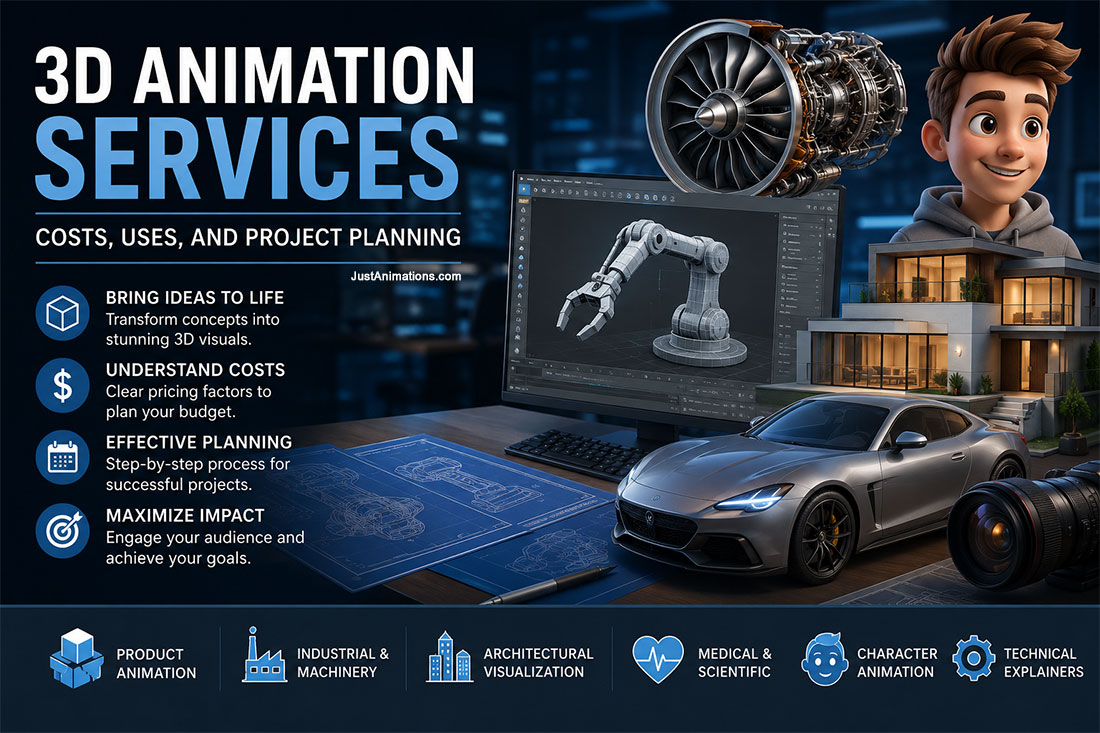
3D animation services help businesses present products, processes, environments, and ideas in ways that traditional video cannot always achieve.
A 3D animation company can build realistic product models, demonstrate internal components, visualize buildings before construction, create branded characters, or explain a complex technical process. The camera can move anywhere, objects can be separated or enlarged, and scenes can be created without requiring a physical location or prototype.
However, 3D animation projects generally require more planning, production time, and budget than basic 2D animation.
Understanding the process before production begins can help a business control costs, avoid unnecessary revisions, and choose the right visual approach.
Quick Answer: What Are 3D Animation Services?
3D animation services involve designing and animating three-dimensional digital objects, characters, products, or environments.
The production process may include:
- Concept development
- Scriptwriting
- Storyboarding
- 3D modelling
- Texturing
- Rigging
- Character or object animation
- Lighting
- Rendering
- Sound design
- Editing and post-production
Professional 3D animation costs can range from approximately $5,000 for a simple project to more than $100,000 for highly detailed, cinematic, or technically complex animation.
The final price depends on the length, realism, number of models, movement complexity, environments, rendering requirements, and production quality.
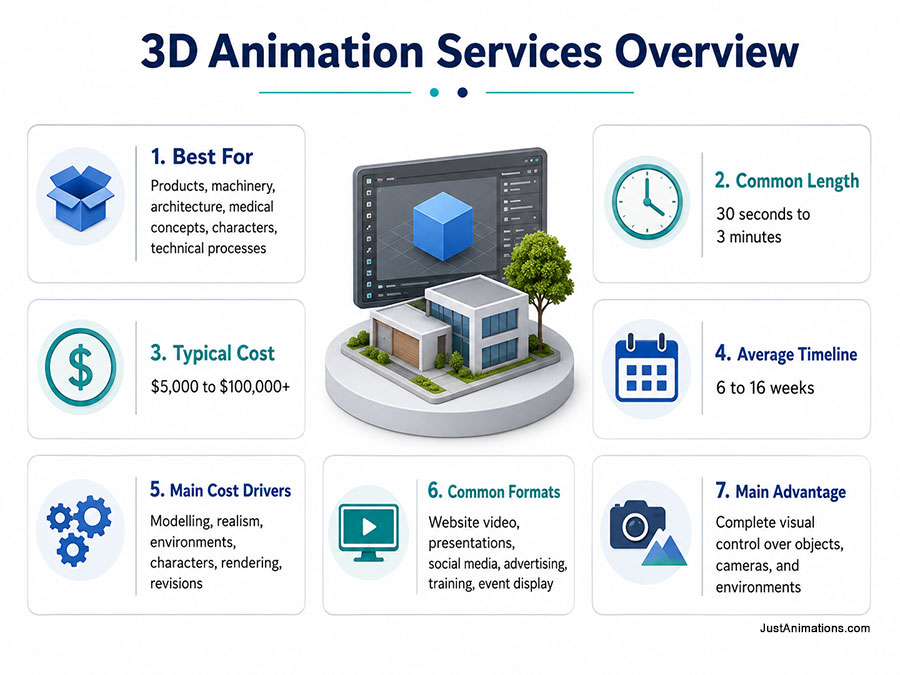
3D Animation Services Overview
| Project Element | Typical Requirement |
|---|---|
| Best for | Products, machinery, architecture, medical concepts, characters and technical processes |
| Common length | 30 seconds to 3 minutes |
| Typical cost | $5,000 to $100,000+ |
| Average timeline | 6 to 16 weeks |
| Main cost drivers | Modelling, realism, environments, characters, rendering and revisions |
| Common formats | Website video, presentation, social media, advertising, training and event display |
| Main advantage | Complete visual control over objects, cameras and environments |
What Is 3D Animation?
3D animation creates digital objects that have width, height, and depth.
Unlike flat illustrations, a 3D object can be rotated, viewed from different angles, placed inside a realistic environment, and animated with physically believable movement.
A product can be opened to reveal its internal components.
A building can be shown before construction begins.
A machine can be demonstrated without bringing equipment into a studio.
A character can walk through a completely digital environment.
This flexibility makes 3D animation useful for projects where realism, technical accuracy, scale, or visual impact is important.
What Are 3D Animation Services Used For?
Businesses use 3D animation services for more than entertainment.
The same techniques used in films, television, and video games can be adapted for marketing, sales, product development, training, healthcare, real estate, manufacturing, and public communication.
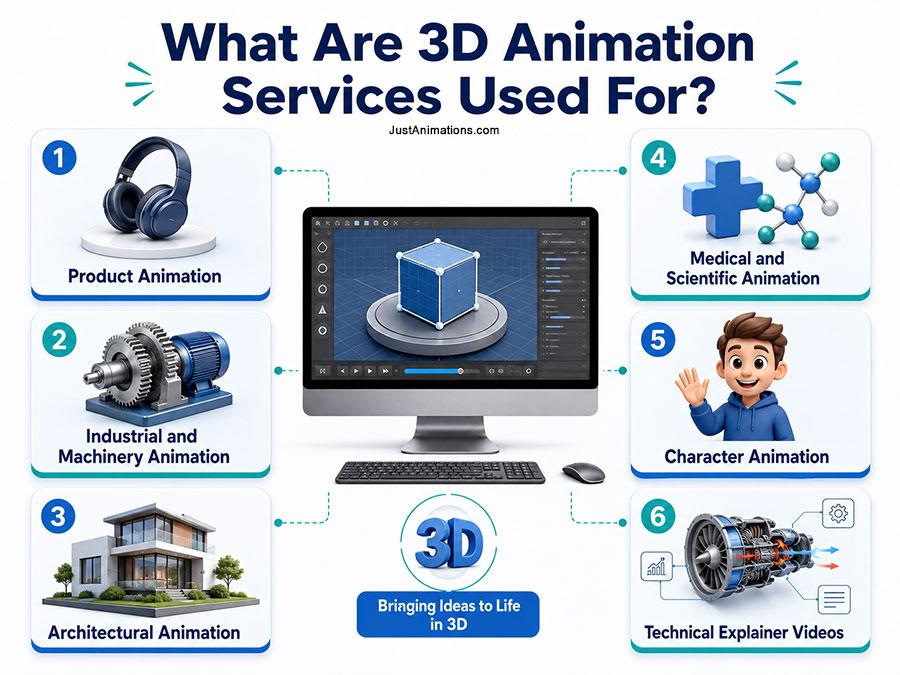
Product Animation
3D product animation demonstrates how a product looks, moves, opens, connects, or functions.
It is particularly useful when the physical product is:
- Expensive to transport
- Still being developed
- Difficult to film
- Too small to capture clearly
- Too large for a traditional studio
- Made with internal components that cannot normally be seen
A product animation can show exploded views, materials, technical features, assembly steps, and internal mechanisms.
Industrial and Machinery Animation
Manufacturers frequently use industrial 3D animation to demonstrate industrial equipment.
The animation can remove safety barriers, exterior panels, or surrounding structures so the viewer can understand what is happening inside a machine.
Industrial animation may support:
- Sales presentations
- Equipment demonstrations
- Maintenance instructions
- Installation training
- Safety programs
- Investor presentations
- Trade show displays
Architectural Animation
Architectural animation helps viewers experience a building or development before it exists.
A virtual camera can travel through residential buildings, commercial properties, public spaces, industrial facilities, and proposed developments.
The animation may include landscaping, vehicles, pedestrians, lighting changes, interior finishes, and surrounding infrastructure.
Medical and Scientific Animation
Medical animation can visualize anatomy, surgical procedures, medications, biological processes, and medical devices.
Concepts that are microscopic, internal, or otherwise impossible to film can be enlarged and presented clearly.
Accuracy is especially important because models and movements may need to be reviewed by medical, scientific, or regulatory specialists.
Character Animation
3D characters may be used as brand mascots, presenters, training guides, entertainment characters, or virtual representatives.
Character animation usually requires additional work because the studio must model, texture, rig, and animate the character.
Facial expressions, clothing, hair, dialogue, and realistic movement can further increase production complexity.
Technical Explainer Videos
A 3D technical explainer helps simplify a process that may be difficult to communicate through text or live-action video.
It can show:
- How a system operates
- How components connect
- How materials move through a process
- How a technology solves a problem
- How a product changes over time
- How equipment should be installed
When Should a Business Choose 3D Animation?
3D animation is not automatically the best choice for every video. Leveraging such an approach for a 3D trade show animation can be quite beneficial for organizations looking to attract attention.
Simple service explanations, software introductions, corporate messages, and educational content can often be communicated effectively through 2D animation or motion graphics.
3D animation becomes more valuable when the audience needs to understand physical form, depth, scale, movement, or internal components.
| Business Requirement | Recommended Approach |
|---|---|
| Explain a simple service | 2D animation |
| Demonstrate physical equipment | 3D animation |
| Show internal product components | 3D animation |
| Present statistics and text | Motion graphics |
| Visualize an unbuilt property | 3D animation |
| Create a realistic character | 3D character animation |
| Explain software screens | 2D or interface animation |
| Produce a cinematic branded scene | 3D or hybrid animation |
Some projects combine the two approaches.
For example, a video may use 3D animation for the product demonstration and 2D motion graphics for labels, statistics, diagrams, and calls to action.
How Much Do 3D Animation Services Cost?
Professional 3D animation frequently costs between $5,000 and $50,000 or more per finished minute. Highly realistic, cinematic, character-driven, or effects-heavy work can reach six figures per minute.
However, cost per minute is only a general reference.
A technically demanding 20-second animation may cost more than a simple two-minute video.
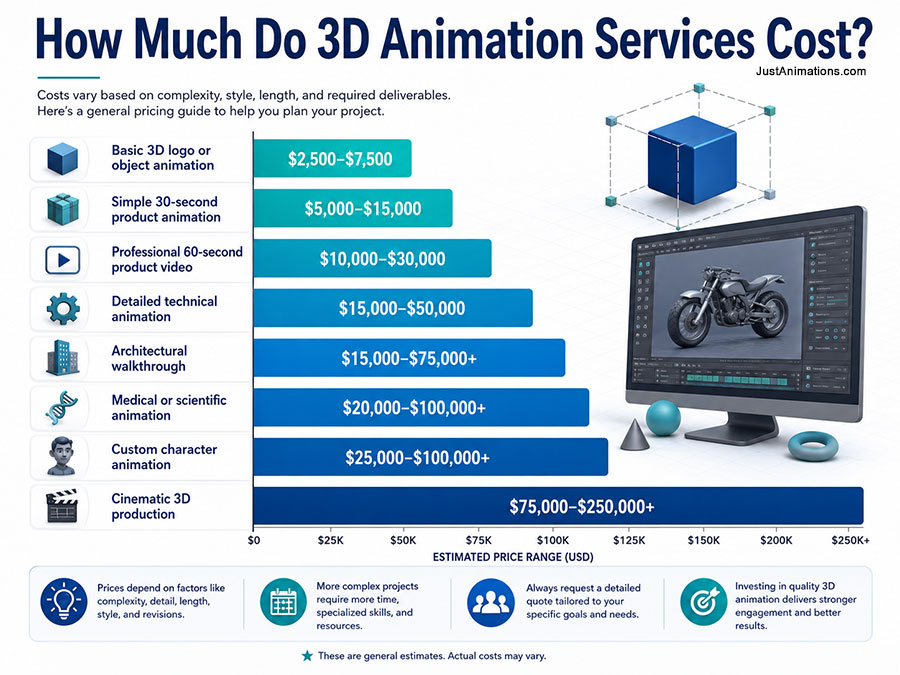
| 3D Animation Project | Estimated Cost |
|---|---|
| Basic 3D logo or object animation | $2,500–$7,500 |
| Simple 30-second product animation | $5,000–$15,000 |
| Professional 60-second product video | $10,000–$30,000 |
| Detailed technical animation | $15,000–$50,000 |
| Architectural walkthrough | $15,000–$75,000+ |
| Medical or scientific animation | $20,000–$100,000+ |
| Custom character animation | $25,000–$100,000+ |
| Cinematic 3D production | $75,000–$250,000+ |
These figures should be treated as planning ranges rather than fixed prices. Generally speaking high-end 3D animation can be significantly more costly than basic logo or object aniamtion.
A 3D animation studio will normally prepare a custom estimate after reviewing the required scenes, available assets, deadline, quality expectations, and delivery formats.
How Project Complexity Changes the Budget
A simple 3D object rotating against a clean background may only require one model, a basic lighting setup, and limited camera movement.
A cinematic scene may require multiple environments, characters, simulations, visual effects, advanced lighting, and extensive rendering.
Typical Budget Progression
Basic 3D object animation
████ $5,000–$10,000
Professional product animation
████████ $10,000–$30,000
Technical or architectural animation
████████████ $20,000–$60,000
Character or medical animation
████████████████ $30,000–$100,000+
Cinematic 3D production
████████████████████ $75,000–$250,000+
The cost increases as more specialized production stages and team members are required.
What Affects 3D Animation Pricing?
Number of 3D Models
Every custom object must be created.
A project involving one product will generally cost less than a project requiring a factory, several machines, workers, vehicles, and surrounding environments.
Existing engineering files or CAD models may reduce some modelling work, but they usually still need to be cleaned, optimized, textured, and prepared for animation.
Level of Realism
Stylized animation is often more affordable than photorealistic animation.
Realism requires more detailed models, textures, materials, lighting, reflections, simulations, and rendering.
The visual standard should match the project’s purpose.
A technical training video may prioritize clarity and accuracy, while a premium product advertisement may require highly realistic materials and cinematic lighting.
Character Requirements
Characters increase production requirements considerably.
A character may need:
- Concept artwork
- 3D modelling
- Clothing and accessories
- Hair or fur
- Facial controls
- Body rigging
- Lip synchronization
- Movement animation
- Crowd variations
Reusing the same character across several videos can make future production more efficient.
Environments
A simple studio background costs less than a detailed city, factory, laboratory, hospital, construction site, or natural environment.
Environmental effects such as smoke, fire, liquid, weather, dust, or moving crowds can add additional complexity.
Rendering
Rendering converts the 3D scene into finished video frames.
Detailed scenes, realistic lighting, high resolutions, and complex simulations require more computing power and rendering time.
A small change made late in production may require part of the animation to be rendered again.
Revisions
Revisions are easier and less expensive during the script and storyboard stages.
Changing the product design, camera sequence, character movement, or entire environment after animation has been completed can affect several production stages.
Clear approval points help protect the budget.
The 3D Animation Production Process
Professional 3D animation follows a structured pipeline. Autodesk identifies common stages including modelling, texturing, rigging, animation, lighting, and rendering.
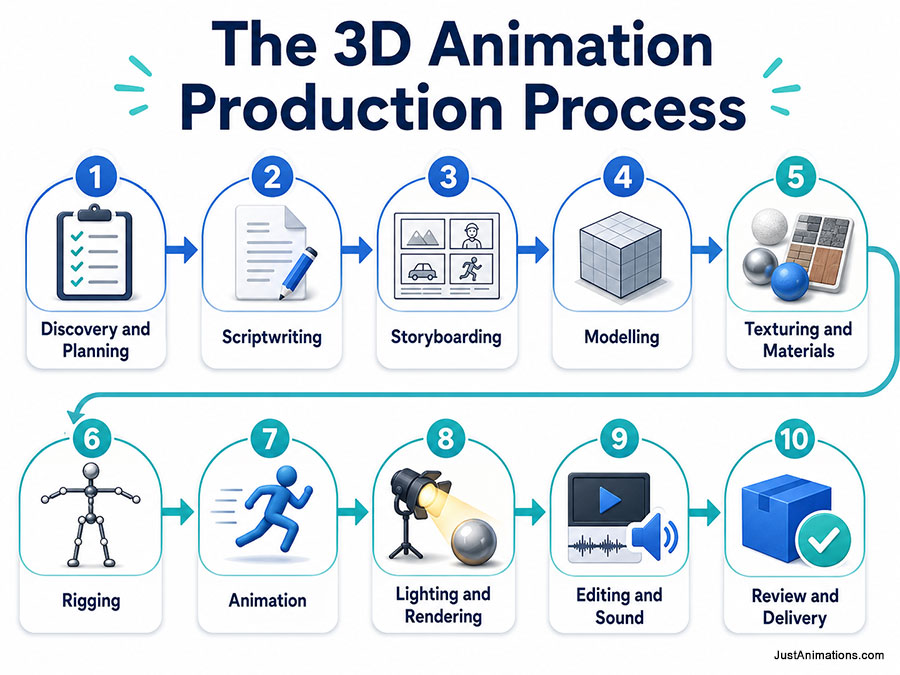
1. Discovery and Planning
The animation studio learns about the audience, message, product, required scenes, technical details, and intended distribution.
The project scope should be established before detailed production begins.
2. Scriptwriting
The script determines what the viewer will hear and what the animation must communicate.
A focused script can reduce unnecessary scenes and help control costs.
3. Storyboarding
Storyboards show the planned composition, actions, transitions, and camera angles.
They allow the business to approve the visual direction before expensive modelling and animation work begins.
4. Modelling
Artists create the products, characters, props, and environments.
Models may be built from reference photographs, sketches, engineering drawings, CAD files, or product specifications.
5. Texturing and Materials
Textures give surfaces their color, detail, reflectivity, transparency, roughness, and material appearance.
This stage helps objects look like metal, glass, plastic, fabric, skin, wood, or other materials.
6. Rigging
Rigging creates the controls needed to move a character, object, or mechanical system.
It functions like a digital skeleton or control structure.
7. Animation
Animators create the movement of the models, cameras, characters, and environmental elements.
The animation may be realistic, stylized, mechanical, instructional, or cinematic.
8. Lighting and Rendering
Lighting establishes visibility, realism, atmosphere, and visual focus.
The completed scenes are then rendered into individual frames.
9. Editing and Sound
The rendered scenes are combined with voiceover, music, sound effects, text, labels, logos, and transitions.
10. Review and Delivery
The client reviews the completed video before final versions are exported for websites, presentations, advertisements, social media, events, or internal systems.
How Long Does 3D Animation Take?
A professional 3D animation project may require approximately 6 to 16 weeks.
Simple product animations may be completed sooner, while realistic character, architectural 3D animation, medical, or cinematic projects can require several months. Industry production references commonly place a typical 60-to-90-second animation project at roughly eight to ten weeks, although style and complexity can change the schedule substantially.
| Production Stage | Typical Timeline |
|---|---|
| Discovery and script | 1–2 weeks |
| Storyboard and visual planning | 1–2 weeks |
| Modelling and texturing | 2–5 weeks |
| Rigging and animation | 2–6 weeks |
| Lighting and rendering | 1–3 weeks |
| Editing and final revisions | 1–2 weeks |
Some stages can overlap.
However, delays in feedback, missing product files, design changes, or technical approvals can extend the schedule.
How to Plan a 3D Animation Project
A successful project begins with a clear production brief.
Before contacting a 3D animation company, businesses should define:
✓ The primary audience
✓ The main message
✓ The intended video length
✓ The required products or environments
✓ The desired level of realism
✓ The delivery deadline
✓ The available budget range
✓ The platforms where the animation will appear
The business should also gather available reference materials.
These may include CAD files, product photographs, architectural drawings, brand guidelines, technical diagrams, scripts, previous videos, and examples of preferred animation styles.
How to Choose a 3D Animation Company
Review more than the studio’s showreel.
A showreel demonstrates visual quality, but it may not show whether the 3D animation studio can manage technical accuracy, communication, revisions, deadlines, and business objectives.
Ask potential studios:
- Have you completed similar 3D animation projects?
- Who will manage the project?
- What is included in the quoted price?
- How many revision rounds are included?
- Which production stages require approval?
- Can you work with our CAD or engineering files?
- Who owns the finished animation and custom models?
- Which final file formats will be delivered?
- Can individual scenes be reused later?
- How are major scope changes priced?
A qualified 3D animation studio should also be able to explain when a simpler visual approach would be more appropriate.
For example, Just Animations may recommend a combination of 3D product animation and 2D motion graphics when that approach communicates the message more clearly and uses the budget more effectively.
Conclusion
3D animation services give businesses the ability to visualize products, systems, environments, and ideas that may be difficult or impossible to film.
They are especially valuable for product demonstrations, industrial equipment, architecture, healthcare, technical training, branded characters, and premium marketing content.
The most important decisions should be made before modelling and animation begin.
A clear script, approved storyboard, defined visual standard, accurate reference materials, and realistic budget can significantly improve the production process.
The best 3D animation project is not necessarily the one with the most effects or realism.
It is the one that communicates the right information clearly, supports the business objective, and creates visual assets that can continue delivering value across multiple platforms.
Frequently Asked Questions
How much does a professional 3D animation cost?
Professional 3D animation may cost approximately $5,000 to more than $100,000. A simple product animation may fall near the lower end, while realistic characters, architectural environments, medical visualization, simulations, or cinematic scenes require larger budgets.
How long does it take to produce a 3D animation?
Most professional business animations require approximately 6 to 16 weeks. The timeline depends on the number of models, video length, realism, characters, environments, rendering requirements, client feedback, and revision rounds.
What businesses use 3D animation services?
3D animation is used by manufacturers, construction companies, architects, real estate developers, healthcare organizations, technology companies, product brands, engineering firms, educational organizations, government agencies, and entertainment companies.
Is 3D animation more expensive than 2D animation?
3D animation is generally more expensive because it may require modelling, texturing, rigging, lighting, simulation, and rendering. However, completed 3D models may be reused in future videos, product images, interactive demonstrations, advertisements, and presentations.
What should I provide to a 3D animation studio?
Provide the studio with a clear project objective, audience information, expected length, budget, deadline, brand guidelines, product photographs, CAD files, engineering drawings, architectural plans, technical documentation, and examples of the visual quality you expect.