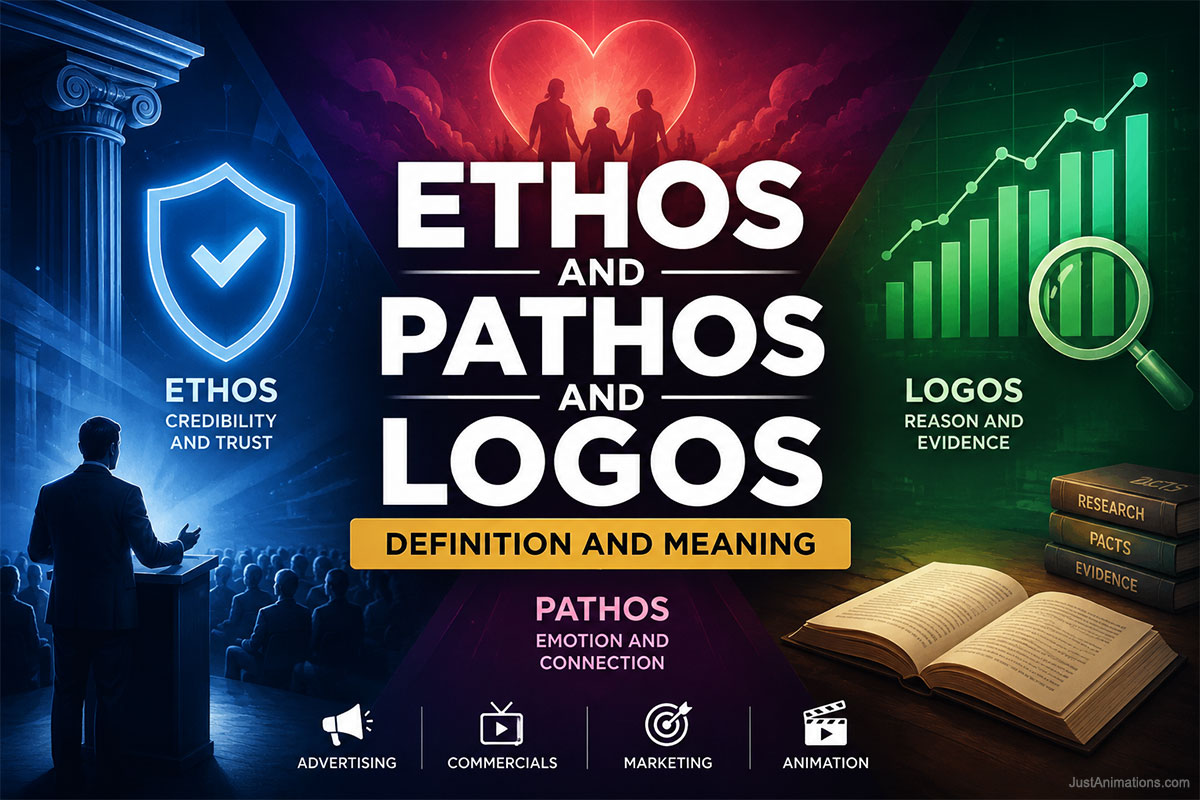
The concept of Ethos and Pathos and Logos implies that every persuasive message asks an audience to do something.
Believe an idea.
Trust a company.
Buy a product.
Support a cause.
Remember a story.
Change a behavior.
For more than two thousand years, one of the most influential ways of understanding persuasion has been through ethos and pathos and logos.
The three concepts are most closely associated with the Greek philosopher Aristotle and his study of rhetoric. In simple terms:
- Ethos builds credibility and trust.
- Pathos appeals to emotion.
- Logos appeals to reasoning, evidence, and logic.
These principles began in the study of public speaking, but their influence extends far beyond ancient speeches.
Today, ethos, pathos, and logos can be found in:
✓ Advertising
✓ Television commercials
✓ Political communication
✓ Business presentations
✓ Websites
✓ Social media
✓ Sales materials
✓ Documentary films
✓ Product demonstrations
✓ Branding
✓ Marketing campaigns
✓ Animation
A successful advertisement may establish that a company is trustworthy, make the audience feel something, and provide evidence explaining why its product deserves consideration—all within thirty seconds.
That is ethos, pathos, and logos working together.
This guide explains the Ethos And Pathos And Logos Definition, their historical and linguistic roots, how the concepts relate to modern human psychology, and how businesses can apply them to advertising, marketing, commercials, presentations, and professional animation.
Ethos And Pathos And Logos Definition: The Short Version
The easiest way to understand the three concepts is to connect each one to a question in the audience’s mind.
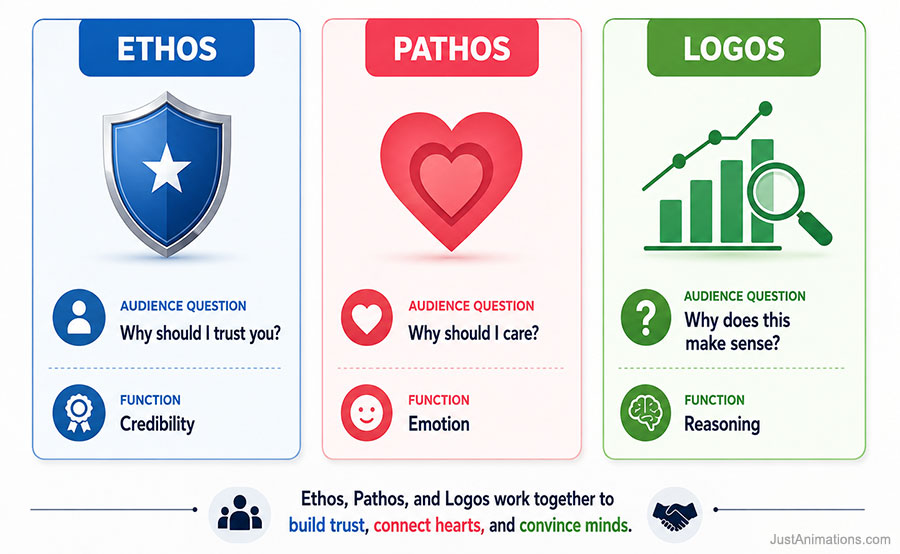
| Persuasive Appeal | Audience Question | Primary Function |
|---|---|---|
| Ethos | Why should I trust you? | Credibility |
| Pathos | Why should I care? | Emotion |
| Logos | Why does this make sense? | Reasoning |
A persuasive message does not necessarily need equal amounts of all three.
The balance depends on the subject, audience, platform, and objective.
A technical engineering presentation may lean heavily on logos.
A charity campaign may rely more strongly on pathos.
A financial institution discussing retirement planning may need significant ethos because credibility is essential.
The strongest communication often combines all three.
Imagine an advertisement for a new safety product.
Ethos: An experienced engineer or recognized organization explains the product.
Pathos: The advertisement shows how protecting employees can affect real families.
Logos: Testing results demonstrate how effectively the product performs.
One message can therefore answer:
Can I trust this?
Do I care about this?
Does the evidence support it?
What Is Ethos?
Ethos is the persuasive appeal based on credibility, character, authority, and trustworthiness.
When an audience evaluates ethos, they are essentially deciding:
“Should I believe this person, company, institution, or message?”
Ethos can come from several sources.
Expertise
A physician discussing a medical subject may have stronger relevant credibility than someone with no healthcare background.
Experience
A company that has worked in an industry for decades may use that history to establish credibility.
Reputation
Awards, certifications, professional affiliations, recognizable clients, and public reputation can influence trust.
Transparency
Acknowledging limitations or explaining how a conclusion was reached can strengthen credibility.
Presentation
Visual quality, professionalism, language, tone, and consistency also affect how credible a message feels.
Demonstrated Knowledge
An organization can establish ethos by showing that it understands the audience’s problem.
For businesses, ethos may appear through:
✓ Testimonials
✓ Case studies
✓ Expert interviews
✓ Customer reviews
✓ Certifications
✓ Awards
✓ Research credentials
✓ Demonstrated experience
✓ Professional design
✓ Transparent processes
✓ Brand consistency
Ethos does not mean simply claiming:
“We are the best.”
Credibility is more persuasive when the audience can see reasons to believe the claim.
What Is Pathos?
Pathos is the persuasive appeal to emotion.
Instead of asking primarily whether something is credible or logically supported, pathos focuses on how the audience feels.
Those emotions can include:
- Happiness
- Fear
- Hope
- Pride
- Compassion
- Excitement
- Nostalgia
- Anger
- Curiosity
- Belonging
- Relief
- Confidence
- Urgency
Pathos is particularly powerful in storytelling.
Consider two ways of presenting the same information.
Statement A:
“Thousands of families experience food insecurity.”
Statement B:
A short story follows a parent trying to provide dinner for their children after unexpectedly losing a job.
Both may communicate the same underlying issue.
The second approach gives the audience a human perspective through which to experience it.
That is pathos.
Pathos Does Not Always Mean Sadness
Emotional persuasion is sometimes incorrectly reduced to tragedy.
Advertising frequently uses positive forms of pathos.
A travel commercial might create:
Excitement.
A sports advertisement might create:
Determination.
A luxury advertisement might create:
Aspiration.
A family brand might create:
Warmth.
A technology launch might create:
Curiosity and anticipation.
Emotion can influence how audiences interpret and remember a message.
What Is Logos?
Logos is persuasion through reasoning, argument, evidence, and the structure of the message itself.
Logos asks the audience:
“Does this make sense?”
It may involve:
- Statistics
- Comparisons
- Research
- Demonstrations
- Cause-and-effect explanations
- Data
- Examples
- Measurements
- Logical sequences
- Product specifications
- Cost comparisons
- Performance results
Suppose a company says:
“Our machine increases efficiency.”
That is a claim.
Now suppose the company demonstrates:
“The previous production process required six steps and 14 minutes. The new system requires four steps and 9 minutes.”
The second message provides the audience with information it can evaluate.
That is logos.
Logos Is More Than Statistics
A common misconception is that logos means adding numbers to a presentation.
Numbers can support logos, but logical persuasion also comes from structure.
For example:
Problem → cause → solution → result
is a logical communication sequence.
An animated explainer might show:
- A customer has a problem.
- The existing process creates friction.
- A new service removes that friction.
- The customer receives a measurable benefit.
Professional explainer video animation frequently uses this type of structure because the viewer can visually follow the reasoning from one idea to the next.
Ethos And Pathos And Logos Meaning in One Example
Consider a fictional commercial for an electric vehicle.
Ethos
The commercial explains that the vehicle was developed by an engineering team with extensive automotive experience and has completed independent safety testing.
The message is:
Trust the people and process behind the product.
Pathos
A family drives through a beautiful landscape while a parent and child talk about what the world may look like in the future.
The message is:
Feel connected to the future this product represents.
Logos
The commercial displays:
- Driving range
- Charging time
- Warranty
- Operating costs
The message is:
The practical facts support the purchase.
The advertisement is not limited to one persuasive technique.
It combines credibility, emotion, and reasoning.
Where Did Ethos, Pathos, and Logos Come From?
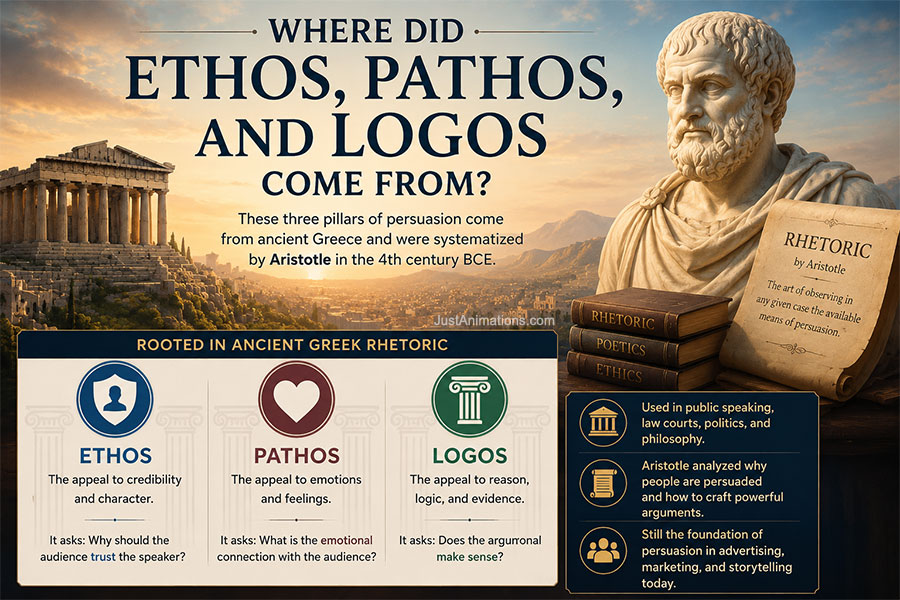
The concepts are associated most strongly with Aristotle, the ancient Greek philosopher who lived during the fourth century BCE.
Rhetoric was already important in Greek society before Aristotle.
Public speaking played a major role in:
- Political assemblies
- Legal disputes
- Civic decision-making
- Public ceremonies
- Education
Teachers of rhetoric developed methods for constructing arguments and persuading audiences.
Aristotle did not simply invent persuasion.
Instead, he systematically analyzed why certain forms of communication persuade people.
In his work Rhetoric, Aristotle identified three central means of persuasion connected to:
- The character of the speaker
- The emotional condition of the listener
- The argument presented
For readers interested in the philosophical background, the Stanford Encyclopedia of Philosophy’s overview of Aristotle’s Rhetoric provides a detailed academic examination of Aristotle’s theory and the three means of persuasion.
What began as a framework for understanding speech remains remarkably useful in the age of websites, streaming video, advertising algorithms, social networks, branded content, and animation.
What Does the Root Word Ethos Mean?
Ethos comes from ancient Greek and is associated with ideas of character, disposition, custom, or habitual character.
This history helps explain its rhetorical meaning.
Ethos is concerned with the kind of character an audience perceives in the communicator.
Is the speaker knowledgeable?
Honest?
Fair?
Experienced?
Responsible?
It is worth making an important distinction.
Modern explanations often describe ethos as a speaker’s reputation.
Reputation can certainly contribute to credibility, but classical rhetorical ethos is also created through the communication itself.
A previously unknown speaker can begin establishing ethos by:
- Demonstrating knowledge
- Reasoning fairly
- Acknowledging uncertainty
- Speaking appropriately to the audience
- Showing good judgment
For modern brands, this means credibility is not determined only by company size or fame.
It can also be built through how the organization communicates.
What Does the Root Word Pathos Mean?
Pathos comes from Greek and relates to experience, feeling, suffering, or emotion.
The same linguistic family appears in English words such as:
- Sympathy
- Empathy
- Pathetic
- Pathology
The meanings of these modern words have developed in different directions, but the underlying linguistic history reflects experiences or states that affect a person.
In rhetoric, pathos concerns the emotional condition of the audience.
An audience does not evaluate every message from an emotionally neutral position.
A person who is:
- Afraid
- Excited
- Angry
- Hopeful
- Skeptical
- Inspired
may interpret information differently.
Modern advertisers understand this intuitively.
They rarely sell only the physical characteristics of a product.
They often sell the feeling connected to the product.
What Does the Root Word Logos Mean?
Logos has a broad history in Greek language and philosophy.
Depending on context, it can relate to:
- Word
- Speech
- Account
- Explanation
- Reason
- Argument
This helps explain why logos in rhetoric is broader than “logic” in the narrow mathematical sense.
Logos concerns the persuasive power contained within the argument.
A message should have internal coherence.
The audience should be able to follow the reasoning.
Consider:
Our software saves businesses time because it automates manual data entry.
That contains a logical relationship.
The claim explains why the benefit occurs.
Adding evidence can strengthen it:
Our software automates three stages that were previously completed manually, reducing average processing time from 20 minutes to 8 minutes.
The reasoning becomes easier to evaluate.
Why Do People Sometimes Say Ethos and Logos and Pathos?
The familiar order is usually:
Ethos, pathos, and logos.
However, searches for ethos and logos and pathos refer to the same three rhetorical appeals.
There is no different framework implied by changing their order.
A person searching for:
ethos and logos and pathos
is generally trying to understand the same concepts:
Credibility + reasoning + emotion.
The order matters far less than understanding how they interact.
How Ethos, Pathos, and Logos Relate to Human Psychology
Aristotle developed rhetoric long before modern experimental psychology existed.
We should therefore be careful not to claim that modern psychology simply “proved Aristotle right.”
However, many aspects of contemporary communication and behavioral research involve psychological processes that resemble the problems Aristotle was analyzing.
Ethos and the Psychology of Trust
People constantly make judgments about sources.
They ask:
- Does this person know what they are talking about?
- Does this company appear legitimate?
- Is the information biased?
- Does this person have relevant experience?
- Can this institution be trusted?
Modern communication happens too quickly for audiences to investigate every claim from first principles.
As a result, credibility signals can influence whether people continue listening.
Brands may establish trust through:
✓ Professional presentation
✓ Consistent identity
✓ Expert participation
✓ Transparent information
✓ Customer experiences
✓ Independent evidence
✓ Recognizable partnerships
This is modern ethos in practice.
Pathos and the Psychology of Emotion
Emotion can affect:
- Attention
- Memory
- Motivation
- Interpretation
- Decision-making
That is one reason advertisements often tell stories rather than simply display product specifications.
A viewer may forget a list of features but remember:
The child opening the gift.
The athlete crossing the finish line.
The family returning home.
The entrepreneur finally succeeding.
Animation provides particularly strong control over emotional communication because artists can intentionally design:
- Facial expressions
- Music
- Lighting
- Color
- Timing
- Camera angles
- Environments
- Character movement
Our article Animation Is Art: Why Animation Remains a Powerful Art Form explores how these artistic decisions influence the meaning and emotional character of animated content.
Logos and the Psychology of Understanding
Audiences are more likely to understand complicated ideas when information is structured clearly.
Logical communication can reduce confusion by showing:
What happened.
Why it happened.
What changed.
What the evidence shows.
What should happen next.
Visual communication can strengthen logos when it helps viewers see relationships that would otherwise require lengthy explanation.
For example:
A graph can show a trend.
A comparison animation can show two processes simultaneously.
A 3D cutaway can show why one mechanical design operates differently from another.
Logos becomes visual.
Why the Three Appeals Work Better Together
Imagine three advertisements.
Advertisement A: Ethos Without Pathos or Logos
“Trust us. We are experts.”
The audience may ask:
Why should I care, and where is the evidence?
Advertisement B: Pathos Without Ethos or Logos
The advertisement tells a powerful emotional story but provides no reason to trust the company or believe its claims.
The audience may remember the story but not be persuaded by the product.
Advertisement C: Logos Without Ethos or Pathos
The advertisement presents fifteen statistics.
The information may be valid but difficult to remember.
Strong persuasion often combines the three:
Trust + emotion + reason.
How Ethos, Pathos, and Logos Apply in Modern Society
Ancient Greek citizens encountered rhetoric in assemblies and courts.
Modern audiences encounter persuasion almost continuously.
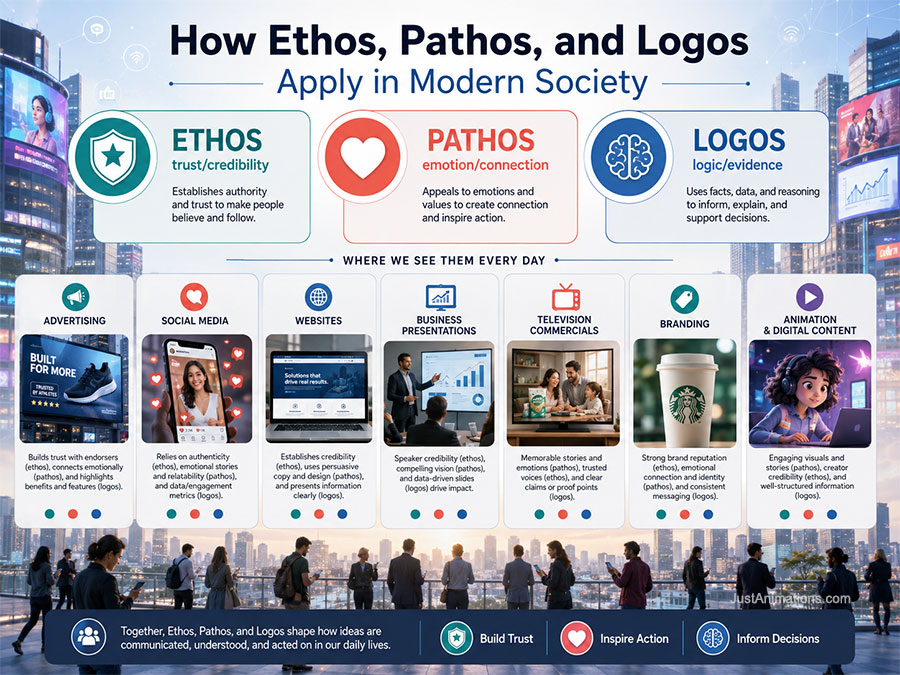
It appears in:
- Search results
- Product pages
- News
- Political campaigns
- Social media feeds
- Podcasts
- Television
- Streaming media
- Online reviews
- Corporate communication
- Sales presentations
- Fundraising campaigns
Understanding ethos, pathos, and logos therefore has value beyond marketing.
It can also help people evaluate messages critically.
When you encounter a persuasive claim, ask:
Ethos: Who is making this claim, and why should I trust them?
Pathos: What emotion is this message trying to create?
Logos: What evidence and reasoning actually support the conclusion?
These questions can make people more conscious of how communication is influencing them.
How Ethos, Pathos, and Logos Are Used in Advertising
Advertising is one of the clearest modern applications of classical rhetoric.
A professional advertising animation studio may use all three appeals while developing a campaign.
Ethos in Advertising
Advertisers establish credibility through:
- Expert endorsements
- Customer testimonials
- Awards
- Brand heritage
- Independent testing
- Professional production
- Recognizable partnerships
- Certifications
A toothpaste advertisement featuring a dentist is using an obvious form of ethos.
A technology company demonstrating years of engineering research may use ethos more subtly.
Pathos in Advertising
Advertising frequently creates emotional associations.
Examples include:
Automotive: freedom, power, adventure.
Insurance: security, family, reassurance.
Sportswear: determination, identity, achievement.
Travel: curiosity, excitement, escape.
Food: comfort, pleasure, nostalgia.
Technology: possibility, creativity, progress.
The emotional association can become part of how consumers remember the brand.
Logos in Advertising
Logos appears through:
- Price comparisons
- Performance demonstrations
- Research
- Specifications
- Warranty information
- Feature comparisons
- Customer savings
- Measurable results
A software advertisement might say:
“Automate five manual tasks from one dashboard.”
A product advertisement might demonstrate:
“Battery life lasts up to twice as long under the same test conditions.”
The audience receives a practical reason to evaluate the product.
Ethos, Pathos, and Logos in Television Commercials
Television and streaming commercials have limited time.
That makes rhetorical efficiency especially important.
A 30-second commercial might use:
Seconds 0–8: Pathos
Introduce a relatable problem.
Seconds 8–18: Logos
Show how the product solves it.
Seconds 18–25: Ethos
Provide credibility through experience, customers, testing, or expertise.
Seconds 25–30: Call to action
Tell the viewer what to do next.
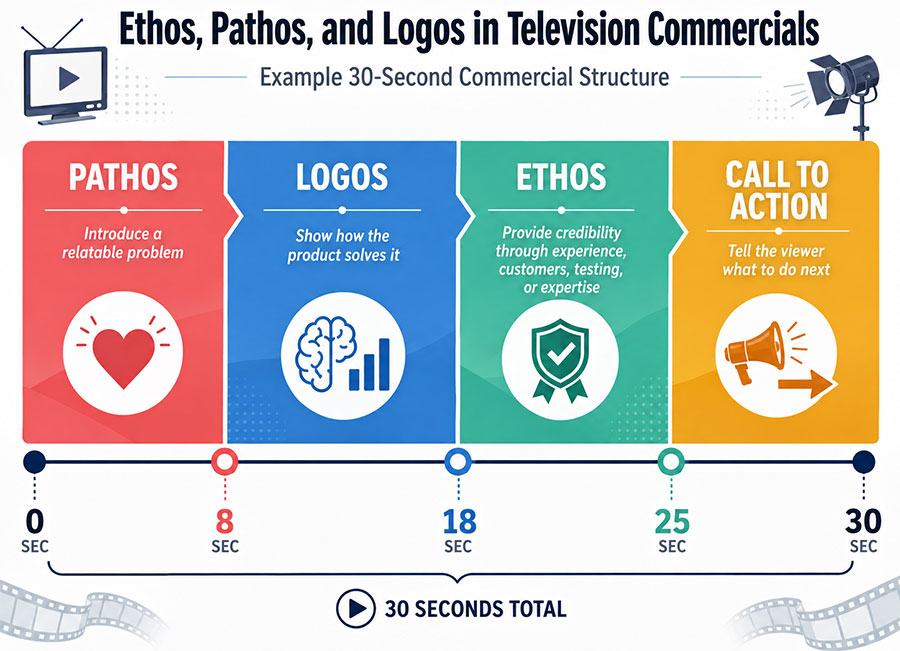
This is not a required formula.
A luxury commercial may rely almost entirely on pathos and ethos.
A direct-response advertisement may lean heavily on logos.
The right combination depends on the audience and objective.
Ethos, Pathos, and Logos in Marketing
Marketing operates across a longer customer journey than one advertisement.
The three appeals can therefore appear at different stages.
Awareness
Pathos may capture initial attention through storytelling, humor, aspiration, surprise, or curiosity.
Consideration
Logos helps buyers compare products, features, capabilities, costs, and outcomes.
Evaluation
Ethos becomes increasingly important as buyers examine:
- Experience
- Testimonials
- Case studies
- Credentials
- Company history
- Expertise
Decision
All three may work together.
The buyer trusts the company.
The product makes rational sense.
The buyer feels confident about proceeding.
Which Marketing Platforms Best Showcase Ethos, Pathos, and Logos in Branded Content?
Different platforms emphasize different persuasive strengths.
| Marketing Platform | Ethos | Pathos | Logos |
|---|---|---|---|
| Company website | Strong | Moderate | Strong |
| YouTube/video | Strong | Very strong | Strong |
| Social media | Moderate | Very strong | Moderate |
| Landing pages | Strong | Moderate | Very strong |
| Email marketing | Strong | Strong | Strong |
| Webinars | Very strong | Moderate | Very strong |
| Sales presentations | Very strong | Moderate | Very strong |
| Television commercials | Strong | Very strong | Moderate |
| Trade shows | Strong | Strong | Strong |
| Animated explainers | Strong | Strong | Very strong |
Video and animation are especially flexible because they can combine all three simultaneously.
A spokesperson can establish ethos.
Characters and music can create pathos.
Animated diagrams and data can communicate logos.
That makes animated branded content particularly useful when a business needs to persuade while also explaining something.
Ethos, Pathos, and Logos in Business Presentations
Business presentations frequently fail because they rely almost exclusively on logos.
Slide after slide contains:
- Statistics
- Charts
- Forecasts
- Features
- Tables
The information may be useful, but persuasion requires more than information.
A stronger presentation might include:
Ethos
Why is the presenter qualified?
What experience does the company have?
Pathos
Why does this issue matter to the audience?
What happens if the problem is solved—or ignored?
Logos
What evidence supports the proposed solution?
This balance is particularly valuable in:
- Sales presentations
- Investor presentations
- RFP responses
- Government presentations
- Product launches
- Internal strategy presentations
Can You Recommend Software That Assists in Crafting Ethos, Pathos, and Logos-Driven Presentations?
Software cannot automatically make an argument persuasive, but several tools can help teams organize and visualize the three appeals.
Microsoft PowerPoint
Useful for combining:
- Speaker credentials
- Customer evidence
- Data
- charts
- Videos
- Stories
- Presentations
Google Slides
Useful for teams collaborating on persuasive presentations and organizing claims, evidence, and supporting visuals.
Canva
Useful for quickly creating visually polished presentations, social media graphics, and branded layouts.
Adobe Creative Tools
Useful when the presentation requires more advanced:
- Illustration
- Photography
- Motion
- Video
- Graphic design
Professional Animation Software
Animation teams may use specialized 2D, 3D, compositing, and motion-design applications to transform persuasive ideas into visual sequences.
The important point is that software assists execution.
It does not decide:
Which source is credible.
Which emotion is appropriate.
Which evidence is convincing.
Those remain strategic and creative decisions.
How Ethos, Pathos, and Logos Apply to Animation
Animation is particularly interesting from a rhetorical perspective because nearly every creative choice can influence persuasion.
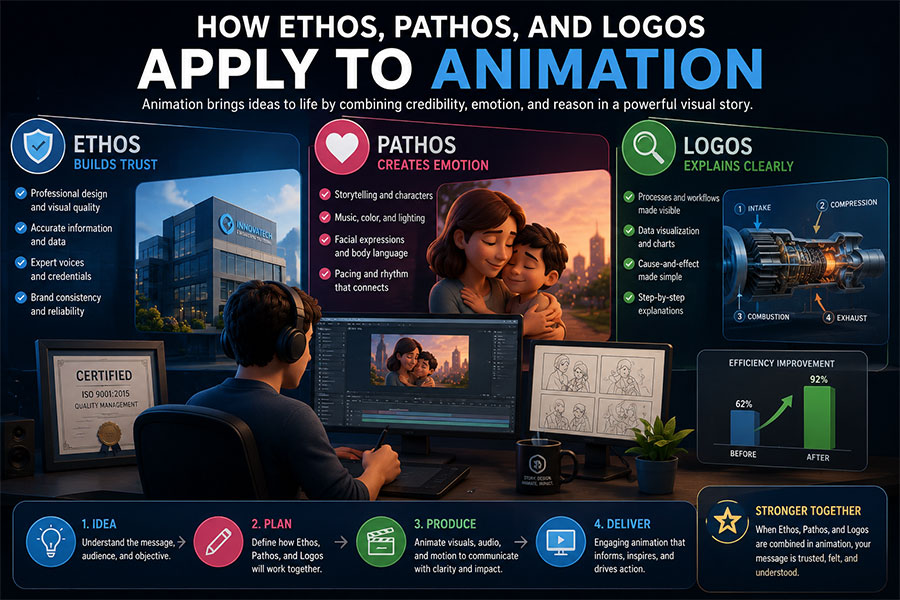
An animator controls:
- Character design
- Voice
- Movement
- Color
- Typography
- Sound
- Music
- Camera
- Timing
- Visual evidence
- Scene order
That means ethos, pathos, and logos can be designed visually.
How Animation Creates Ethos
Animation can establish credibility through visual presentation.
Professional execution itself affects perception.
Imagine a company selling sophisticated aerospace technology.
A generic template animation with inaccurate product proportions may weaken credibility.
A carefully modeled technical animation can communicate:
Precision.
Competence.
Attention to detail.
Ethos in animation can also come from:
✓ Expert narration
✓ Accurate diagrams
✓ Brand consistency
✓ Real product data
✓ Professional visual design
✓ Customer testimonials
✓ Certifications shown on screen
✓ Technical review
For businesses in highly competitive media and advertising markets, a professional New York City animation studio can help translate brand authority into polished visual communication for advertising, technology, finance, corporate presentations, and other applications.
How Animation Creates Pathos
Animation gives artists enormous control over emotion.
Consider a character standing alone.
Change:
The lighting and the scene becomes threatening.
Change:
The music and it becomes hopeful.
Change:
The character’s posture and it becomes sad.
Change:
The timing and it becomes humorous.
Animators can use:
- Facial expressions
- Body language
- Character design
- Music
- Color
- Camera movement
- Environment
- Pacing
to influence how a scene feels.
A nonprofit may use gentle illustrated storytelling to build empathy.
A sports brand may use fast cuts and aggressive motion to create energy.
A technology company may use futuristic environments to create excitement about innovation.
This is pathos expressed visually.
How Animation Creates Logos
Animation can make logical arguments easier to understand.
Consider a complicated mechanical product.
A written paragraph might explain:
- Material enters the system.
- The first component separates contaminants.
- A second component regulates flow.
- The cleaned material exits.
A 3D animation can simply show the sequence happening.
The reasoning becomes visible.
Animation can support logos through:
✓ Animated diagrams
✓ Charts
✓ Before-and-after comparisons
✓ Timelines
✓ Product demonstrations
✓ Exploded views
✓ Data visualization
✓ Process animation
✓ Software interface demonstrations
Animation does not replace evidence.
It can make evidence easier to understand.
Ethos, Pathos, and Logos in an Animated Explainer
Imagine a cybersecurity company launching a new platform.
Opening — Pathos
A visual sequence shows an employee unknowingly opening the door to a cyber threat.
Tension builds.
The audience understands the risk emotionally.
Explanation — Logos
The animation shows:
- How the attack enters
- Which systems are vulnerable
- How the platform identifies abnormal behavior
- What action follows
The audience understands the mechanism.
Proof — Ethos
The animation introduces:
- Security expertise
- Certifications
- Customer experience
- Product validation
- Relevant results
The audience receives reasons to trust the provider.
Conclusion
The three appeals converge:
We understand your concern.
Here is how the solution works.
Here is why you can trust us to deliver it.
Using Ethos, Pathos, and Logos Without Manipulating the Audience
Persuasion can be used responsibly or irresponsibly.
Pathos becomes problematic when emotional content is designed to overwhelm evidence.
Ethos becomes problematic when authority is falsely represented.
Logos becomes problematic when statistics are selectively presented or comparisons are misleading.
Ethical communication should avoid:
✗ False testimonials
✗ Invented experts
✗ Manipulated data
✗ Fear without justification
✗ Misleading visual comparisons
✗ Unsupported claims
✗ Emotional exploitation
Businesses should use rhetoric to communicate their strongest legitimate case—not to disguise weak evidence.
Why Animation Makes the Three Appeals More Visible
Animation can make abstract persuasion physically visible.
Ethos can have a visual identity.
A precise, professional visual language can communicate expertise.
Pathos can have a face.
Characters can express emotions audiences recognize instantly.
Logos can have movement.
Processes, statistics, and cause-and-effect relationships can unfold directly on screen.
This is one reason animation works across:
- Advertising
- Healthcare
- Technology
- Manufacturing
- Finance
- Education
- Government
- Entertainment
- Nonprofits
The medium can move between emotional storytelling and technical explanation without changing platforms.
A Simple Ethos, Pathos, and Logos Planning Framework
Before creating an advertisement, presentation, commercial, or animation, answer three questions.
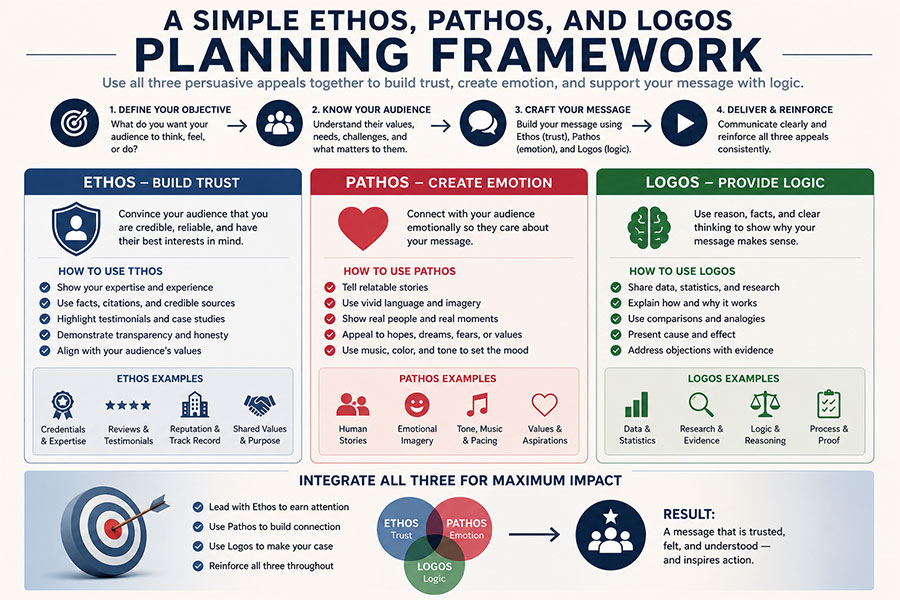
1. Ethos: Why Should the Audience Trust Us?
Possible answers:
- Experience
- Expertise
- Results
- Customers
- Credentials
- Transparency
2. Pathos: What Should the Audience Feel?
Possible answers:
- Confidence
- Excitement
- Curiosity
- Empathy
- Urgency
- Relief
3. Logos: What Should the Audience Understand?
Possible answers:
- How the product works
- Why the problem exists
- What evidence supports the claim
- Why one solution differs from another
- What measurable result is possible
If the creative team cannot answer these questions, the message may not yet be ready for production.
Ethos, Pathos, and Logos Advertising Checklist
Before launching a campaign, ask:
Ethos
✓ Have we demonstrated relevant expertise?
✓ Are our claims believable?
✓ Is our presentation professional?
✓ Are testimonials or credentials legitimate?
Pathos
✓ What emotion is the campaign intended to create?
✓ Does that emotion fit the brand?
✓ Is the story relevant to the audience?
✓ Are we avoiding unnecessary manipulation?
Logos
✓ Is the main argument understandable?
✓ Are important claims supported?
✓ Can viewers follow the reasoning?
✓ Are statistics presented accurately?
Combined
✓ Does the audience understand why it should trust us?
✓ Does the audience care?
✓ Does the message make sense?
✓ Is there a clear next step?
Which Is More Important: Ethos, Pathos, or Logos?
There is no universal winner.
The answer depends on context.
Ethos May Matter Most When:
- Trust is essential
- The purchase is high risk
- The subject requires expertise
- The organization is unfamiliar
Pathos May Matter Most When:
- The objective is awareness
- Storytelling is central
- The subject involves people
- Immediate attention is important
Logos May Matter Most When:
- The product is technical
- Buyers compare alternatives carefully
- The audience needs evidence
- The buying process is rational and complex
For many business campaigns, the better question is not:
Which one should we use?
It is:
How should we balance all three?
Ethos And Pathos And Logos Meaning for Modern Brands
For modern companies, the three concepts can be condensed into a simple communication framework.
Ethos = Trust
Show audiences why the brand deserves credibility.
Pathos = Connection
Give audiences a reason to care.
Logos = Understanding
Give audiences a rational reason to believe or act.
A brand that has ethos but no emotional connection may feel cold.
A brand with pathos but no evidence may feel superficial.
A brand with logos but no credibility may struggle to convince people that its claims are trustworthy.
The strongest communication connects all three.
Using Ethos, Pathos, and Logos in Professional Animation
When Just Animations develops content for businesses, companies, enterprises, government agencies, NGOs, and public-sector organizations, the objective is not simply to make images move.
Animation has to communicate.
That may involve:
Ethos: Presenting the brand professionally.
Pathos: Building emotional engagement.
Logos: Explaining the product, process, service, or argument clearly.
Those principles can apply to:
- Animated commercials
- Explainer videos
- Product demonstrations
- Corporate presentations
- Training animation
- Public-information campaigns
- Social media content
- Website animation
The appropriate balance depends on the audience.
An industrial animation may emphasize logos.
A brand film may emphasize pathos.
A public-sector explainer may require strong ethos and logos.
Understanding the persuasive objective before production begins helps the creative team make better decisions about script, storyboard, visual style, characters, voiceover, pacing, music, and animation.
Ancient Principles for Modern Communication
Ethos, pathos, and logos originated in a world without television, websites, social media, streaming platforms, animation software, or digital advertising.
Yet the underlying communication problems have barely changed.
Audiences still ask:
Can I trust you?
Why should I care?
Does this make sense?
Technology has changed the way those questions are answered.
A Greek speaker used voice, language, argument, and physical presence.
A modern marketer can use:
- Video
- Animation
- Data
- Music
- Characters
- Websites
- Interactive experiences
- Artificial intelligence
But the persuasive foundation remains recognizable.
Understanding ethos, pathos, and logos gives marketers, advertisers, animators, business leaders, educators, and audiences a practical way to think about why communication works.
Frequently Asked Questions
What are ethos, pathos, and logos?
Ethos, pathos, and logos are three classical approaches to persuasion associated with Aristotle’s study of rhetoric. Ethos concerns credibility and character, pathos concerns the emotions of the audience, and logos concerns reasoning, argument, and evidence.
What is the difference between ethos, pathos, and logos?
Ethos asks why the audience should trust the communicator. Pathos asks what the audience should feel. Logos asks whether the argument makes sense and is supported by reasoning or evidence. Effective communication can combine all three.
How are ethos, pathos, and logos used in advertising?
Advertising uses ethos through experts, reputation, testimonials, and credibility signals; pathos through emotional storytelling, music, characters, and imagery; and logos through statistics, comparisons, demonstrations, product features, and evidence.
Which marketing platforms best showcase ethos, pathos, and logos in branded content?
Video, animation, company websites, landing pages, webinars, social media, email, television commercials, trade-show presentations, and sales presentations can all combine the three appeals. Video and animation are especially flexible because credibility, emotion, and logical explanations can appear together within one sequence.
Can you recommend software that assists in crafting ethos, pathos, and logos-driven presentations?
PowerPoint, Google Slides, Canva, Adobe creative applications, video editors, and professional animation software can all help create persuasive presentations. The software helps execute the message, but marketers and creative teams must still decide what establishes credibility, which emotions are appropriate, and what evidence supports the argument.