Enterprise corporate training animation helps large organizations explain important information clearly, consistently, and at scale.
That is the simple answer.
The better answer is this: training animation reduces the cost of confusion.
When employees do not understand a process, mistakes happen.
When onboarding is inconsistent, performance varies.
When safety training is boring, people tune out.
When compliance material is too dense, retention drops.
When managers explain things differently, teams operate differently.
That is expensive.
Enterprise companies do not just need training content. They need training that people can actually understand, remember, and apply.
That is where corporate training animation becomes valuable.
It turns complex, dry, or repetitive training material into clear visual learning content that can be used across departments, locations, teams, and onboarding programs.
Enterprise Corporate Training Animation: The Short Answer
Corporate training animation is used to teach employees, customers, partners, or internal teams through animated video content.
For enterprise companies, it is especially useful when the training needs to be consistent, repeatable, scalable, and easy to understand.
| Training Need | How Animation Helps | Business Value |
|---|---|---|
| Employee onboarding | Explains company processes clearly | Improves new hire ramp-up |
| Safety training | Shows risks and correct actions visually | Reduces misunderstanding |
| Compliance training | Simplifies dense topics | Improves retention |
| Software training | Demonstrates workflows step by step | Reduces support burden |
| Sales training | Shows messaging, process, and scenarios | Improves consistency |
| Customer service training | Demonstrates real-world interactions | Builds better response habits |
| Operational training | Standardizes internal procedures | Reduces errors |
| Leadership communication | Explains strategy or change clearly | Improves alignment |
The biggest value of training animation is repeatability.
A good training video explains the same message the same way every time.
That matters when a company has hundreds or thousands of employees.
Visual Graph: Where Training Animation Creates Value
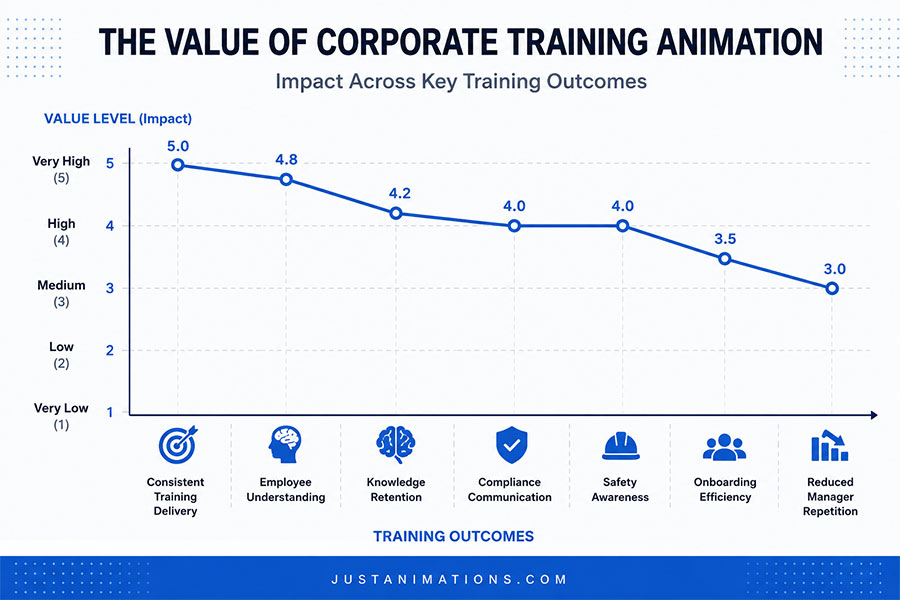
| Training Outcome | Value Level | Visual Scale |
|---|---|---|
| Consistent Training Delivery | Very High | ██████████ |
| Employee Understanding | Very High | ██████████ |
| Knowledge Retention | High | ████████ |
| Compliance Communication | High | ████████ |
| Safety Awareness | High | ████████ |
| Onboarding Efficiency | High | ████████ |
| Reduced Manager Repetition | Medium to High | ███████ |
The larger the organization, the more valuable consistency becomes.
A small team can explain things one-on-one.
An enterprise company needs systems.
Why Enterprise Training Often Fails
Most corporate training fails for one of three reasons.
It is too boring.
It is too complicated.
It is too inconsistent.
Employees may be handed long documents, slide decks, policy pages, recorded meetings, or dense learning modules and expected to absorb everything.
That is not how people usually learn best.
Training needs structure.
It needs examples.
It needs visual clarity.
It needs pacing.
It needs to show what the learner should do, not just tell them what the company expects.
Animation helps because it can break down the topic into simple visual steps.
Instead of reading a five-page process document, the viewer can watch the process unfold.
That creates faster understanding.
Benefits Of Corporate Training Animation
1. Consistent Training Across Teams
Enterprise companies often have multiple offices, locations, departments, managers, trainers, and shifts.
That creates variation.
One manager explains a process one way. Another explains it differently. One team gets detailed training. Another gets a rushed version. One location follows the process correctly. Another develops bad habits.
Training animation helps standardize the message.
Everyone receives the same explanation, the same examples, and the same visual guidance.
That creates a stronger baseline.
2. Better Employee Engagement
Let’s be honest.
Most training material is not exciting.
Employees are busy. They are already dealing with emails, meetings, deadlines, and daily work. If the training content feels dry, they will mentally check out.
Animation makes training more watchable.
It can use motion, characters, icons, diagrams, scenarios, and storytelling to hold attention longer than static slides.
That does not mean training should become entertainment for entertainment’s sake.
It means learning should be easier to follow.
3. Easier Explanation Of Complex Topics
Some training topics are difficult to explain with text alone.
Animation can simplify:
- Safety procedures
- Compliance rules
- HR policies
- Software workflows
- Customer service scenarios
- Sales processes
- Equipment usage
- Cybersecurity risks
- Manufacturing procedures
- Healthcare protocols
- Financial processes
- Internal systems
The more complex the topic, the more useful animation becomes.
Animation can show the right action, the wrong action, the consequence, and the corrected behavior in a way that is easy to understand.
4. Stronger Knowledge Retention
People tend to remember information better when it is organized visually.
Animation helps by giving the learner both the explanation and the visual example.
That combination is useful because it reduces cognitive load.
Instead of asking employees to imagine the scenario, animation shows it.
For training, that matters.
If employees understand and remember the material, the training has a better chance of changing behavior.
5. Scalable Training Content
Enterprise training needs scale.
A video can be used:
- In onboarding programs
- In learning management systems
- During team meetings
- In safety refreshers
- In compliance modules
- For remote employees
- Across departments
- Across locations
- For customers or partners
Once created, the animation can be reused repeatedly.
That makes it more efficient over time.
6. Better Support For Remote And Hybrid Teams
Remote and hybrid teams need training content that does not depend on everyone being in the same room.
Animation works well because it can be delivered digitally and watched on demand.
This is useful for:
- Distributed teams
- Global companies
- Remote onboarding
- Asynchronous training
- LMS content
- Department refreshers
- Contractor training
- Partner education
The training becomes easier to access and easier to repeat.
Corporate Training Animation Cost
Enterprise corporate training animation cost depends on length, style, complexity, number of modules, and production quality.
Here are practical planning ranges:
| Training Animation Type | Typical Budget Range |
|---|---|
| Short Internal Training Video | $3,000 to $10,000 |
| Professional 2D Training Animation | $7,500 to $20,000 |
| Motion Graphics Training Video | $10,000 to $30,000 |
| Character-Based Scenario Training | $15,000 to $50,000+ |
| Safety Or Compliance Animation Series | $25,000 to $100,000+ |
| Enterprise Training Video Program | $50,000 to $250,000+ |
The cost is not only based on runtime.
A short compliance video may require careful scripting, legal review, stakeholder feedback, and precise language. A safety animation may need accurate visuals and scenario planning. A training series may need consistent characters, templates, voiceovers, and multiple modules.
Scope matters more than length alone.
What Affects The Cost Of Training Animation?
| Cost Factor | Why It Matters |
|---|---|
| Number of videos | More modules require more scripting, design, and animation |
| Animation style | 2D, motion graphics, character, and 3D all have different costs |
| Script complexity | Compliance, safety, and technical content need careful review |
| Custom visuals | Branded characters, environments, and diagrams increase scope |
| Voiceover | Professional narration improves clarity and polish |
| Revisions | Multiple stakeholders can add review time |
| Languages | Translation, subtitles, and localization increase deliverables |
| LMS requirements | Training platforms may need specific formats |
| Timeline | Rush projects may require more resources |
The more reusable the training content is, the easier it is to justify a larger investment.
A video used once has limited value.
A training module used by thousands of employees over several years can become a very efficient asset.
Training Animation Vs Live Training
Live training can be valuable.
It allows questions, discussion, interaction, and real-time coaching.
But live training has limitations.
It can vary depending on the trainer. It can be expensive to repeat. It can be hard to schedule. It can be difficult to scale across teams and locations.
Animation works differently.
| Category | Live Training | Training Animation |
|---|---|---|
| Consistency | Varies by trainer | Same message every time |
| Scalability | Harder to scale | Easy to distribute |
| Scheduling | Requires coordination | On-demand |
| Engagement | Depends on presenter | Built into visual design |
| Repeatability | Limited | High |
| Cost over time | Can increase with sessions | Often decreases per use |
| Best use | Discussion, coaching, Q&A | Explanation, onboarding, standardization |
The best enterprise training strategy may use both.
Animation can deliver the core message consistently.
Live training can handle discussion, questions, coaching, and application.
Best Uses For Enterprise Training Animation
Corporate training animation works especially well for topics that need to be taught repeatedly.
| Training Category | Example Use |
|---|---|
| Onboarding | Company overview, systems, expectations |
| Compliance | Policies, privacy, workplace conduct |
| Safety | Hazard awareness, emergency procedures |
| Software | Platform walkthroughs and workflows |
| Sales | Messaging, objection handling, process |
| Customer Service | Scenario-based response training |
| HR | Benefits, culture, internal policies |
| Operations | Standard operating procedures |
| Cybersecurity | Phishing, password safety, data protection |
| Manufacturing | Equipment usage and process control |
The strongest use cases are topics where mistakes are expensive, consistency matters, or the same explanation needs to be delivered many times.
How Enterprises Can Get More Value From Training Animation
A training animation should not be treated as a one-off video.
It should be treated as part of a learning system.
Businesses can get more value by creating:
- Short modules instead of one long video
- Quiz questions after each section
- Branded templates for future training videos
- Role-specific versions
- Manager discussion guides
- Subtitled versions
- Short recap clips
- LMS-ready files
- Updated modules over time
Shorter modules usually work better than long, overloaded videos.
If employees need to learn five different things, create five focused videos.
Clarity wins.
Common Mistakes In Corporate Training Animation
Training animation fails when companies try to do too much at once.
Common mistakes include:
- Making the video too long
- Including too much policy language
- Using jargon employees do not use
- Skipping real scenarios
- Making the animation too generic
- Ignoring the learner’s actual job context
- Treating training as a box-checking exercise
- Not planning for updates
- Using weak audio
- Forgetting subtitles or accessibility needs
Good training animation is not just about making content look better.
It is about making learning easier.
What To Prepare Before Creating Training Animation
Before starting, enterprise teams should prepare:
- Training objective
- Target learners
- Key learning outcomes
- Existing training documents
- SOPs or policy materials
- Brand guidelines
- Subject matter experts
- Required compliance language
- Common employee mistakes
- Real-world scenarios
- Desired video length
- LMS requirements
- Accessibility needs
- Timeline
- Budget range
The best training videos are built from real business context.
Generic training often feels forgettable because it does not reflect the actual situations employees face.
How Just Animations Approaches Corporate Training Animation
Just Animations creates corporate training animation for businesses that need clear, professional, scalable learning content.
That includes 2D animation, motion graphics, character animation, 3D animation, explainer videos, product animation, corporate videos, AI-assisted animation, social media videos, and video production.
For enterprise training projects, the focus is on clarity, structure, and usability.
The goal is not to make training “look animated.”
The goal is to help people understand what they need to know and apply it correctly.
That is the business value.
Final Thoughts
Enterprise corporate training animation can help companies train better, communicate more consistently, reduce confusion, and create scalable learning assets.
It is useful for onboarding, safety, compliance, software training, sales training, customer service, operations, cybersecurity, and internal communication.
The cost depends on scope, style, complexity, number of modules, and quality level.
But the better question is not only what training animation costs.
The better question is what poor training is already costing the business.
If employees misunderstand processes, make avoidable mistakes, forget important rules, or receive inconsistent training, the hidden cost is already there.
Animation helps reduce that cost by making training clearer, more consistent, and easier to repeat.
FAQ
What is enterprise corporate training animation?
Enterprise corporate training animation is animated video content used by large organizations to train employees, explain procedures, support onboarding, teach compliance, improve safety awareness, and communicate internal processes clearly.
How much does corporate training animation cost?
Corporate training animation can cost from $3,000 to $30,000+ for individual training videos. Larger safety, compliance, onboarding, or enterprise training programs can cost $50,000 to $250,000+ depending on scope and number of modules.
Why use animation for corporate training?
Animation helps make training more consistent, engaging, visual, and easier to understand. It is especially useful for explaining complex procedures, safety rules, compliance topics, software workflows, and internal processes.
Is training animation better than live training?
Training animation is better for consistent, repeatable, scalable explanations. Live training is better for discussion, coaching, and Q&A. Many enterprise companies use both together for stronger learning outcomes.
What types of corporate training work best as animation?
Animation works well for onboarding, safety, compliance, software training, cybersecurity, sales training, customer service scenarios, operational procedures, HR policies, and any training that needs to be repeated consistently across teams.