Artificial intelligence (AI) is changing how animation is planned, produced, edited, and delivered through the use of AI animation.
What began as a technology primarily used to automate individual production tasks has expanded into a much broader creative toolkit capable of helping generate concepts, scripts, images, motion, character ideas, backgrounds, video sequences, voice tracks, and alternate versions of animated content.
Artificial intelligence animation combines AI-assisted or AI-generated technology with traditional animation, motion design, editing, storytelling, and human creative direction.
For businesses, animation studios, filmmakers, marketers, educators, government organizations, and content creators, AI can potentially make parts of the animation process faster and more flexible.
However, AI does not eliminate the need for:
- Creative direction
- Storytelling
- Character consistency
- Brand control
- Technical accuracy
- Editing
- Quality assurance
- Human judgment
The most useful way to understand AI animation is therefore not as a replacement for every traditional animation technique.
It is better understood as another set of production tools available to animators and creative teams.
Artificial intelligence can accelerate some tasks dramatically while other parts of professional animation still benefit from experienced human artists, directors, editors, and production specialists.
In this article, we explore how artificial intelligence animation works, where AI fits into modern video production, its major benefits and limitations, and how businesses can decide when AI animation is appropriate for a project.
What Is Artificial Intelligence Animation?
Artificial intelligence animation is the use of artificial intelligence and machine-learning technologies to assist with or generate elements of animated content.
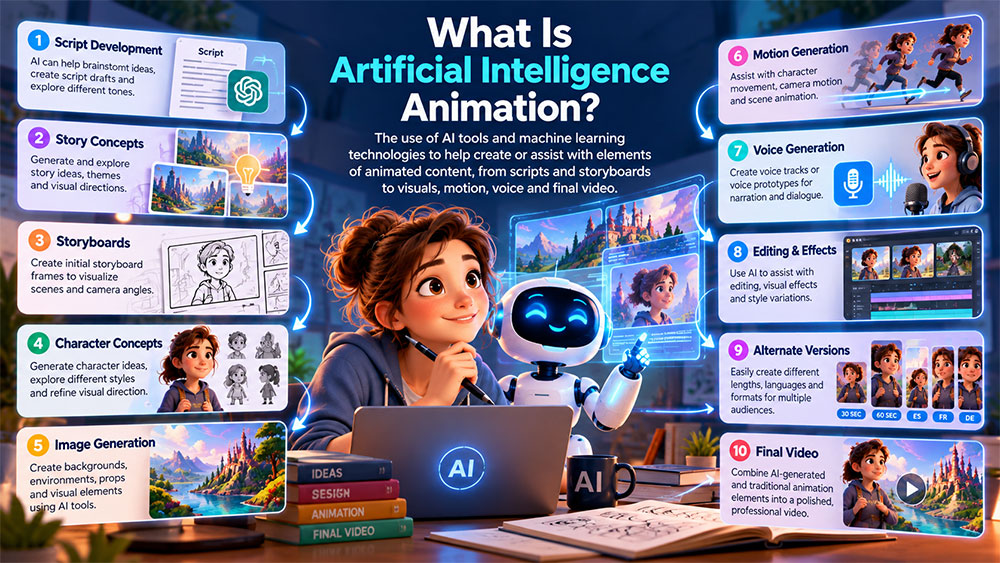
Depending on the production, AI may contribute to:
- Script development
- Story concepts
- Storyboards
- Character concepts
- Image generation
- Background generation
- Motion
- Lip synchronization
- Voice generation
- Video generation
- Editing
- Visual effects
- Alternate versions
- Localization
Some productions may use AI only during pre-production.
Others may incorporate AI-generated material directly into the finished animation.
Professional AI animation services can also combine AI-generated assets with conventional animation, editing, motion graphics, sound design, and human creative direction.
That distinction matters.
AI animation does not necessarily mean that an entire video was automatically generated by artificial intelligence.
AI can participate in only one stage—or several stages—of a much larger production process.
Using Artificial Intelligence to Craft Scripts and Stories
One of the earliest ways artificial intelligence became useful in animation production was through scripting and story development.
Scripts are still shaped by human creative direction, but AI can help creative teams:
- Brainstorm story ideas
- Explore alternate openings
- Suggest scene structures
- Generate rough dialogue
- Organize information
- Create first-draft narration
- Explore different tones
- Summarize technical source material
For companies with large creative teams, AI can also help accelerate the early ideation process.
Instead of beginning with an empty page, a creative team can develop multiple directions quickly and decide which concept deserves further development.
This does not mean the first AI-generated script should automatically become the final script.
Professional animation still requires someone to decide:
Who is the audience?
What should they understand?
What should they remember?
What tone fits the organization?
What action should they take afterward?
The quality of the finished animation depends heavily on these decisions.
AI may accelerate the brainstorming stage, but storytelling still requires intention.
How AI Is Revolutionizing Video Animation
Artificial intelligence is influencing almost every stage of modern digital-content production.
In animation, that influence can take several forms.
AI Can Accelerate Concept Development
Creative teams can explore:
- Character concepts
- Environments
- Color palettes
- Visual references
- Composition ideas
much faster than traditional sketching alone.
A production team may generate many rough visual directions before deciding which one should move into professional development.
AI Can Support Storyboarding
Early storyboard concepts can be generated or explored more quickly.
This can help teams visualize:
- Camera angles
- Character positions
- Scene composition
- Environment
- Lighting
- Narrative sequence
The final storyboard may still be redrawn or refined manually.
But AI can shorten the distance between:
idea
and:
something the team can evaluate visually.
AI Can Assist With Motion
Artificial intelligence can support certain motion-generation tasks.
Depending on the workflow, this may include:
- Character movement
- Image-to-video motion
- Camera movement
- Facial animation
- Lip synchronization
- Motion interpolation
The usefulness of these techniques varies substantially according to the type of production.
AI Can Create Visual Variations Quickly
A single concept can sometimes be explored across several visual directions.
For example:
Realistic
Cartoon
Illustrated
Cinematic
Futuristic
Minimal
This can help art directors evaluate possibilities before committing production resources.
AI Can Accelerate Versioning
Businesses frequently need multiple versions of the same animation.
These may include:
- Different lengths
- Different languages
- Different audiences
- Different social formats
- Different campaign messages
AI-assisted workflows can make parts of this versioning process more efficient.
Where Does Artificial Intelligence Fit Into the Animation Process?
AI can appear at several points in a professional animation workflow.
| Production Stage | Possible AI Contribution | Human Role |
|---|---|---|
| Strategy | Research and idea generation | Define objective and audience |
| Script | Drafting and variations | Shape message and story |
| Storyboard | Concept frames | Direct composition and sequence |
| Design | Characters and visual concepts | Establish style and consistency |
| Animation | Motion assistance or generation | Direct movement and performance |
| Voice | Voice prototypes or generation | Select tone and performance |
| Editing | Rough assembly and automation | Control pacing and story |
| Effects | Generative visual elements | Refine and integrate |
| Versioning | Alternate formats and variations | Approve final output |
| Quality control | Automated assistance | Final human review |
AI can therefore support production without controlling the entire production.
That is one reason the relationship between AI animation and traditional animation is increasingly hybrid rather than competitive.
Artificial Intelligence Animation vs Traditional Animation
Is artificial intelligence animation better than traditional animation?
Not universally. They solve different production problems.
Traditional animation gives artists highly deliberate control over:
- Drawing
- Modeling
- Rigging
- Acting
- Timing
- Camera movement
- Materials
- Lighting
- Frame-by-frame continuity
AI-generated animation can provide advantages in:
- Speed
- Ideation
- Variations
- Early concepts
- Rapid experimentation
- Some repetitive tasks
A useful comparison is:
| Factor | AI-Assisted Animation | Traditional Animation |
|---|---|---|
| Concept speed | Very fast | Moderate |
| Visual exploration | Excellent | Excellent |
| Exact art direction | Variable | Strong |
| Character consistency | Improving but can vary | Strong |
| Product accuracy | Requires careful review | Strong |
| Repeatability | Can vary | Predictable |
| Fine motion control | Variable | Strong |
| Rapid variations | Excellent | More labor-intensive |
| Human authorship control | Depends on workflow | Clearer |
| Custom production | Possible | Highly controllable |
Neither approach needs to exist alone.
Many professional productions can use:
AI + traditional animation + editing + compositing + motion graphics
within the same project.
Businesses deciding between visual techniques can also compare professional 2D animation and 3D animation approaches alongside AI-assisted production.
Benefits of AI-Driven Video Animation
There are several reasons artificial intelligence animation has attracted so much attention.
Faster Creative Exploration
Traditional concept development requires time.
Artists may create:
- Sketches
- Mood boards
- Character concepts
- Background concepts
- Storyboard ideas
AI can generate early visual directions rapidly.
That allows teams to evaluate more possibilities before selecting a final direction.
Faster Production for Certain Tasks
AI can potentially accelerate:
- Rough storyboards
- Background creation
- Lip synchronization
- Voice prototypes
- Visual variations
- Image generation
- Certain motion tasks
This does not mean every animation becomes instant.
Complex productions still require planning and revision.
But selected stages may become considerably faster.
More Affordable Early Experimentation
Traditional production can become expensive when teams repeatedly develop concepts that are later rejected.
AI may allow companies to test more ideas before investing heavily in final production.
For example:
Concept A
Concept B
Concept C
can potentially be explored much earlier.
This reduces the cost of discovering that a visual direction does not work.
Greater Content Scalability
A business may need animation for:
- Website
- Social media
- Advertising
- Training
- Sales
- Presentations
- Events
AI-assisted workflows can make it easier to create alternate versions from common source material.
The central creative system can remain consistent while the outputs change.
Faster Localization
International companies may need different:
- Languages
- Voice tracks
- Text
- Regional messaging
AI-assisted voice and translation technologies can help accelerate localization.
Human review remains important, especially for:
- Technical language
- Cultural context
- Regulated information
- Brand messaging
Rapid Prototyping
AI is particularly useful before final production.
A team can visualize an idea quickly and ask:
Does this concept work?
Does this character fit?
Should the scene feel realistic or stylized?
Does the environment communicate the right idea?
This is often more efficient than debating an idea only through text.
Challenges of AI-Driven Video Animation
The growth of AI does not remove production challenges.
It introduces new ones.
Character Consistency
A character may look correct in one scene and subtly different in another.
Changes can occur in:
- Facial structure
- Clothing
- Proportions
- Hair
- Accessories
- Color
For a short experimental clip, this may be acceptable.
For an enterprise campaign or animated series, it may not be.
Product Accuracy
AI-generated systems may approximate objects rather than reproduce them precisely.
That creates problems for:
- Manufacturing
- Engineering
- Automotive
- Medical devices
- Consumer products
If a customer needs to see the exact product, controlled 3D animation based on product references or CAD data may be more appropriate.
Continuity Between Scenes
Generating individual attractive shots is different from producing a coherent multi-scene animation.
Professional animation requires continuity in:
- Character appearance
- Environment
- Lighting
- Camera language
- Motion
- Story
AI-generated scenes may require editing and compositing to feel like part of the same production.
Fine Art Direction
A creative director may request:
“Move the hand three inches to the left while keeping everything else exactly the same.”
Traditional production workflows can provide highly specific control.
Generative workflows may sometimes reinterpret more of the image than intended.
That can make highly precise revisions more difficult.
Text and Graphic Accuracy
AI-generated visual content can still introduce issues with:
- Typography
- Labels
- Numbers
- Interface details
- Logos
Important text and branding should therefore be carefully reviewed or added through conventional design and compositing.
Unexpected Output
Generative systems are probabilistic.
The same or similar instruction may produce different outputs.
That unpredictability can be useful creatively.
It can also become a production challenge when consistency matters.
Human Oversight Remains Important
The faster content can be generated, the more important quality control becomes.
Someone still needs to check:
- Accuracy
- Brand consistency
- Visual quality
- Continuity
- Story
- Messaging
- Claims
- Technical correctness
AI can generate content quickly.
It does not automatically know whether that content is correct for the organization using it.
Examples of AI-Driven Video Animation
Artificial intelligence animation can be used in many different ways.
Virtual Characters
AI can assist with virtual characters used for:
- Storytelling
- Training
- Marketing
- Entertainment
- Education
Characters may combine AI-generated visuals with professional editing, animation, voice, and sound.
Machine-Generated Visual Content
AI can help produce:
- Backgrounds
- Concept imagery
- Supporting scenes
- Short video sequences
- Alternate visuals
This can be useful where companies need a large amount of visual content.
Realistic Simulations
AI-assisted workflows can contribute to simulations and conceptual visualizations for subjects that are difficult to film.
These might include:
- Future environments
- Conceptual worlds
- Educational sequences
- Marketing visuals
Highly technical simulations still require appropriate subject-matter and animation expertise.
Advertising Concepts
Advertising teams can use AI to explore creative directions rapidly.
A product might be visualized across:
- Futuristic environments
- Stylized worlds
- Abstract spaces
- Cinematic scenes
The most useful concept can then be refined into a professional campaign.
Social Media Animation
Short-form content is another practical use case.
AI can help generate:
- Short scenes
- Visual experiments
- Campaign variations
- Backgrounds
However, social content still benefits from deliberate pacing and visual hierarchy.
The principles behind why movement captures attention are explored further in Animation Psychology: Why Motion Captures Human Attention.
How Are Businesses Using Artificial Intelligence Animation?
Businesses are increasingly using AI animation as part of broader communication workflows.
Common applications include:
- Product marketing
- Brand storytelling
- Training
- Social media
- Advertising
- Technology explainers
- Internal communication
- Concept visualization
- Event content
Technology companies are especially well suited to AI-assisted visual communication because many technology concepts have no obvious physical appearance.
Cloud infrastructure, automation, software, data, and artificial intelligence itself often require visualization.
Professional technology animation can combine AI, 2D, 3D, interface animation, product demonstrations, and motion graphics according to the subject.
Can Artificial Intelligence Create an Entire Animated Video?
Yes, AI systems can now generate substantial parts of an animated video, but generating a video and producing a polished professional animation are not necessarily the same thing.
A complete business video still needs decisions involving:
- Objective
- Script
- Story
- Brand
- Scene order
- Consistency
- Editing
- Music
- Voice
- Timing
- Delivery format
The more important the project becomes, the more valuable deliberate creative control becomes.
A casual social clip may tolerate visual inconsistencies.
A national advertising campaign, technical product demonstration, government communication, or enterprise presentation usually requires much stronger quality assurance.
Will AI Replace Animators?
AI is more likely to change what animators do than eliminate every animation role.
Animation has changed repeatedly through technology.
Artists moved from:
- Physical cels
- Digital drawing
- Computer compositing
- CGI
- Motion capture
- Procedural tools
to increasingly sophisticated production systems.
AI represents another major technological change.
Certain repetitive tasks may require less manual work.
At the same time, creative teams still need people capable of:
- Directing
- Designing
- Storytelling
- Editing
- Evaluating
- Correcting
- Integrating
The animator of the future may spend less time executing some repetitive tasks and more time directing systems toward a desired result.
Our broader guide to animation maker tools and professional solutions explores the difference between automated animation tools and full professional production.
Is Artificial Intelligence Animation Good Enough for Professional Business Videos?
AI animation can be suitable for professional business content when the production method matches the project’s quality, accuracy, and control requirements.
AI may be especially useful for:
✓ Concept development
✓ Short marketing content
✓ Visual experimentation
✓ Backgrounds
✓ Supporting scenes
✓ Rapid variations
More controlled animation may be preferable where a company requires:
✓ Exact product accuracy
✓ Strict character consistency
✓ Complex multi-scene continuity
✓ Detailed technical visualization
✓ Precise branded motion
The answer is therefore not:
AI or professional animation.
It can be:
AI within professional animation.
AI Animation, Motion Graphics, 2D or 3D: Which Should You Choose?
Choose the technique according to what the audience needs to understand.
Use AI Animation When:
- Fast creative exploration matters
- Visual experimentation is useful
- Multiple variations are needed
- Generative imagery supports the concept
Use 2D Animation When:
- Simplification matters
- Character illustration is important
- Services or workflows need explanation
- Graphic storytelling fits the brand
Use 3D Animation When:
- Products need dimensional accuracy
- Physical depth matters
- Internal components need visualization
- Realistic materials are important
Use Motion Graphics When:
- Data needs to move
- Typography matters
- Statistics need visualization
- The message is highly informational
Professional motion graphics services are particularly useful for combining animated typography, diagrams, charts, shapes, and information.
Many projects ultimately use more than one technique.
The Best AI Animation Workflow Is Often Hybrid
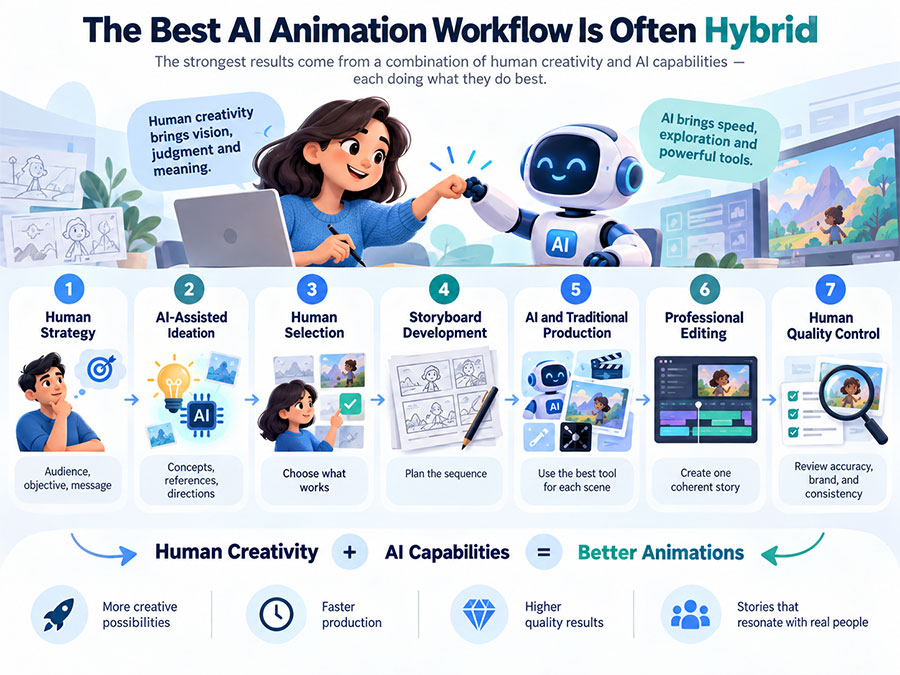
A practical professional workflow may look like this:
1. Human Strategy
Define:
- Audience
- Objective
- Message
- Brand
2. AI-Assisted Ideation
Explore:
- Concepts
- References
- Story directions
- Visual ideas
3. Human Selection
Choose what is actually useful.
4. Storyboard Development
Plan the final sequence.
5. AI and Traditional Production
Use the best technique for each scene.
6. Professional Editing
Combine the material into one coherent story.
7. Human Quality Control
Review:
- Brand
- Accuracy
- Consistency
- Pacing
- Technical details
This approach allows artificial intelligence to accelerate production without giving up all creative control.
What About Copyright and AI Animation?
Copyright and ownership are increasingly important considerations when using generative AI.
Businesses should evaluate:
- Where source material came from
- What rights the AI platform provides
- Whether copyrighted material was supplied as an input
- Whether third-party likenesses are involved
- How much human authorship exists in the final work
The U.S. Copyright Office’s artificial intelligence initiative has examined AI-generated works, digital replicas, copyrightability, and generative-AI training.
For professional production, AI should therefore be considered not only from a creative perspective but also from a rights-management perspective.
Companies working on commercially important projects should review applicable platform terms and seek appropriate legal guidance when necessary.
What Should Companies Look for in AI Animation Production?
Before choosing an AI animation workflow or provider, businesses should ask:
Can the visual style stay consistent?
One excellent scene is not enough if the next five look unrelated.
Can revisions be controlled?
Determine how specific changes will be handled.
Can products be represented accurately?
This is particularly important for technical industries.
Who directs the story?
Technology should support communication rather than determine it.
What happens after AI generation?
Professional finishing may require:
- Editing
- Color correction
- Compositing
- Typography
- Sound
- Voice
- Motion graphics
Where will the animation be used?
A social-media clip has different production requirements from:
- Television
- Trade shows
- Enterprise presentations
- Government communication
- Technical training
Artificial Intelligence Animation Is a Production Tool, Not the Strategy
The most important question is not:
“Can AI animate this?”
Modern tools increasingly make the answer:
Yes.
The more useful question is:
“What is the best way to communicate this?”
If AI improves:
- Speed
- Creativity
- Experimentation
- Production efficiency
then it can be extremely useful.
If it reduces:
- Accuracy
- Consistency
- Brand control
- Story quality
then another animation method may be more appropriate.
Professional animation is ultimately judged by the experience the audience receives, not by which software or technology produced every frame.
Conclusion
Artificial intelligence has the potential to continue transforming video animation.
AI can help creative teams:
- Generate ideas
- Develop scripts
- Explore storyboards
- Create visuals
- Produce motion
- Generate variations
- Accelerate selected production tasks
At the same time, artificial intelligence animation introduces challenges involving consistency, precision, art direction, quality control, and intellectual-property considerations.
That is why the future of AI animation is unlikely to be purely automated.
The strongest professional workflows increasingly combine:
artificial intelligence + human creativity + traditional animation techniques + professional production.
AI can accelerate the process.
Human direction determines what the process is trying to accomplish.
For businesses and organizations, that distinction matters.
The objective is not simply to create animation faster.
It is to create animation that communicates the right idea, represents the brand accurately, and gives the audience a reason to keep watching.
Frequently Asked Questions
What is artificial intelligence animation?
Artificial intelligence animation is animation created or assisted using AI technologies. AI can support tasks such as scripting, visual concept development, storyboarding, image generation, motion generation, lip synchronization, voice creation, editing, and producing alternate versions.
How is artificial intelligence used in animation?
Artificial intelligence can assist animation teams with ideation, scripts, storyboards, character concepts, backgrounds, image-to-video motion, lip synchronization, editing, visual effects, and versioning. Professional productions often combine these capabilities with human creative direction and conventional animation techniques.
What are the benefits of AI animation?
The primary benefits of AI animation include faster concept development, rapid visual experimentation, more efficient production of certain assets, easier creation of variations, and the ability to prototype creative ideas before committing to full production.
What are the disadvantages of artificial intelligence animation?
Potential disadvantages include inconsistent characters, unpredictable outputs, limited fine control, product inaccuracies, continuity problems, incorrect text or graphics, and copyright or rights-management considerations. Human review remains important for professional projects.
Will artificial intelligence replace professional animators?
AI is more likely to change animation workflows than completely replace professional animators. AI can automate or accelerate selected tasks, while human artists and directors remain important for storytelling, creative direction, brand consistency, technical accuracy, editing, and final quality control.