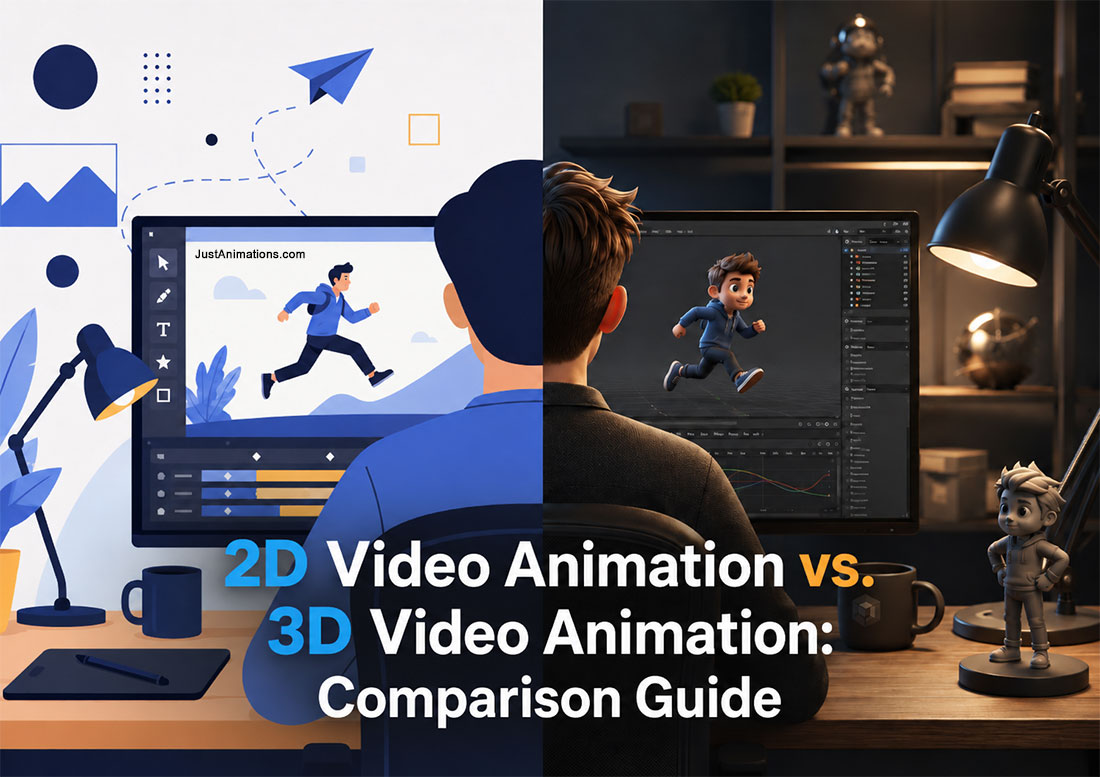
Choosing between 2D video animation and 3D video animation is one of the first decisions a business needs to make when planning an animated video.
Both styles can work well. But they work differently.
2D animation is usually better for clear storytelling, explainer videos, social media content, training videos, and service-based messaging.
3D animation is usually better for product demos, technical visuals, medical animation, architecture, machinery, and videos that need depth, realism, or detailed movement.
The right choice depends on the message.
Not the trend.
Not the most expensive style.
Not what looks impressive at first glance.
A good animation style should make the message easier to understand, not harder.
This guide compares 2D vs 3D animation, explains the strengths and limits of each, and shows when it makes sense to work with a professional video animation agency.
Quick Answer: 2D vs. 3D Video Animation
| Factor | 2D Video Animation | 3D Video Animation |
|---|---|---|
| Visual style | Flat, illustrated, graphic, cartoon, or motion-based | Dimensional, realistic, detailed, and immersive |
| Best for | Explainers, service videos, training, social media, education | Product demos, medical visuals, architecture, machinery, technical content |
| Cost | Usually more affordable | Usually more expensive |
| Timeline | Usually faster | Usually longer |
| Realism | Lower realism, higher simplicity | Higher realism, depth, and detail |
| Flexibility | Easy to style for many brands | Strong for objects, environments, and physical demonstrations |
| Complexity | Moderate | Higher |
| Best business use | Explaining ideas clearly | Showing how something looks, moves, or works |
Simple Rule
Choose 2D animation when your business needs clarity, speed, affordability, and simple storytelling.
Choose 3D animation when your business needs realism, depth, product detail, or technical demonstration.
Choose a hybrid animation style when you need the clarity of 2D and the visual impact of 3D.
What Is 2D Video Animation?
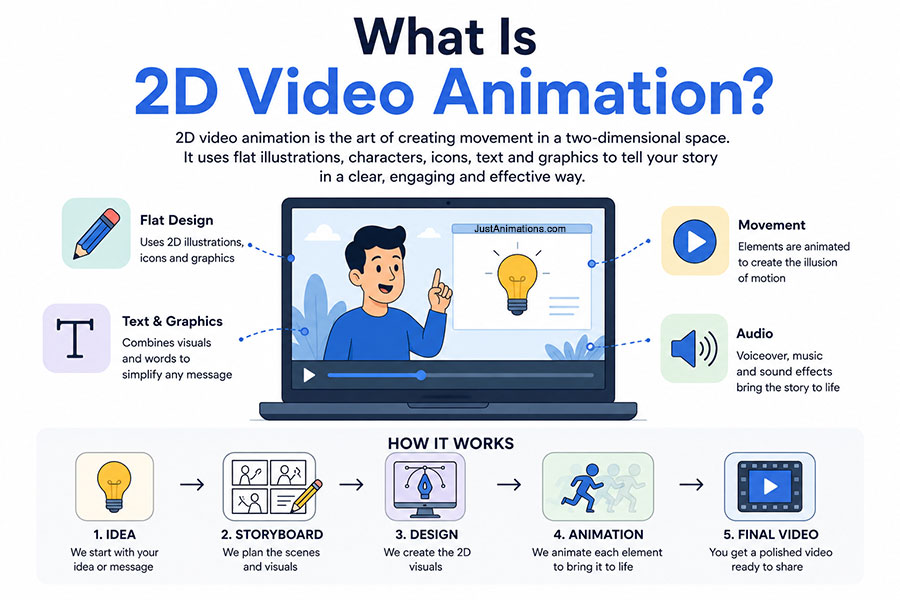
2D video animation is animation created in a two-dimensional space.
It uses height and width, but not realistic depth.
The visuals can include illustrated characters, icons, typography, backgrounds, charts, UI screens, objects, and motion graphics.
2D animation can be simple.
It can be playful.
It can be polished.
It can be corporate.
It can be artistic.
It can also be highly branded.
That flexibility is why many businesses use 2D animation for explainer videos, service videos, training content, and social media campaigns.
Common 2D Animation Styles
- Explainer animation
- Motion graphics
- Character animation
- Whiteboard animation
- Cartoon animation
- Logo animation
- Animated infographics
- App walkthrough animation
- Social media animation
- Educational animation
Best Uses For 2D Animation
2D animation is especially useful when the goal is to explain something clearly.
It works well for:
- Service explanations
- SaaS platform explainers
- Brand videos
- Training videos
- Social media ads
- Product overview videos
- Internal communication
- Educational content
- Landing page videos
- Promotional videos
- Animated sales presentations
Benefits Of 2D Animation
2D animation is popular because it is practical.
It is often faster to produce than 3D.
It is usually more affordable.
It is easier to adjust during revisions.
And it can make complex ideas feel simple.
Key benefits include:
- Clear visual communication
- Strong storytelling flexibility
- Cost-effective production
- Faster turnaround
- Easy brand customization
- Strong fit for explainer videos
- Works well on social media
- Good for abstract or service-based ideas
- Easier to simplify complex information
Limitations Of 2D Animation
2D animation is not always the best choice.
It may not be ideal when the viewer needs to see realistic depth, physical movement, product mechanics, or exact technical structure.
Common limitations include:
- Less realistic than 3D
- Limited depth and camera movement
- Not ideal for highly technical product demos
- Less useful for architectural walkthroughs
- May not show mechanical function as clearly as 3D
- Can feel too simple for premium product presentations if not designed well
What Is 3D Video Animation?
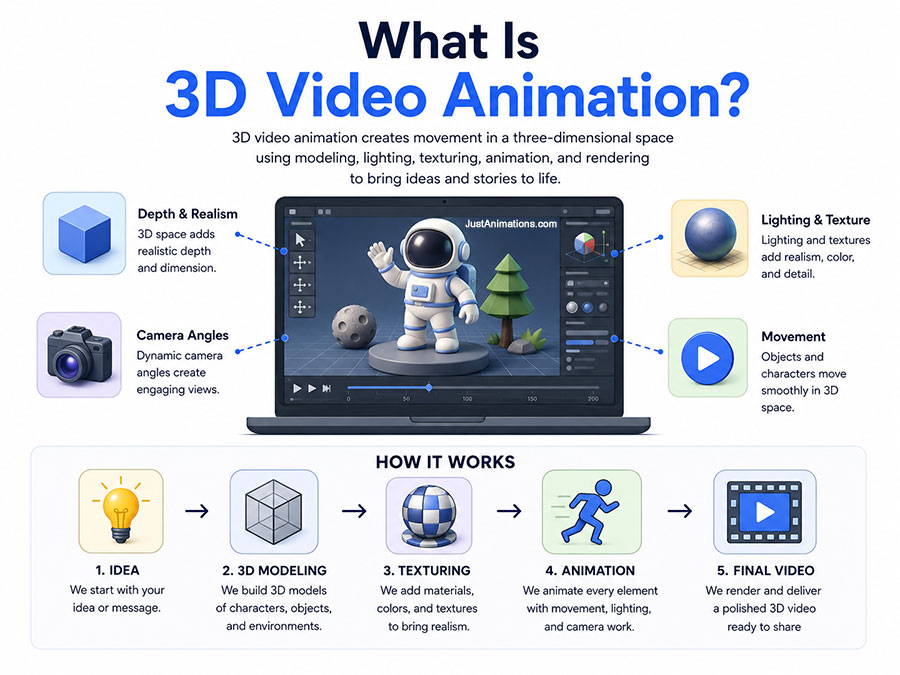
3D video animation is animation created in a three-dimensional digital space.
It includes height, width, and depth.
Objects can be modeled, textured, lit, animated, rotated, and viewed from different angles.
This makes 3D animation powerful when a business needs to show how something looks or works in a realistic way.
A 3D animation can show a product from the inside.
It can rotate a device.
It can demonstrate a machine.
It can visualize a building.
It can show a medical procedure.
It can create a realistic environment.
That makes 3D animation especially useful for technical, product-based, and high-value presentations.
Common 3D Animation Styles
- 3D product animation
- 3D medical animation
- 3D architectural animation
- 3D character animation
- 3D explainer videos
- 3D motion graphics
- 3D industrial animation
- 3D visualization
- 3D product rendering
- 3D technical animation
Best Uses For 3D Animation
3D animation works best when the video needs realism, depth, and detail.
It is useful for:
- Product demonstrations
- Medical animation
- Architecture and real estate
- Manufacturing and machinery
- Technical product visualization
- Device demonstrations
- Automotive visuals
- Engineering explainers
- Scientific visualization
- Premium brand presentations
- Investor or sales presentations
Benefits Of 3D Animation
3D animation can show things that are difficult, expensive, or impossible to film.
It can show hidden parts.
It can zoom inside products.
It can demonstrate motion from any angle.
It can make abstract technical details easier to see.
Key benefits include:
- Realistic depth
- Strong product visualization
- Premium visual quality
- Multi-angle views
- Strong fit for technical communication
- Excellent for physical products
- Useful for medical and scientific content
- Better for showing movement, scale, and structure
- Strong visual impact
Limitations Of 3D Animation
3D animation is powerful, but it is not always necessary.
It usually takes more time.
It usually costs more.
It can require modeling, rigging, lighting, rendering, and technical refinement.
Common limitations include:
- Higher production cost
- Longer timeline
- More complex revision process
- Not always needed for simple messages
- Can feel overbuilt for basic explainers
- Requires strong technical direction
- Poor-quality 3D can look worse than clean 2D
2D vs. 3D Animation: Side-By-Side Comparison
| Decision Factor | Choose 2D Animation If… | Choose 3D Animation If… |
|---|---|---|
| Your message | Needs to be explained simply | Needs physical or technical detail |
| Your product | Is a service, app, process, or idea | Is a physical product, machine, device, or space |
| Your budget | Needs to stay more manageable | Can support a larger production investment |
| Your timeline | Needs a faster turnaround | Allows more time for modeling and rendering |
| Your brand tone | Is friendly, simple, educational, or approachable | Is premium, technical, futuristic, or product-focused |
| Your audience | Needs quick understanding | Needs detailed visual proof |
| Your platform | Social media, landing page, training, sales deck | Product page, investor deck, trade show, technical presentation |
| Your goal | Explain, educate, promote, simplify | Demonstrate, visualize, impress, show function |
Animation Style Fit By Business Goal
| Business Goal | Best Animation Style |
|---|---|
| Explain a service clearly | 2D animation |
| Launch a SaaS platform | 2D animation or motion graphics |
| Promote a product benefit | 2D or 3D animation depending on complexity |
| Show a product from multiple angles | 3D animation |
| Demonstrate how a machine works | 3D animation |
| Create a social media ad | 2D animation |
| Build a premium product presentation | 3D animation |
| Train employees | 2D animation or motion graphics |
| Explain medical information | 3D animation or hybrid animation |
| Create a homepage explainer | 2D animation |
| Show architecture or real estate | 3D animation |
| Create a brand story | 2D animation or character animation |
| Explain financial data | Motion graphics |
| Create a technical sales asset | 3D animation or hybrid animation |
Cost And Complexity Comparison
| Animation Style | Typical Cost Level | Production Complexity |
|---|---|---|
| Simple 2D animation | Lower | ████░░░░░░ |
| 2D explainer video | Moderate | ██████░░░░ |
| 2D character animation | Moderate to high | ███████░░░ |
| Motion graphics | Moderate | ██████░░░░ |
| Simple 3D animation | Moderate to high | ████████░░ |
| 3D product animation | High | █████████░ |
| 3D medical or technical animation | High | ██████████ |
| Hybrid 2D and 3D animation | Moderate to high | ████████░░ |
Simple Cost Reality
2D animation is usually more affordable because it often requires fewer technical production steps.
3D animation usually costs more because it may involve modeling, texturing, lighting, rigging, camera movement, rendering, and more detailed revisions.
That does not mean 2D is always cheap.
And it does not mean 3D is always the better investment.
The best value comes from matching the animation style to the business goal.
When 2D Animation Is The Better Choice
2D animation is usually the better choice when the video needs to explain something quickly and clearly.
It is especially useful for service businesses, SaaS companies, education brands, marketing campaigns, and internal communication.
Choose 2D animation when:
- The message is more important than realism
- The video needs to be simple and easy to follow
- The project has a tighter timeline
- The budget is more limited
- The brand wants a friendly or approachable style
- The video will be used on social media
- The content explains a service, process, or concept
- The video needs to be repurposed across multiple platforms
When 3D Animation Is The Better Choice
3D animation is usually the better choice when the viewer needs to understand a physical product, device, space, or technical process.
It is especially useful when filming would be difficult, expensive, or impossible.
Choose 3D animation when:
- The product needs to be shown from multiple angles
- The video needs realism and depth
- The subject is technical or mechanical
- The audience needs to see internal parts or hidden details
- The project is for a medical, industrial, architectural, or engineering use case
- The video is being used for a high-value sales presentation
- The animation needs to feel premium and immersive
Can You Combine 2D And 3D Animation?
Yes.
Many strong business videos use a hybrid approach.
A video may use 2D animation for messaging, text, icons, and story structure, while using 3D animation to show the product or technical detail.
This can be a smart choice when the business needs both clarity and visual impact.
A hybrid animation style can work well for:
- Product explainers
- SaaS and hardware demos
- Medical device videos
- Technical sales presentations
- Trade show videos
- Investor decks
- Premium landing page videos
- Brand campaigns
The key is balance.
Use 2D to simplify.
Use 3D to demonstrate.
Use both when the project needs both explanation and depth.
Why Work With A Professional Video Animation Agency?
A professional video animation agency helps with more than production.
It helps with strategy.
That matters because the wrong style can weaken the message.
A business may think it needs 3D when a clean 2D explainer would communicate better.
Another business may choose 2D to save money, but actually need 3D because the product must be shown in detail.
A professional agency can help make that decision before production begins.
A Strong Agency Can Help With
- Clarifying the video goal
- Choosing between 2D and 3D animation
- Writing the script
- Planning the storyboard
- Creating the visual style
- Designing characters, objects, scenes, or models
- Producing the animation
- Managing voiceover and sound
- Handling revisions
- Delivering final files for web, social, ads, sales, or presentations
What To Ask Before Choosing 2D Or 3D Animation
Before starting a project, ask these questions:
- What does the viewer need to understand?
- Is the subject abstract or physical?
- Does the product need to be shown from multiple angles?
- Is realism important?
- Is speed more important than visual depth?
- What is the budget?
- What is the timeline?
- Where will the video be used?
- Will the video need social media cutdowns?
- Does the audience need a simple explanation or a detailed demonstration?
These questions make the style decision easier.
Common Mistakes To Avoid
Choosing between 2D and 3D animation can go wrong when businesses focus on the wrong thing.
Common mistakes include:
- Choosing 3D only because it sounds more premium
- Choosing 2D only because it seems cheaper
- Skipping the scriptwriting stage
- Making the video too long
- Using too many visual ideas at once
- Forgetting the target audience
- Not planning for social media versions
- Underestimating sound design
- Comparing quotes without comparing scope
- Choosing a studio without relevant project experience
The best animation style is the one that supports the message.
Not the one that looks the most complex.
Working With Just Animations
Just Animations provides both 2D and 3D animation services for businesses that need clear, polished, and professional animated video content.
For projects that need simplicity and storytelling, 2D animation can be a strong choice.
For projects that need product detail, realism, or technical visualization, 3D animation may be the better fit.
For projects that need both, a hybrid approach can help combine clear messaging with stronger visual impact.
The goal is always the same.
Create animation that helps the audience understand the message faster and remember it longer.
Conclusion: 2D Animation vs. 3D Animation
2D animation and 3D animation both have important roles in business video production.
Neither one is automatically better.
They simply solve different problems.
2D animation is usually stronger for explainers, service videos, social media content, training, education, brand storytelling, and clear business communication.
It is flexible, cost-effective, fast to understand, and easy to adapt across different platforms.
3D animation is usually stronger for product demos, medical visuals, architecture, machinery, technical processes, engineering, and premium presentations.
It offers realism, depth, movement, and visual detail that 2D animation cannot always provide.
The best choice depends on what the video needs to do.
If the goal is to explain a service clearly, choose 2D.
If the goal is to show how a product works, choose 3D.
If the goal requires both simple messaging and detailed visuals, use a hybrid approach.
A professional video animation agency can help you make that decision with more confidence. The right team will consider your audience, message, budget, timeline, brand, and business goals before recommending a production style.
That is what makes the difference between a video that simply looks animated and a video that actually communicates.
FAQ
What Is The Difference Between 2D And 3D Video Animation?
The main difference is depth. 2D animation uses flat illustrated visuals with height and width, while 3D animation adds depth, lighting, camera movement, and realistic dimensional objects.
Is 2D Animation Cheaper Than 3D Animation?
In most cases, 2D animation is cheaper than 3D animation because it usually requires fewer technical production steps. 3D animation often involves modeling, rigging, lighting, rendering, and more complex revisions.
Is 3D Animation Better Than 2D Animation?
3D animation is not always better than 2D animation. It is better when the project needs realism, product detail, or technical visualization. 2D animation is often better when the goal is clear storytelling, explainer content, or fast communication.
When Should A Business Use 2D Animation?
A business should use 2D animation when it needs an explainer video, service video, training video, social media ad, educational video, landing page video, or simple product overview.
When Should A Business Use 3D Animation?
A business should use 3D animation when it needs to show a product, device, machine, building, medical process, technical system, or physical object in realistic detail.
Can A Video Use Both 2D And 3D Animation?
Yes. Many business videos combine 2D and 3D animation. This hybrid approach can use 2D for simple messaging and 3D for product detail, technical visuals, or premium presentation.
Which Animation Style Is Better For Explainer Videos?
2D animation is often better for explainer videos because it is simple, clear, flexible, and easy to follow. However, 3D animation may be better if the explainer needs to show a technical product or physical process.
Which Animation Style Is Better For Product Demos?
3D animation is usually better for product demos because it can show the product from different angles, demonstrate movement, reveal internal details, and create a more realistic presentation.
How Do I Choose Between 2D And 3D Animation?
Choose based on the message, audience, budget, timeline, and use case. Use 2D animation for clarity and simplicity. Use 3D animation for realism and technical detail. Use hybrid animation when the project needs both.
Why Hire A Professional Video Animation Agency?
A professional video animation agency can help with strategy, scripting, storyboarding, design, animation, sound, revisions, and final delivery. This helps ensure the video looks polished and communicates the message clearly.